Tuesday, May 12, 2026
HomeUnexplained MysteriesModern MysteriesThe strange mystery of the USS Scorpion

The strange mystery of the USS Scorpion

The Eternal Patrol: What Really Happened to the USS Scorpion?

May 27th, 1968. A pier in Norfolk, Virginia. The sun is shining. Families gather, clutching handmade signs and American flags, their faces alight with anticipation. They are waiting for their heroes to come home.

They are waiting for the USS Scorpion.

But the sleek, black hull of the nuclear submarine never cuts through the harbor water. The hours tick by. The smiles fade, replaced by the tight-lipped dread of the unknown. The flags begin to droop. The homecoming celebration slowly, silently, transforms into a vigil.

They didn’t know it then, but their wait would be in vain. Their husbands, sons, and fathers were already gone, entombed in a twisted steel coffin two miles beneath the waves of the cold Atlantic. The USS Scorpion and its 99 crew members had vanished, swallowed by the sea in one of the most chilling and persistent mysteries of the Cold War.

The official story is a shrug. A collection of “maybe’s” and “probably’s.” But decades later, the questions still scream from the abyss. Was it a tragic accident? A catastrophic equipment failure? Or was the Scorpion the victim of something far more sinister? A secret act of war, a ghost from the depths, an attack that was never supposed to have happened?

Strap in. Because the truth is buried deeper than the wreck itself.

The Hunter: A Profile of a Cold War Predator

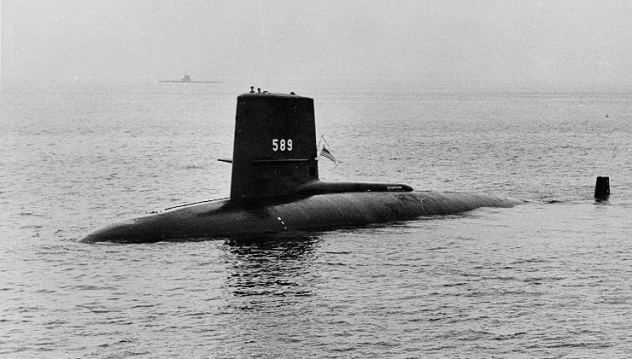
To understand the death of the Scorpion, you first have to understand the beast itself. The USS Scorpion (SSN-589) wasn’t just a boat. It was a technological marvel, a frontline warrior in a silent, underwater war. Commissioned in 1960, she was a Skipjack-class nuclear-powered attack submarine. And that meant one thing: she was built to hunt.

These weren’t the clumsy metal coffins of World War II. The Skipjack-class subs had a revolutionary teardrop-shaped hull, allowing them to “fly” through the water with unprecedented speed and agility. They were faster than any Soviet submarine and could outrun most of the torpedoes designed to kill them. They were the apex predators of the deep ocean, the unseen sentinels holding the line against the Red Menace.

But Was She a Healthy Predator?

For all her advanced technology, the Scorpion had a dark side. A reputation. Her crew, with the gallows humor common among sailors, had another name for her: the “USS Scrap Iron.”

The boat was plagued by problems. An endless list of maintenance woes that never seemed to get fixed. Unexplained vibrations that shook the entire hull at high speeds. A hydraulic system that was notoriously unreliable. In fact, just before her final deployment, the Scorpion had to perform an emergency blow to the surface because of a valve malfunction that began flooding the sub. The request for a full, much-needed overhaul was denied. The Cold War was hot, and every hunter was needed on the front lines, ready or not.

So, in February 1968, the USS Scorpion, leaking and rattling but still deadly, slipped out of Norfolk, Virginia, and pointed its nose toward the Mediterranean. It had a job to do. A date with destiny.

The Final, Fatal Voyage

Her mission was classic Cold War cloak-and-dagger stuff. For three months, the Scorpion shadowed Soviet naval units, gathering intelligence, her crew listening to the eerie pings and groans of a potential enemy. Business as usual.

On May 21st, the job done, Commander Francis Slattery sent his final radio transmission to Naval Station Rota in Spain. His position was about 400 miles south of the Azores islands. The message was routine. He was en route to Norfolk, ETA May 27th. All was well.

And then… silence.

Utter, absolute, and terrifying silence.

When the 27th came and went, the Navy knew something was horribly wrong. A massive search began, one of the largest in naval history. But the Atlantic Ocean is vast and unforgiving. For five agonizing months, there was nothing. No oil slick. No debris. No trace. The Scorpion had simply vanished from the face of the Earth.

A Graveyard 10,000 Feet Down

The break in the case came from a place of deep secrecy. The Navy used its top-secret SOSUS network—a chain of underwater listening posts designed to track Soviet subs—to go back and listen to the tapes from May 22nd. They isolated a series of strange, faint acoustic events near the Scorpion’s last known position. They weren’t conclusive, but they were a lead.

Using this data, the deep-sea research ship USNS Mizar began a painstaking search. Finally, in late October 1968, they found it. A ghost on the sonar screen. The tomb of the USS Scorpion.

image

The sight was horrific. She lay on a sandy plain on the floor of the Atlantic, 10,000 feet down. Broken. The main hull section, containing the reactor and control room, was largely intact but showed clear evidence of catastrophic implosion from the immense pressure. The operations compartment—the front of the sub—was completely obliterated, peeled back and smashed as if by a giant’s hand. The stern had been ripped clean off.

All 99 men were gone. The Navy had found their ship, but the mystery had only just begun. What could have caused such total, instantaneous devastation?

The Treacherous Tin Fish: Did the Scorpion Kill Itself?

This is the theory the Navy quietly favors. It’s neat, it’s tidy, and it blames no one but the machinery. It’s called a “hot run” torpedo.

The scenario is the stuff of submariners’ nightmares. The Scorpion carried Mark 37 torpedoes, a weapon with a known, terrifying flaw. They were powered by a silver-zinc battery that, if jostled or activated improperly, could overheat and explode with tremendous force. The theory goes that during a drill, or simply due to a malfunction, one of these torpedoes activated *inside the torpedo tube*.

A Circle of Death

The crew, faced with an armed, overheating weapon in their midst, would have had only one choice: get it out of the boat. Eject it. Now.

But the problem doesn’t end there. Once in the water, the Mark 37’s acoustic guidance system would switch on, searching for a target. And what would be the biggest, loudest, and only target in the immediate area? The very submarine that just launched it.

The torpedo would have turned on its master. A “circle run.” The Scorpion, for all its speed, may not have had time to evade. The impact would have been devastating, ripping apart the bow and causing a catastrophic flood that sent the sub plunging past its crush depth. The acoustic data from the SOSUS network recorded two events: a smaller sound, followed about 91 seconds later by a much larger, crunching implosion. Could that first sound have been the torpedo exploding?

It’s a plausible, horrifying sequence of events. But it leaves a giant question unanswered: why would they have been arming a live torpedo in the first place? With no logs and no survivors, we’ll never know.

A Ghost From the Cold War: Was Scorpion Hunted and Killed?

Now we enter the shadows. The world of conspiracy and whispered secrets. This theory suggests the Scorpion wasn’t the victim of an accident, but of an enemy attack. A secret battle in a secret war.

The context is everything. Just two months before the Scorpion vanished, a Soviet Golf-II class submarine, the K-129, sank in the Pacific under mysterious circumstances, taking its entire crew with it. The Cold War was a brutal game of chess, and the loss of a major piece like a ballistic missile submarine would not have gone unanswered. Was the Scorpion’s death a direct, tit-for-tat retaliation by the Soviet Union?

In his explosive book *Scorpion Down*, military reporter Ed Offley lays out a compelling case. He argues the Scorpion was diverted from its trip home to spy on a Soviet naval group that included an Echo-II class submarine. He claims this Soviet task force detected the Scorpion, hunted it down, and sank it with a torpedo.

The Unseen Enemy

Imagine the scene. The claustrophobic tension inside the Scorpion’s control room. The sonar operator hearing the tell-tale sound of an active torpedo homing in on them. The frantic, desperate maneuvers to escape a weapon they never saw coming. A flash. A roar of water. And then, darkness.

The US government, Offley argues, engaged in a massive cover-up to prevent the incident from triggering World War III. Admitting a premiere US attack sub was sunk by the Soviets would have demanded a public, and possibly nuclear, response.

The official line? The US Navy vehemently denies this. They say there’s zero evidence of any other vessel in the area, no debris from a Soviet torpedo, and no intelligence chatter to support an attack. But in the world of espionage and black ops, the absence of evidence isn’t evidence of absence. Is it possible the greatest secret of the Cold War still lies on the ocean floor?

Catastrophic Failure: Did the Sub Simply Fall Apart?

The third major possibility is less cinematic, but no less terrifying. It posits that the “USS Scrap Iron” finally lived up to its name. That years of shoddy maintenance and deferred repairs caught up with her in the most violent way imaginable.

There are several ways this could have happened.

The Exploding Garbage Can

One shocking theory centers on a seemingly mundane piece of equipment: the Trash Disposal Unit, or TDU. To eject garbage, the TDU had to be pressurized to match the outside sea pressure. If a critical valve failed—a known issue on these subs—it could cause seawater to blast back into the submarine with the force of a firehose. If that jet of seawater hit the sub’s massive main battery, located directly beneath, the reaction would be instantaneous and apocalyptic. The saltwater mixing with the battery acid would create a massive cloud of deadly chlorine gas and trigger a huge hydrogen explosion. That explosion could have easily breached the hull, sinking the sub in minutes.

A Fatal Weakness

Another mechanical theory points to the propeller shaft. The Scorpion was known for severe vibrations. It’s possible the shaft itself failed, or that the seal where it passed through the hull gave way. This would create a flood that no pump could handle. The aft compartments would fill with water, the sub would lose control, pitch nose-down, and begin its unstoppable plunge toward crush depth. The final, violent implosion of the forward compartments would be the result, not the cause, of the sinking.

This theory is bolstered by the testimony of sailors who had served on her. They knew she was a wounded animal. The Navy knew it, too. And they sent her out anyway. This explanation doesn’t involve a foreign enemy, but it points to something just as chilling: a disaster that was not just predictable, but preventable.

The Ballard Mission and The Nuclear Secret

For years, the wreck lay undisturbed. Then, in 1985, a familiar name enters the story: Dr. Robert Ballard. The world knows him as the man who found the Titanic. But that’s not the whole story. Finding the Titanic was actually a cover.

Ballard was on a secret mission for the US Navy. His primary targets were the wrecks of two lost US nuclear subs: the USS Thresher and the USS Scorpion. The Navy wanted him to use his new deep-sea technology to photograph the wrecks and, most importantly, assess the state of their nuclear reactors and nuclear-tipped torpedoes. They needed to know if they were leaking radiation into the ocean. The Navy told Ballard that if he had any time left over after finding and studying their subs, he was free to look for the Titanic.

He found the Scorpion, confirming the earlier photos of the devastation. The Navy’s findings from that mission remain classified, but ongoing environmental monitoring has shown no significant radiation leakage… so far. The Scorpion is not just a tomb; it’s a ticking nuclear time bomb, resting silently in the dark.

The Lingering Question

In 2012, family members of the lost crew and naval veterans petitioned the US Navy to reopen the investigation. To send modern robotic submersibles back to the site to finally solve the mystery once and for all. The request was denied.

Why? Is it the immense cost? The technical difficulty? Or is it because the Navy already knows the answer and has decided it’s a truth the world isn’t ready for? A truth that could either reveal a shocking act of war or a tragic story of institutional negligence.

So the Scorpion waits. The 99 men of its crew remain on their eternal patrol. The families are left with only photographs and fading memories. The theories continue to swirl, a storm of speculation over a silent, steel grave. An accident, a malfunction, or an act of war? The ocean keeps its secrets well. And the USS Scorpion keeps the deepest, darkest secret of them all.

Arindam Mukherjee
Arindam Mukherjee
Arindam loves aliens, mysteries and pursing his interest in the area of hacking as a technical writer at 'Planet wank'. You can catch him at his social profiles anytime.
RELATED ARTICLES
- Advertisment -

Most Popular

Recent Comments

Warren Pan Abbott on The legend of the Devil Monkey !
chris davies on The McPherson Tape Mystery
Reed Reedly on ET has Internet!
Bea Houseoffashion on Proof Of Time Travellers – Gallery
Marcus2012 on ET has Internet!
Reed Reedly on ET has Internet!
LaughsAtConspiracyNuts on The 9/11 Conspiracy – Myths and Facts
Alex Sliverman on Did the ancients fly?
Doctor Wholigan on Time Traveler in 1938 film
chris davies on The McPherson Tape Mystery
Archie1954 on 10 secret UFO hideouts
chris davies on Ghosts of flight 401
Marcus2012 on ET has Internet!
jason Macdonald on Proof of Time Travel? – China
chris davies on Long-Lost Pyramids Found?
Reed Reedly on ET has Internet!
Milkman on Connected Universe
Tenmiles on Baigong Pipes Mystery
Simon Foster on Sirius – The Documentary
From the 1st April on 2013 – Alien Contact date ?
SkyWatcher on Is ET ignoring us?
I Come From The Future on Obama to make UFO Alien disclouser soon ?
ÛñK?øWn on 2013 – Alien Contact date ?
Just another person on 2013 – Alien Contact date ?
Malcolm Windowcleaner on The strange case of Rudolph Fentz
Mason Servio on Strange Things on Mars
Marke Wisdom Seeker on What will we find as arctic melts?
Andrea A Elisabeth Levyne on Aliens Captured in Varginha, Brazil
Mitch Grouyeki on Amazing Space Shuttle pictures