Unearthing the Impossible: A Journey to the World’s Most Forbidden Ruins
Forget everything you were taught in history class.
We are told that civilization moves in a straight line. We started as hunter-gatherers, banged some rocks together, and eventually built iPhones. But does that story really hold up? Or is there a massive, gaping hole in our timeline? When you look at the sheer scale, the impossible mathematics, and the baffling precision of certain ancient sites, the official narrative starts to crumble. It falls apart.
We are about to take a tour of the places that shouldn’t exist. These aren’t just “interesting places.” These are crime scenes. Evidence of a lost epoch.

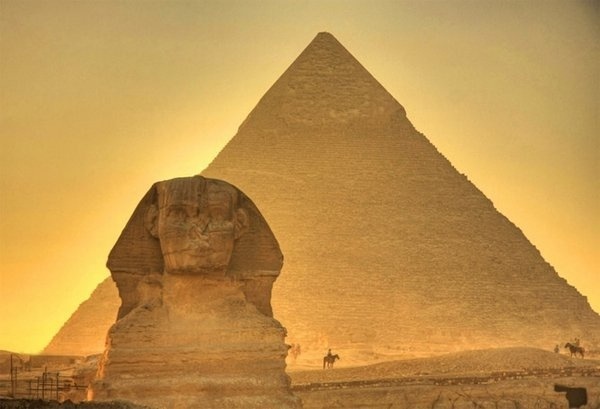
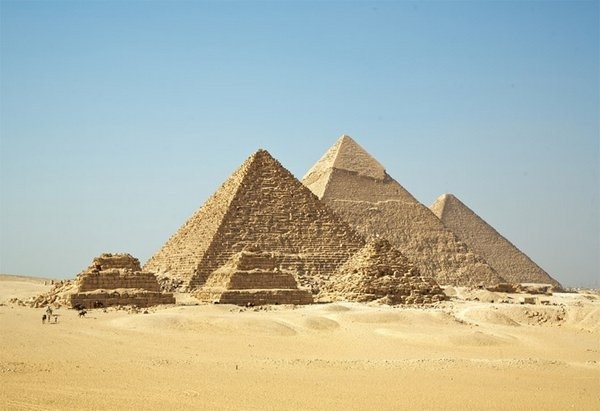
The Pyramids of Giza and the Sphinx (Egypt)
Let’s start with the big one. The grandfather of all mysteries. Mainstream Egyptologists will look you in the eye and tell you these are just tombs. Giant, fancy graveyards for Pharaohs Khufu, Khafre, and Menkaure. But here is the problem: We have never found a single mummy inside a Great Pyramid. Not one.
So, if they weren’t tombs, what were they?
The Math That Shouldn’t Exist
The Great Pyramid is a scale model of the northern hemisphere. It aligns to True North with an accuracy of 3/60th of a degree. We couldn’t achieve that kind of precision until modern satellite technology arrived in the 20th century. How did people with copper chisels and hemp ropes do this 4,500 years ago? They didn’t. They couldn’t.
The structure contains the Golden Ratio (Phi) and Pi. The stones are cut so perfectly that you can’t slide a razor blade between them. Some of these blocks weigh as much as a freight train, and they were lifted hundreds of feet into the air. How?
Deep Dive: The Water Erosion Theory
Look at the Sphinx. Really look at it. Geologist Robert Schoch shocked the academic world when he pointed out that the erosion on the Sphinx enclosure wasn’t from wind and sand. It was from rain. Massive, torrential rainfall.
Why is that scary? Because the last time Egypt had that kind of rain was at the end of the last Ice Age, around 10,000 to 12,000 years ago. That pushes the date of the Sphinx back thousands of years before the dynastic Egyptians supposedly existed. If the Sphinx is 12,000 years old, who built it? Atlantis? A lost global civilization? The history books are silent.
Recent Discoveries: The Void
Just recently, the ScanPyramids project used muon radiography—cosmic ray scanning—to peer inside the Great Pyramid. They found a massive “void” above the Grand Gallery. A huge, empty space. Is it a hidden chamber? A hall of records? Or is it a component of a massive machine, as theorist Christopher Dunn suggests? Dunn believes the pyramid was a power plant, generating microwave energy. It sounds crazy. Until you look at the engineering.

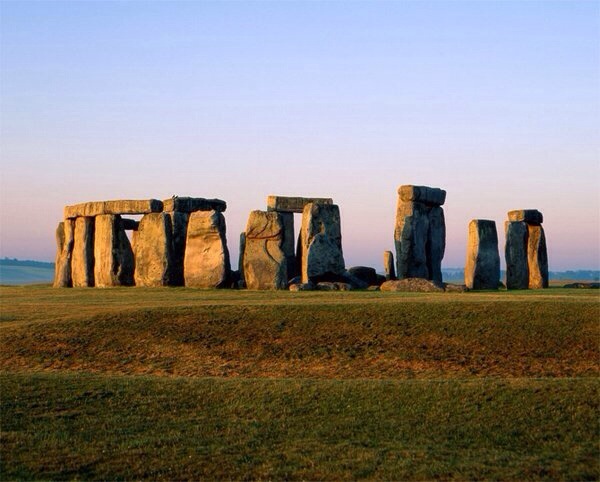
Stonehenge (Great Britain)
Standing in the rolling hills of Wiltshire, England, is a circle of stones that has baffled humanity for centuries. Stonehenge. It’s the world’s most famous prehistoric monument. We are told it was built around 2500 BC. But like Giza, the “how” and “why” remain totally elusive.
The Impossible Transport
The big sarsen stones are local. Heavy, yes, but local. The real mystery lies in the “Bluestones.” These smaller stones, weighing up to 4 tons each, make up the inner circle. Geologists have traced them to the Preseli Hills in Wales.
That is 150 miles away.
How did Neolithic people, without the wheel (supposedly), drag 4-ton rocks over mountains, through dense forests, and across rivers for 150 miles? Did they float them? Roll them on logs? Or is there something else at play? Merlin, the wizard of Arthurian legend, was said to have levitated them. While we can’t count on magic, the logistical nightmare of moving these stones suggests a level of organization and technology we simply don’t credit ancient people with.
Acoustic Levitation?
Here is a wild theory gaining traction online. Recent acoustic tests inside a replica of Stonehenge revealed that the stones act as a giant amplifier. They create a reverb chamber. Some researchers speculate that sound frequencies were used in the construction—or that the site itself was used to generate specific frequencies that alter human consciousness. Was Stonehenge a giant sensory deprivation tank? A communication device?

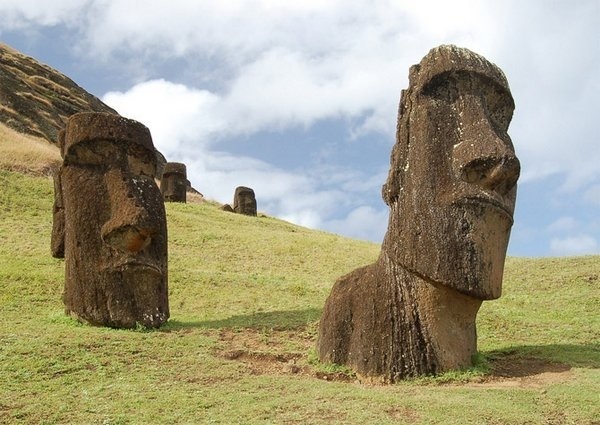
Easter Island (Chile)
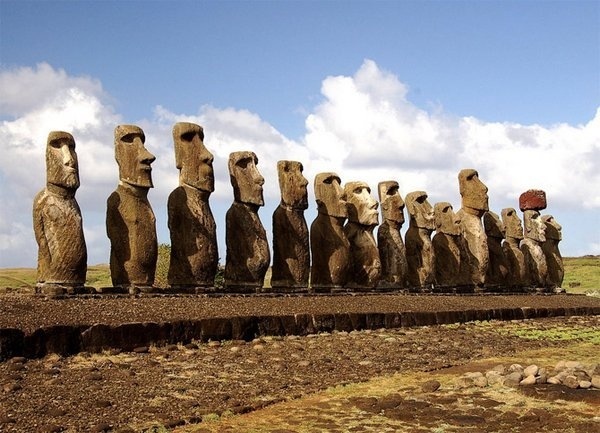
Rapa Nui. The most isolated inhabited island on the planet. Here, staring out toward the horizon, are the Moai. Huge, stoic faces carved from volcanic tuff. For years, we thought they were just heads.
The Shocking Reveal: They Have Bodies
In recent years, excavators dug down. The internet went wild. The heads have bodies! Massive torsos buried deep beneath the earth, complete with carved hands and strange markings on their backs. This changes everything. It means the statues were originally standing on much lower ground, and centuries of sediment buried them.

The heaviest Moai weighs 86 tons. There is one unfinished giant in the quarry that would have weighed 270 tons. The Rapanui people supposedly walked these statues miles from the quarry to their platforms. Local legend says the statues “walked” themselves. Engineers have tried to replicate this by “walking” replicas with ropes. It works for the small ones. But the 80-ton monsters? That is a different story.
The Collapse
Easter Island is also a warning. It is a microcosm of our planet. The accepted theory is that the islanders cut down every single tree to move these statues, destroying their ecosystem and leading to war and starvation. They sacrificed their environment for their gods. Are we doing the same thing today?

Baalbek (Lebanon)
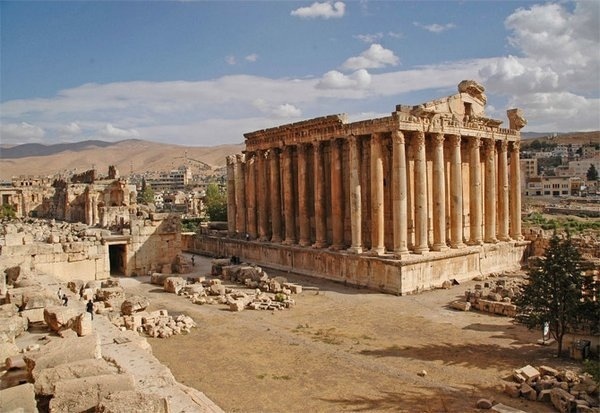
If you want to see stones that defy gravity, logic, and sanity, go to Baalbek. This was a Phoenician city, later occupied by the Greeks and Romans. The Romans built a massive Temple of Jupiter here. But they built it on top of something much older.
The foundation stones at Baalbek are simply impossible.
The Trilithon
Meet the Trilithon. Three stones. Each weighs about 800 tons. They are lifted 20 feet into the air and placed with perfect precision. There is no crane in the modern world that can move these easily. The Romans certainly didn’t have the tech to lift 800-ton blocks. They used small bricks and concrete. So, who placed the foundation?
The Giants of the Past?
It gets weirder. Nearby in the quarry lies the “Stone of the Pregnant Woman.” It weighs an estimated 1,000 tons. But wait—recent excavations found another block underneath it. The “Stone of the South.”
This stone weighs 1,650 tons.
Let that sink in. 1,650 tons. That is equal to about 1,000 cars. In one block. Cut by hand? Dragged by… what? Ropes? There are no trees big enough in Lebanon to make rollers for that weight. They would be crushed to pulp. Ancient alien theorists point to Baalbek as the ultimate landing pad. A platform built to withstand the thrust of massive spacecraft. When you look at the size of these blocks, “aliens” almost sounds more plausible than “chisels and ropes.”

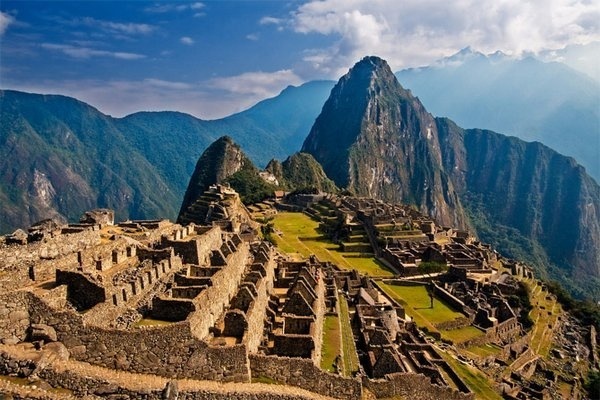
Machu Picchu (Peru)
High in the Andes, shrouded in mist, sits the “Lost City of the Incas.” Hiram Bingham “discovered” it in 1911 (though locals knew it was there all along). It was never found by the Spanish Conquistadors. Thank goodness.
The location is insane. It’s on a saddle between two sharp peaks. Why build a city there? It is a logistical nightmare. Every drop of water, every potato, every stone had to be hauled up sheer cliffs.
Earthquake-Proof Engineering
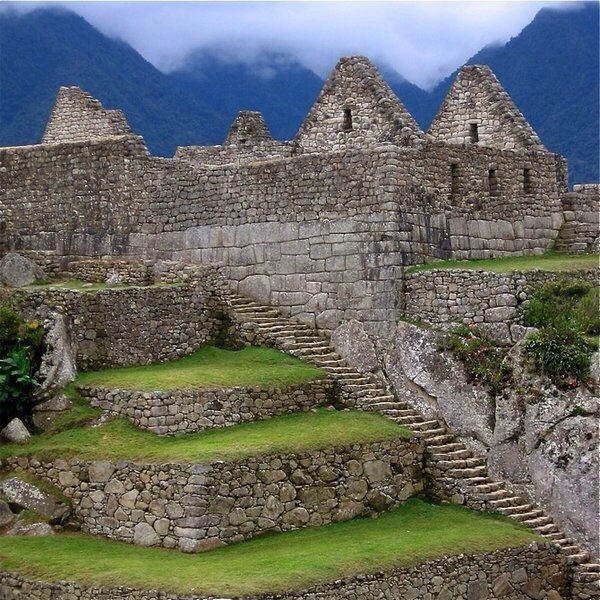
The Incas (or whoever built the foundations) were masters of “ashlar masonry.” They didn’t use mortar. They cut stones into irregular puzzle shapes that lock together. When an earthquake hits—and Peru has many—the stones dance. They bounce, rattle, and fall exactly back into place. Spanish colonial buildings crumble; Inca walls stand strong.
Some stones have 12 or more angles. 12! Try cutting a rock into a 12-sided puzzle piece that fits perfectly with the rock next to it, using only a river stone as a hammer. It seems unlikely. Was this a retreat for the Emperor Pachacuti? Or was it, as some suggest, a university? A place to protect knowledge from a dying world?


Nazca Lines (Peru)
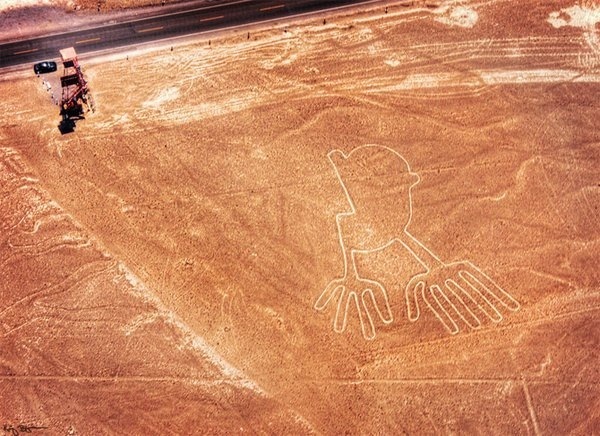
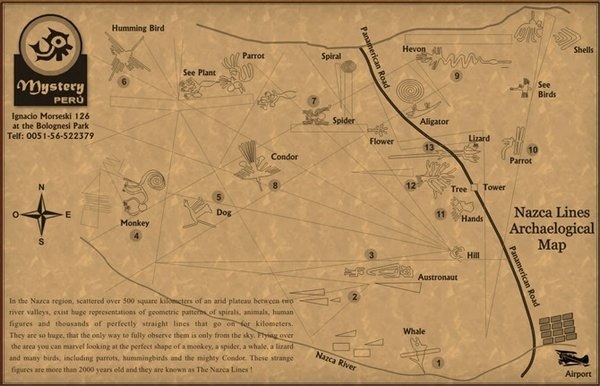
Fly a few hundred miles south of Machu Picchu, and you hit the dry, arid Pampa Colorada. From the ground, it looks like nothing. Just dirt and rocks. But get in a plane, reach 1,500 feet, and look down.
The desert floor is a canvas.
Spiders. Monkeys. Hummingbirds. Whales. Geometric shapes that stretch for miles. Straight lines that run over mountains without deviating a single degree. These are the Nazca Lines.
Who Was the Audience?
The mainstream explanation is that these were processional walkways for water rituals. The Nazca people walked the lines to pray for rain. Maybe. But why make a monkey or a spider that can only be seen properly from the sky?
This is the core of the “Ancient Astronaut” theory championed by Erich von Däniken. Were these runways? Navigation markers for aerial visitors? There is even a figure called “The Astronaut”—a humanoid with huge owl eyes and one hand raised to the sky.
Recent AI scans of the desert have revealed hundreds more glyphs that the human eye missed. The desert is fuller than we thought. Whatever message is written here, it was meant to be read from above.


Tiahuanacu and Puma Punku (Bolivia)
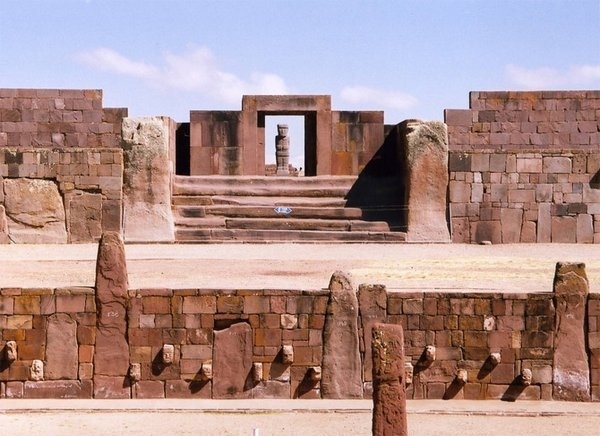
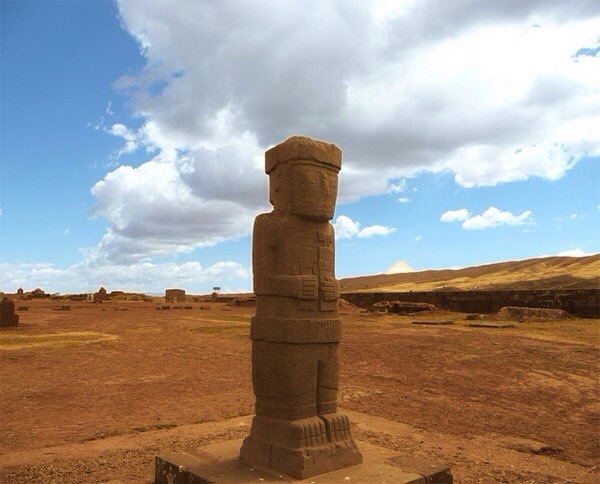
If the Pyramids are impressive, Tiahuanacu (or Tiwanaku) is terrifying. Located near Lake Titicaca at 13,000 feet, the air here is thin. The mystery, however, is heavy.
Some controversial archaeologists, like Arthur Posnansky, studied the astronomical alignments of the Kalasasaya temple and concluded the site dates back to 15,000 BC. That is 17,000 years ago. That predates the end of the Ice Age. Mainstream science laughs this off, dating it to 500 AD. But the stones tell a different story.
The Impossible Blocks of Puma Punku
Just a short walk from the main pyramid is Puma Punku. This is the smoking gun for ancient high technology. The stones here are andesite—super hard volcanic rock. Yet, they are cut with laser-like precision.
We see perfect 90-degree internal angles. We see drill holes that are spaced evenly, as if done by a CNC machine. We see “H-blocks” that interlock like giant LEGO bricks. This isn’t primitive hammering. This is machining. There is no evidence of the tools used to make these cuts. None. Did they have diamond-tipped saws? Sonic drills? Or did they have help?


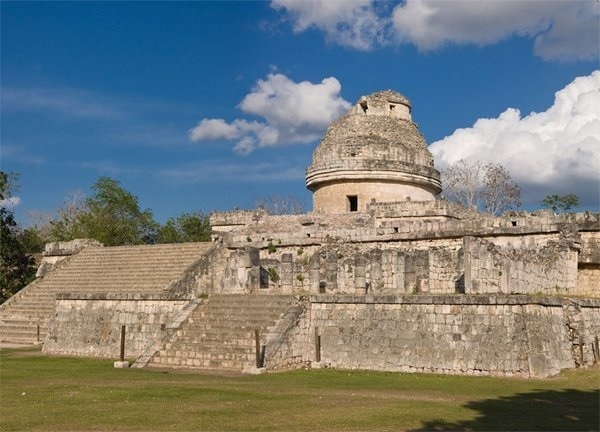
Chichen Itza (Mexico)
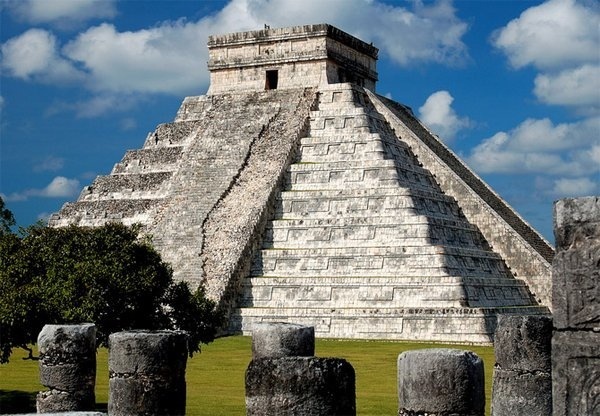
Deep in the Yucatan jungle lies the jewel of the Maya: Chichen Itza. Dominated by El Castillo, the massive step pyramid dedicated to Kukulkan, the Feathered Serpent.
This wasn’t just a temple. It was a calendar. It has 365 steps—one for each day of the solar year. During the equinoxes, the sun hits the corner of the pyramid and casts a shadow that looks like a giant snake slithering down the stairs to join the stone serpent head at the bottom. The illusion is perfect. The math required to orient the building to achieve this effect is mind-boggling.
The Sound of the Quetzal
But the visual trick isn’t the only marvel. Stand at the base of the staircase and clap your hands. The echo that bounces back doesn’t sound like a clap. It sounds like the chirp of the Quetzal bird—a sacred animal to the Maya.
Acoustic engineers have confirmed this. The pyramid was built to synthesize sound. How did they know how to shape stone to replicate a bird call? That is advanced acoustic physics.
The Dark Side
Of course, Chichen Itza has a blood-soaked history. The Temple of Warriors. The Chac-Mool statues. These were places of sacrifice. Beating hearts were offered to the gods to keep the sun moving. It’s a chilling reminder that these highly advanced builders were also driven by a terrifying belief system. They understood the stars, they understood sound, but they lived in fear of the dark.


The Verdict?
We are looking at the remnants of something great. Something lost. Whether it was aliens, a pre-Ice Age super-civilization, or just ancient humans who were way, way smarter than we give them credit for—the mystery remains.
These stones are silent. But if you listen closely, they are screaming that history is wrong.
Originally posted 2014-03-12 23:12:42. Republished by Blog Post Promoter