Home Films & Documentaries Texas UFO Crash : Documentary on the Greatest UFO Mystery in History

Texas UFO Crash : Documentary on the Greatest UFO Mystery in History

0
229

Six years. That’s how long it would be before the Wright Brothers finally got their flimsy glider off the ground at Kitty Hawk. We are talking about 1897. A time of horses, steam trains, and mud.

Yet, something was in the sky.

This wasn’t a bird. It wasn’t a balloon. And according to the terrified residents of a tiny Texas town, it definitely wasn’t human. Welcome to the Aurora Incident. Before Roswell, before Area 51, before the Phoenix Lights, there was Aurora. And it might just be the most smoking-gun case of extraterrestrial contact in American history.

Aurora_Texas_UFO_Incident_1

The Great Airship Mystery of 1897

Let’s set the stage. The year is 1897. The Wild West is dying, but it’s not dead yet. If you wanted to go somewhere, you took a horse or a train. The idea of a heavy machine flying through the air? Impossible. Science fiction. Madness.

But then, the reports started coming in.

They didn’t just come from one drunk farmer. They came from everywhere. Thousands of people across the Midwest—from Nebraska to Texas—reported seeing a massive “airship” gliding over their towns. They saw lights. They heard whirring noises. Some even claimed they saw people waving from the windows.

This wasn’t a couple of isolated crackpots. We are talking about judges, doctors, and lawmen. Credible witnesses. They were seeing something that technology at the time simply could not explain. Ufologists call this the “Great Airship” period. It was a mass sighting event that has never been fully explained. Was it a secret inventor? A time traveler? Or visitors from another star?

In 1897, the luxury of calling these things “weather balloons” or “experimental military jets” didn’t exist. Those things hadn’t been invented yet. If it was metal and it was flying, it was a UFO. Period.

Dawn at Aurora: April 17, 1897

Aurora, Texas. A small, sleepy farming community just north of Fort Worth. The sun hadn’t even fully risen yet. It was around 6:00 AM. Most people were just waking up, brewing coffee, getting ready to feed the livestock.

Then came the sound.

It wasn’t the chug of a train. It was a hiss. A hum. A roar. Residents looked up and froze. Moving due north, a massive, cigar-shaped craft was sailing over the town. But something was wrong. It wasn’t gliding smoothly like the airships reported in other states. It was struggling.

Witnesses said the craft was traveling slowly—maybe 10 or 12 miles per hour. It was losing altitude fast. It was pitching and rolling, clearly suffering from a mechanical failure. It wasn’t just drifting; it was crashing.

The Impact

The craft dipped lower. Too low. It was heading straight for the property of Judge J.S. Proctor, a well-known local figure. In the yard stood a windmill, used to pump water from the well. The airship couldn’t pull up.

CRASH.

The collision was catastrophic. The cigar-shaped vessel slammed directly into the windmill tower. The sound was deafening, shattering the morning silence. A massive explosion followed, sending debris, metal, and fire raining down over several acres. The ship was obliterated. The windmill was destroyed. The Judge’s prized flower garden? Ruined.

The townspeople didn’t run away. They ran toward it.

The Body in the Wreckage

This is where the story goes from “weird” to “absolutely terrifying.”

The locals sifted through the burning wreckage. The debris was strange. They found pieces of a heavy metal that resembled aluminum but was much harder and silver-like. It was a mix of silver and aluminum, unlike anything available in standard metallurgy at the time. Tons of it. Scattered everywhere.

But they found something else. Among the twisted metal and the smoldering wood of the windmill, they found the pilot.

It wasn’t a man. It wasn’t a monkey.

S.E. Hayden, a reporter for the Dallas Morning News, was on the scene. He wrote the article that would become legendary. He described the pilot clearly: the body was “badly disfigured” by the crash and the fire. But enough remained to tell the townsfolk one thing for certain.

The pilot was “not an inhabitant of this world.”

Let that sink in. In 1897, a Texas journalist put it in print. The being was small. Frail. It had papers on its body. The witnesses couldn’t read them. They said the writing looked like “hieroglyphics.” Not English. Not Spanish. Not German. Alien.

Some locals speculated the pilot was a native of Mars. Why Mars? Because back then, that was the only planet anyone thought might harbor life. They didn’t have the concept of intergalactic travel yet. To them, this was a Martian.

A Christian Burial for an Alien?

What do you do when a space traveler crashes in your backyard in 19th-century Texas? You don’t call the FBI. The FBI didn’t exist. You don’t call the Air Force. The Air Force didn’t exist.

You do the decent, Christian thing. You give it a funeral.

The townspeople of Aurora took the small, mangled body of the pilot. They didn’t preserve it in a jar. They didn’t sell it to a circus. They took it to the local Aurora Cemetery. A traveling traveling preacher presided over the service. They dug a grave. They lowered the “Martian” into the Texas soil.

They even marked the grave. A rough rock was placed at the head. On it, someone carved a crude shape of the vessel—cigar-shaped with portholes.

The pilot of the Aurora UFO is, according to legend, still there. Resting in peace alongside the pioneers and farmers of 1897.

The Curse of the Well

The story doesn’t end with the funeral. In fact, it gets darker. Much darker. Remember the well? The windmill stood directly over the town’s water source. When the ship crashed, tons of wreckage fell into the water. The debris clogged the well.

The Judge and the townspeople cleaned up the surface mess, but they left the debris in the bottom of the well. They thought it was harmless. They were wrong.

Enter Mr. Brawley Oates. Years later, in 1945, Oates bought the property. He cleaned out the well to use the water. He didn’t know what that metal was. He didn’t know what kind of fuel an interstellar craft uses.

Oates developed a severe, agonizing case of arthritis. But it wasn’t normal joint pain. His hands became gnarled. His joints swelled to grotesque sizes. He was in constant misery. Many researchers now believe this wasn’t arthritis at all.

It was radiation poisoning.

The theory is terrifyingly simple: The drive system of the alien craft was nuclear or radioactive. When it crashed, it contaminated the water table. Brawley Oates was drinking radioactive water every single day. Eventually, the well was sealed up with a concrete slab. It sits there today, a silent monument to a possible nuclear event in the 1800s.

The 1970s: The Cover-Up Begins?

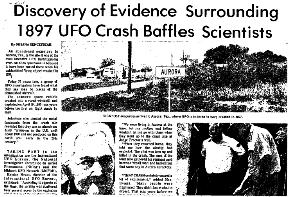
For decades, the story was just a local legend. A campfire tale. Then came the 1970s. UFO interest exploded. Investigators rediscovered the old Hayden article. The Mutual UFO Network (MUFON) descended on Aurora.

They wanted the truth. They wanted the body.

In 1973, MUFON investigators located the grave. They found the marker with the strange ship carving. Their metal detectors went wild over the grave site. The readings suggested there were large chunks of metal buried alongside the organic remains. It was the smoking gun.

They applied for permission to exhuming the body. They were ready to dig.

Then, the government stepped in? Maybe. Or perhaps just angry locals. But suddenly, the permission was denied. The cemetery association fought back. They guarded the grave with guns. They refused to let anyone disturb the dead, even if the dead wasn’t human.

But someone did disturb it.

One night, shortly after the media circus arrived, the grave marker disappeared. Stolen. When investigators returned with ground-penetrating radar years later, the signal was different. The large metal readings? Gone. The soil had been disturbed.

Did the government come in the middle of the night and snatch the body? Did a secret military recovery team sanitize the site? Or did a local prankster dig it up to hide the hoax? We don’t know. The body—if it was there—is likely gone.

Hoax or History?

Skeptics have a theory, of course. They always do. They point to the fact that Aurora was a dying town in 1897. The railroad had bypassed them. A spotted fever epidemic had killed many residents. The boll weevil had destroyed the cotton crops.

The town was on the verge of becoming a ghost town.

The theory goes that S.E. Hayden, the reporter, made the whole thing up. A “sensational” story to bring tourists to Aurora. A desperate bid to save the town. If so, it was a brilliant piece of fiction. But there are holes in the hoax theory.

First, the debris. Locals kept pieces of that metal for generations. In recent years, samples of metal allegedly from the crash site have been analyzed. Some tests showed the aluminum was too pure for 1897 refining capabilities. Other tests found trace elements that are incredibly rare on Earth.

Second, the grave. Why guard a hoax with shotguns? Why seal a well with concrete if it’s just a story?

Third, the witnesses. Too many people saw the airship across Texas. Hayden might have embellished the crash, but he didn’t invent the airship. That thing was real. Thousands saw it.

The Legacy of Aurora

Today, Aurora is a quiet town again. But they haven’t forgotten. There is a Texas Historical Commission marker near the cemetery. It mentions the legend of the spaceship crash. It is one of the only government-sanctioned markers in the world that mentions a UFO.

Think about the implications. If this story is true, it changes everything. It means we were visited before we had radio. Before we had planes. It means they have been watching us for a very, very long time.

The Aurora incident isn’t just a story about a crash. It’s a story about how we react to the unknown. In 1897, they didn’t panic. They didn’t dissect. They just buried the stranger and went back to work.

Maybe there is a lesson in that. Or maybe, just maybe, somewhere in a government warehouse, there is a small box labeled “Aurora, 1897,” containing the bones of a traveler who ran out of gas a few lightyears from home.

Watch the investigation below. Look at the evidence. And ask yourself: What really happened that morning in Texas?