The Vanishing of the Ninth World
It feels like a glitch in the matrix.
If you were born before 2006, you remember the solar system map. It was perfect. Nine planets. Mercury, Venus, Earth, Mars, Jupiter, Saturn, Uranus, Neptune. And then, at the very edge, the tiny, icy watchdog. Pluto.
Then, overnight, it was gone.
Imagine waking up tomorrow and the powers that be tell you that Australia isn’t a continent anymore. It’s just a “big island.” That is exactly what happened to our ninth world. For decades, Pluto sat on the edge of our celestial map, orbiting deep in the freezing darkness. We are talking about a staggering six billion kilometers away from the Sun. That is 40 times the distance between you and the star that warms your face. It is so far out there, so hidden in the void, that it took astronomers until 1930 to even know it existed.
History books will tell you the discovery was a triumph of math and science. They say we found it because we were looking for it. But was it that simple? And why, after 76 years of being part of the family, did a small group of people in a conference room in Prague suddenly decide to scrub it from existence?
Buckle up. We are going to dig deep into the story of the celestial coup that stole a planet.
The Obsession with “Planet X”
To understand why they killed Pluto, you have to understand how desperate they were to find it in the first place. The story doesn’t start in 2006. It starts in the late 1800s with a wealthy businessman named Percival Lowell.
Lowell was obsessed. He was convinced that something massive was hiding behind Neptune. He called it “Planet X.”
Why? Because the math didn’t add up. Uranus and Neptune were wobbling. Something with heavy gravity was tugging on them, pulling them off their predicted paths. Lowell built a massive observatory in Arizona and spent his fortune hunting for this ghost.
He died without finding it. But the hunt didn’t stop.
In 1930, a young 23-year-old farm boy named Clyde Tombaugh was hired to continue the search. He didn’t use computers. He used a “blink comparator.” He would take photos of the night sky days apart, then flip back and forth between them rapidly. If a star moved, it wasn’t a star. It was a planet.
On February 18, 1930, he saw it. A tiny speck moving against the backdrop of infinity. We had found the Ninth World.
Here is the kicker, though. The “wobble” that Lowell was looking for? It was a calculation error. It didn’t exist. Pluto was way too small to pull on Neptune. We found Pluto by sheer, blind luck. It was a cosmic accident. Or was it meant to be found?
The Secret Vote to Demote
Fast forward to 2006. The mood in astronomy had changed. We weren’t just looking at planets anymore; we were finding thousands of rocks in the dark.
Things got weird. The International Astronomical Union (IAU) convened in Prague. They formed a “Planet Definition Committee.” It sounds like something out of a sci-fi dystopia, doesn’t it? A group of select members met, debated behind closed doors, and prepared to hold a vote that would shatter our model of the solar system.
Here is a fact that usually gets left out of the textbooks: Only 424 astronomers voted.
There are over 10,000 professional astronomers in the world. Less than 5% of the community actually cast a ballot to kill Pluto. Many had already gone home. It was the last day of the conference. The room was half-empty. Yet, this small group held the power to rewrite history.
They decided that Pluto was no longer special enough. They stripped it of its title. They demoted it to a “dwarf planet.” But the reason why has left people scratching their heads for nearly two decades.
The Rules of the Game
The IAU needed a way to kick Pluto out, so they wrote a new definition. According to these new rules, being a planet is harder than it looks. The committee decided that to be a true planet, an object must do three things:
- Orbit the Sun: Pluto does this. It has a strange, tilted, oval-shaped orbit, but it definitely goes around the Sun.
- Be Round: It must have enough gravity to pull itself into a spherical shape. This is called hydrostatic equilibrium. Pluto does this perfectly. It is a beautiful sphere.
- Clear the Neighborhood: This is the trap. This is where they caught Pluto.
The “Neighborhood” Loophole
This is the controversial part. The smoking gun.
To be a planet, the IAU says an object must “suck up,” eject, or clear out all the other debris in its path. The eight major planets have mostly swept their orbits clean. Jupiter is a bully; it eats anything that gets close or flings it away.
Pluto, however, lives in the Kuiper Belt.
Think of the Kuiper Belt as a second asteroid belt, but massive, icy, and mysterious. It sits beyond Neptune. It is a ring of frozen rocks, debris, and history from the birth of the solar system. Because Pluto travels through this field of other objects, the committee ruled that it failed the test.
It hadn’t “cleared its neighborhood.”
Why the Rule Makes No Sense
Let’s play devil’s advocate. If we apply this rule strictly, Earth isn’t a planet either.
Have you looked at our neighborhood lately? It is messy. We are constantly dodging asteroids. There are over 20,000 “Near-Earth Objects” floating around us. Earth hasn’t cleared its path. Neither has Jupiter—it is trailed by thousands of “Trojan” asteroids that share its orbit.
Alan Stern, the lead scientist behind the New Horizons mission to Pluto, called the IAU decision “stinky.” He pointed out that if you put Earth out where Pluto is, our planet would be too small to clear that massive zone. We would be demoted too. Location matters more than the object itself.
So, why did they really do it?
The Eris Problem: The “10th Planet” Panic
They didn’t kill Pluto because of science. They killed it because of fear. Fear of numbers.
In 2005, an astronomer named Mike Brown found something in the Kuiper Belt that terrified the establishment. He found Eris.
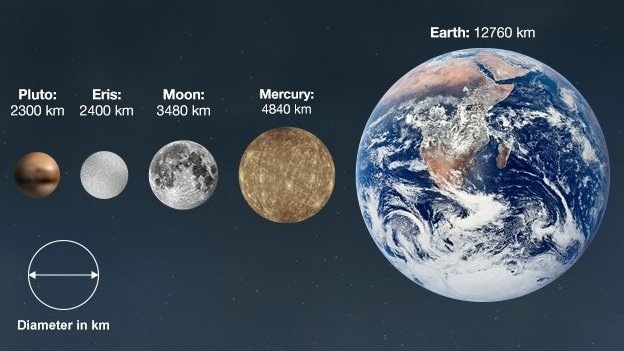
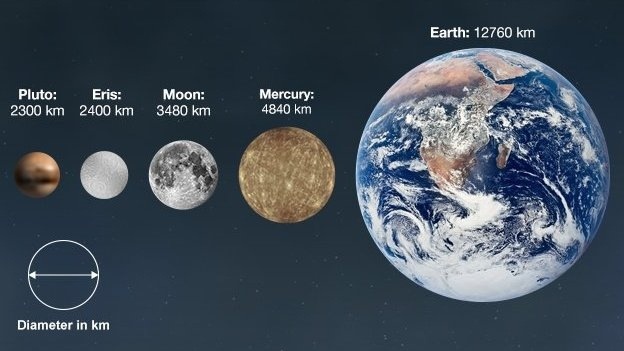
Eris is almost the same size as Pluto. It is massive. It is icy. And it is further out. If Pluto was a planet, Eris had to be a planet. That would make 10 planets.
Then they found Makemake. Then Haumea. Then Sedna. The darkness was full of these things.
The IAU realized a terrifying truth: if they let Pluto stay, they wouldn’t just have 10 planets. Within a decade, we might have 15. Then 20. Then 50. School kids wouldn’t be able to memorize the solar system anymore. The model would become chaotic.
They had a choice: Expansion or Reduction. They chose to close the door. They drew an arbitrary line in the sand and said, “No more.” Pluto was simply the collateral damage of a bureaucracy trying to keep things tidy.
The Zombie Planet: New Horizons Arrives
Here is where the story gets cinematic. While the astronomers were arguing in a conference room in Prague in 2006, a robot was already screaming across the void.
NASA had launched the New Horizons probe in January 2006. Its destination: Pluto. When it launched, it was heading toward the ninth planet. By the time it arrived in July 2015, it was visiting a “dwarf.”
But Pluto didn’t care about the labels. What New Horizons sent back shocked the world.
Scientists expected a dead, cratered ice ball. A frozen relic. Instead, they saw a world that looked… alive.
The Heart of the King
The first high-definition images revealed a massive, heart-shaped glacier on the surface. We named it Tombaugh Regio, after the man who discovered the planet. A beating heart of nitrogen ice.
But that wasn’t all. They found:
- Ice Volcanoes: Massive mountains that spew slushy ice instead of lava.
- Blue Skies: Pluto has an atmosphere. It is thin, but it has layers of haze that scatter sunlight, creating a blue halo.
- A Liquid Ocean? The data suggests that beneath the frozen crust, there might be a slushy ocean of water. A subsurface sea capable of harboring… well, who knows?
The surface was young. It was shifting. It had dunes made of methane grains. It had towering mountains made of water ice as hard as granite. This was not a dead rock. It was a dynamic, geologically active world. In terms of complexity, it is far more “planet-like” than Mercury.
The “Planet Nine” Conspiracy
Here is the final twist in the tale. The irony is thick enough to cut with a knife.
A few years after killing Planet 9 (Pluto), the same astronomers who led the charge started looking for a new Planet 9.
Mike Brown (the man who found Eris) and Konstantin Batygin noticed something strange. The orbits of the distant objects in the Kuiper Belt were all clustering together. They were all tilting in the same direction. The odds of this happening by chance are almost zero.
Something is out there.
The math suggests a “Super-Earth”—a planet ten times the mass of Earth—is hiding deep in the black, perhaps 20 times further out than Neptune. They call it “Planet Nine.”
So, we demoted Pluto to keep the list small, only to immediately start hunting for a replacement? It feels like a cosmic joke.
What Are We Missing?
Here is the question you have to ask yourself: Is this just about science, or is it about rewriting the map to fit a human narrative?
We are humans. We like boxes. We like categories. We want “Planets” to be this thing, and “Asteroids” to be that thing. But the universe doesn’t care about our boxes. Nature loves the spectrum. It loves the gray areas.
By changing the definition, astronomers kept the number of planets small and manageable. But as we look deeper into space with modern telescopes like the James Webb, the line between a “planet” and a “rock” isn’t just getting blurrier; it is vanishing.
Pluto hasn’t gone anywhere. It is still out there, spinning in the dark. It has five moons. It has an atmosphere. It has a heart. It is watching from the edge of the solar system, waiting for us to drop our ego and understand that the solar system is much, much stranger than eight simple orbits.
Is Pluto a planet? If you ask the IAU, the answer is no. But if you ask the child in all of us, or the scientists who stare at the photos of its blue skies and ice mountains… the answer is pretty clear.
Long live the King of the Kuiper Belt.