It is the loneliest object in existence.
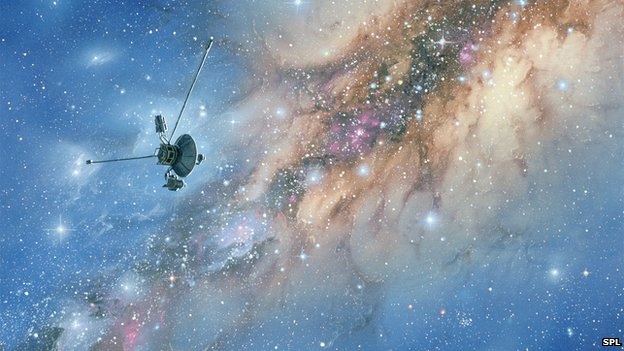
Imagine being so far from home that the Sun—the giant, burning ball of fire that gives us life—looks like just another tiny, bright star in the sky. No heat. No distinct shape. Just a pinprick of light in an endless, suffocating dark. That is the reality for Voyager 1 right now.
But here is the thing that keeps astronomers and conspiracy theorists up at night: It’s still talking to us.

For decades, we’ve been told a simple story. NASA launched a probe. It took pictures of Jupiter and Saturn. It kept going. End of story, right? Wrong.
The saga of Voyager 1 isn’t just about space exploration. It is a ghost story. It’s a story about a piece of 1970s technology, running on computer power weaker than a musical greeting card, that somehow refuses to die. And the deeper we look into the data it sends back, the stranger the story gets.
Some scientists now say Voyager 1 has fully punched through the cosmic bubble. It has left the building. If confirmed, this little metal box is the first man-made object to physically leave the Solar System and enter the terrifying void between stars.
The 1977 Gamble: A Shot in the Dark
Let’s rewind. The year is 1977. Star Wars just hit theaters. Disco is king. And at Cape Canaveral, a group of nervous engineers are about to throw a Hail Mary pass into the cosmos.
They called it the “Grand Tour.”
This wasn’t just a standard launch. The planets had aligned in a way that only happens once every 176 years. Jupiter, Saturn, Uranus, and Neptune were arranged in a perfect celestial arc. This allowed NASA to skip the probe like a stone across a pond, using the gravity of one planet to slingshot it to the next. Without this alignment, the trip would have taken decades longer. Maybe centuries.
They had one shot. They took it.
Launched in September 1977, Voyager 1 was only supposed to survive for five years. Its job was simple: study the outer planets, take some pictures, and then likely freeze to death or go silent. That was the plan.
But Voyager had other ideas. It just kept going.
It didn’t stop at Saturn. It didn’t stop when its cameras were turned off to save power. It kept screaming across the void at 38,000 miles per hour.
The “Heliocliff” Event: What Actually Happened?
Fast forward to the modern era. Researchers analyzing the telemetry data noticed something bizarre happening billions of miles away. The probe had entered a “realm” (sorry, a zone) of space that defied their models. They called it the Heliopause.
Think of the Sun not just as a light bulb, but as a bubble blower. It constantly blows a wind of hot, charged particles outward. This creates a giant bubble around our solar system called the heliosphere. Inside the bubble, we are safe, bathed in the Sun’s atmosphere. Outside? That’s interstellar space. The deep ocean.
For years, NASA speculated about where this border was. Was it a hard wall? A soft fade? A turbulent mix?
Then came the data shock.
On August 25, 2012, everything changed. The sensors on Voyager 1 went haywire. It was like the craft fell off a cliff. Hence the term: The Heliocliff.
“Within just a few days, the heliospheric intensity of trapped radiation decreased, and the cosmic ray intensity went up as you would expect if it exited the heliosphere,” explained Prof Bill Webber from New Mexico State University. He was stunned.
Let’s break that down into plain English. The “wind” from the Sun suddenly stopped. Dead calm. At the exact same moment, the amount of galactic radiation—dangerous, high-energy particles shooting from exploding stars across the galaxy—spiked massively. It was like walking out of a house during a storm; suddenly the air conditioning stops, and you get hit by the rain.
The NASA Cover-Up? Or Just Caution?
Here is where the internet theories start to boil. When this data first came in, NASA hesitated. They didn’t pop the champagne. In fact, they publically doubted it.
Why the hesitation?
Because the magnetic field didn’t change direction. According to all the textbooks, if you leave the solar system, the magnetic lines should shift. They didn’t. This confused everyone. Was Voyager actually out? or was it stuck in some weird, magnetic purgatory between the stars?
“It’s outside the normal heliosphere, I would say that,” Prof Webber insisted at the time. “We’re in a new region. And everything we’re measuring is different and exciting.”
Some conspiracy theorists believe NASA knew Voyager had crossed over much earlier but withheld the announcement to analyze strange anomalies in the data. What did they find out there? The “Hum.”
The Interstellar Hum
Years after the initial crossing, scientists examining the data found something chilling. Voyager was detecting a constant, monotonous drone. A “hum” in the plasma waves. It wasn’t random noise. It was a persistent, low-level vibration of the universe itself.
Imagine stepping out of your house and hearing the universe buzzing. That is what Voyager is hearing right now.
Voyager is currently moving more than 14 billion miles (over 22 billion km) from Earth. To put that number in perspective, it is 123 times the distance between our planet and the Sun. If you tried to drive that distance in a car at 60mph, it would take you roughly 26,000 years.
No human artifact has ever reached so deep into the cosmos. It is the ultimate pioneer.
The 16-Hour Lag (and growing)
Communication out here is a nightmare. A measure of the distance traveled is that it takes a staggering 22 hours (updated from the original 16 hours in 2013) for Voyager 1’s radio messages to arrive on Earth.
Think about that lag. You send a command: “Turn left.” You have to wait nearly two full days to find out if the probe heard you or if it crashed into a rogue asteroid.
Standing in NASA’s Jet Propulsion Laboratory in California years ago, I watched as data from the lonely craft flickered across giant screens. It felt religious. The room was quiet. The numbers were scrolling. This wasn’t just data; it was a heartbeat.
The scientist behind the mission, Ed Stone, talked in adoring terms of the 70s technology. He described it like a proud father. This craft has survived decades of hurtling through space, bombarded by radiation that would fry a modern iPhone in seconds.
The 2024 “Heart Attack” and Resurrection
You cannot talk about Voyager without mentioning the scares. The big one happened recently. In late 2023 and early 2024, Voyager 1 started speaking gibberish. Total nonsense.
The telemetry data—the ones and zeros that tell us “I’m okay”—turned into a garbled mess. The probe was still calling home, but it was like it had suffered a stroke. It was screaming into the void, but the words were broken.
Engineers at NASA spent months sweating bullets. They couldn’t just send a repairman. They had to debug code written 47 years ago, blindly, over a 15-billion-mile gap.
And guess what? They fixed it.
They found a single corrupted memory chip in the FDS (Flight Data Subsystem). By sending a command to “poke” the code and move it to a different location in the memory, they brought the probe back to life. It was a miracle of digital necromancy.
The Golden Record: A Map or a Target?
Bolted to the side of Voyager is a gold-plated copper disk. The Golden Record. It contains sounds of Earth: whales singing, thunder cracking, a baby crying, and greetings in 55 languages. It also contains a map.
This is where things get controversial. The map uses pulsars to pinpoint the location of Earth. In the 1970s, this seemed like a beautiful, poetic gesture. “Here we are! Come say hello!”
But in the age of the “Dark Forest” theory, modern thinkers aren’t so sure. If there are hostile civilizations out there, we just handed them our home address. We sent a loaded gun and a map to our bedroom out into the dark.
Stephen Hawking once warned that if aliens visit us, the outcome would be much as when Columbus landed in America, which didn’t turn out well for the Native Americans. Voyager is our message in a bottle, but we have no idea who—or what—might pick it up.
The Final Countdown: 2030 and Beyond
The tragedy of Voyager is that it is dying. Slowly. Painfully.
It runs on a nuclear battery—a radioisotope thermoelectric generator. It converts the heat from decaying plutonium into electricity. But the plutonium is running out. Every year, the probe loses about 4 watts of power. NASA has to make impossible choices. Turn off the heaters? Turn off the cameras? Turn off the cosmic ray detector?
Their plutonium power sources will stop generating enough electricity to power the transmitter sometime around 2030. Maybe we can squeeze it to 2035 if we are lucky.
At that point, the transmitter will die. Voyager 1 will not stop moving. It will just stop talking.
It will become a “Ghost Ship.” A silent metal tomb carrying the sounds of 1977 Earth, drifting forever in the silence.
Voyager-1 is on course to approach a star called AC +793888 (also known as Gliese 445), but don’t hold your breath. It will only get to within two light-years of it, and it will be 40,000 years before it does so.
Forty. Thousand. Years.
By the time Voyager reaches that star, humanity might be gone. The pyramids might be dust. But Voyager will still be there. Pristine. Untouched. Flying through the dark.
Is It Actually Free?
The claim that it has left the solar system comes from a paper in the journal Geophysical Research Letters. The spacecraft has been monitoring changes in its environment for some time that suggested it was about to cross the Solar System’s border.
But here is a mind-bending thought to leave you with: Has it really left?
Depends on your definition. Sure, it crossed the Heliopause (the wind bubble). But gravity is a cruel mistress. The gravitational pull of the Sun extends much, much further—out to the Oort Cloud.
The Oort Cloud is a massive shell of icy debris surrounding our system. It is the true edge. To get through that, Voyager would need another 30,000 years. So, in a way, it is still in the backyard. It has just stepped off the patio.

Many researchers would like a long period with the data all pointing in one direction before calling the exit definitive. But for the romantics among us, the line has been crossed.
Voyager-1 was launched on 5 September 1977. Its sister spacecraft, Voyager-2, followed on 20 August 1977. They have seen things we can only dream of. Volcanoes on Io. The rings of Saturn up close. The blue haze of Pluto.
Now, they face the Great Dark.
So next time you look up at the night sky, spare a thought for that tiny, scrap-metal hero. It is cold out there. It is lonely. But it is still going.
And as long as it keeps going, a part of us is out there too, sailing the endless sea.
Originally posted 2013-03-20 18:20:07. Republished, Expanded, and Updated for the Modern Era.
Originally posted 2013-03-20 18:20:07. Republished by Blog Post Promoter
![20130320-194404[1]](https://coolinterestingnews.com/wp-content/uploads/2013/03/20130320-1944041.webp)