
Time is supposed to be a straight line. You’re born, you live, you die. The past is a memory, and the future is a blank page. But what if that’s wrong? What if time is actually like a scratched record, skipping back and forth, playing songs from tomorrow while you’re still stuck in today?
We aren’t talking about science fiction here. We aren’t talking about H.G. Wells or Hollywood movies. We are talking about the documented, sworn testimony of one of the most respected men in British military history. A man who didn’t just claim to see a ghost, but who claimed to physically fly his airplane through a crack in reality and witness the future of World War II, four years before the first shot was fired.
This is the story of Air Marshal Sir Victor Goddard. And if his story is true, everything we think we understand about our reality is completely broken.

The Man Who Saw Too Much
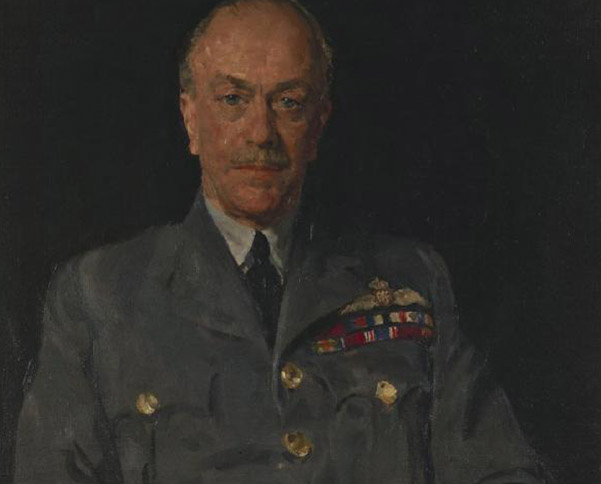
Before we jump into the weird stuff, you have to understand who this guy was. It’s easy to dismiss UFO sightings or ghost stories when they come from “some guy on the internet” or a tabloid headline. Victor Goddard was not “some guy.”
He was a heavy hitter. A legend. We are talking about a senior commander in the Royal Air Force during the darkest days of the Second World War. He held the rank of Air Marshal. He fought in the First World War, survived air combat, and climbed the ranks through sheer competence and grit. This was a man trained in observation, navigation, and keeping a cool head when things went sideways. He wasn’t prone to flights of fancy. He was a man of logic. A man of war.
That is exactly what makes his experience in 1935 so terrifying.
If a man with his credentials says he flew into the future, you don’t just laugh it off. You sit down, shut up, and listen.
The 1935 Flight: Into the Storm
It was a routine mission. Nothing special. The year was 1935. Goddard, then a Wing Commander, fired up his Hawker Hart biplane—a classic, open-cockpit machine that roared like a lawnmower on steroids. He took off from Edinburgh, Scotland, heading home to his base in Andover, England.
The weather? Fine. At first.
Goddard decided to take a scenic route. He wanted to fly over Drem. Now, Drem was an old airbase that had been important during the Great War (WWI), but by 1935, it was a ghost town. The military had abandoned it. It was dead.
As he buzzed over the location, he looked down. It was exactly what he expected. A ruin. The hangars were falling apart, roofs caved in, windows shattered. The tarmac was cracked and useless. Barbed wire rusted in the mud. There were no planes. No soldiers. Just cows. Lots of cows, chewing grass on what used to be a runway. It was a sad sight, a relic of a past war.
Goddard flew on. But then, the sky turned against him.
This wasn’t normal rain. Pilots know storms. They know the grey, the black, the white. This was different. Goddard described hitting a “bizarre storm” with clouds that were a sickly, bruised brown-yellow color. It looked toxic.
The Slip
The turbulence hit him like a sledgehammer. The Hawker Hart was a sturdy plane, but it was being tossed around like a paper toy. Goddard lost control. The horizon vanished. His instruments went haywire. He was in a spin, spiraling down toward the Scottish hills in a brown fog that seemed to glow.
He fought the stick. He fought the pedals. He was seconds away from smashing into the ground. A crash at that speed, in that terrain? Zero survival chance.
Then, the impossible happened.
He didn’t break out of the clouds. The clouds broke around him. But they didn’t just fade away. They vanished instantly, like someone flipped a light switch. One second, he was in a death spiral inside a brown nightmare; the next, he was flying in level, calm air under a brilliant, blazing sun.
But the sun wasn’t the only thing that had changed.
Goddard looked down to get his bearings. He realized the storm had spun him around. He was back over the Drem airfield. But the cows were gone.
A Glitch in the Simulation?
Goddard rubbed his eyes. He checked his altitude. He looked down again. The ruins were gone. The rotting hangars? Gone. The cracked tarmac? Gone.
Below him sat a pristine, bustling airbase. The hangars looked brand new, painted and perfect. The airfield was manicured. But the details… the details were wrong for 1935.
On the ground, Goddard saw four airplanes parked in a neat line. Three of them were biplanes—likely Avro Tutors—but they were painted a bright, garish yellow. In 1935, RAF planes were silver or brown. Nobody painted military aircraft yellow. It was unheard of.
But the fourth plane was the real kicker. It wasn’t a biplane. It was a monoplane (one set of wings). Low-wing. Sleek. Modern. In 1935, the RAF didn’t have monoplanes like that in service. It looked like a miles Magister—a plane that hadn’t been invented yet.
And then there were the people.
Goddard swooped low, practically buzzing the tarmac. He could see the mechanics walking around. He expected to see them look up, wave, or point at the idiot officer buzzing the tower. They didn’t. They ignored him completely. It was as if he was a ghost to them. They went about their business, pushing carts and turning wrenches.
But it was their clothes that froze Goddard’s blood. In 1935, RAF mechanics wore tan or brown overalls. It was standard issue. These men? They were wearing blue. Bright blue overalls.
Confused, shaken, and terrified, Goddard pulled up. He hit the “brown cloud” barrier again at the edge of the airfield. The sunshine vanished. The turbulence returned. He fought his way back to Andover, landed his plane, and told his friends what happened.
They told him he was crazy. They told him he was hallucinating from oxygen deprivation. So, he shut up about it. He wrote it down, filed it away, and tried to forget.
The Prediction Comes True
Fast forward four years. 1939. Europe is on the brink of chaos. Hitler is moving. The British military machine kicks into high gear.
The RAF needed to train pilots—thousands of them—fast. They reopened old airfields. One of them was Drem.
They renovated the hangars. They repaved the runways. And because they needed to distinguish training aircraft from combat fighters, the RAF issued a new order: all training planes were to be painted a specific, high-visibility color. Yellow.
New aircraft models were rolled out to modernize the fleet. The Miles Magister—the sleek monoplane Goddard saw—became a staple trainer.
And the mechanics? The RAF decided the old brown overalls were too similar to the Army infantry uniforms. To avoid confusion, the mechanics’ uniform was switched. To blue.
Four years later, the scene at Drem looked exactly, down to the last rivet and stitch of clothing, like what Goddard had seen in 1935.
Did he hallucinate? Or did he fly through a “time slip”? Did that strange brown storm act as a conductor, a wormhole, or a bridge across the fourth dimension? Skeptics say he made it up later to sell books. But Goddard told his peers immediately after it happened. He was confused at the time because the blue overalls and yellow planes made no sense to him. If he were making it up, why invent details that didn’t exist?
He saw the future. There is no other logical explanation.
The Ghost in the Machine
If that was the only weird thing to happen to Victor Goddard, he’d be a legend. But the universe wasn’t done with him yet. Goddard seems to have been a magnet for the unexplained.
Let’s rewind the clock even further. 1919. The end of The Great War.
Goddard was a young officer in charge of a squadron. The war was over, the men were going home, and the mood was bittersweet. They were disbanding. As was tradition, they gathered for one final group photo. Two hundred men and women, lined up in rows, staring at the camera.
But the mood was heavier than usual. Just two days before the photo was taken, a tragedy struck the base. A mechanic named Freddy Jackson had made a fatal mistake. He walked too close to the nose of a plane while the engine was starting. The spinning propeller hit him. He died instantly. It was messy, sudden, and heartbreaking.
Freddy’s funeral was held on the very morning the squadron photo was taken. The men buried their friend, wiped their eyes, and then marched to the tarmac to pose for the picture.
The Smirking Airman

Decades later, in 1975, a retired Sir Victor Goddard released the photo to the public. He had kept it for over 50 years. Why? Because of what—or who—was in the back row.
Take a close look at the image above. Behind the aviator in the cap, peering over his left shoulder, is a face. It’s faint, but it’s there. The man isn’t wearing a hat. He’s looking directly at the camera. And he is smiling. A cheeky, little smirk.
When the photo was developed back in 1919 and pinned to the squadron bulletin board, the men lost their minds. They didn’t ask “Who is that?” They asked, “Why is Freddy there?”
Every man in that squadron recognized the face instantly. It was Freddy Jackson. The man they had buried that morning. The man who had been dead for two days.
This wasn’t a case of “it looks kind of like him.” These men worked with him every day. They knew his face. They knew his grin. Goddard himself confirmed it. The crew confirmed it.
Deep Dive: The Impossible Negative
Skeptics love to scream “Photoshop!” But this was 1919. Digital manipulation didn’t exist. Could it be a double exposure? Maybe. But for a double exposure to place a face perfectly behind another officer, scaled correctly, without ghosting the rest of the image, would be a miraculous accident. Furthermore, Freddy Jackson was dead. He wasn’t there to be “accidentally” exposed on the film plate.
Could it be a smudge on the lens? Pareidolia (the brain’s tendency to see faces in random patterns)? Perhaps. But look at the detail. You can see the ear, the hairline, the eyes. It’s distinct. And why is he hatless? Everyone else was in full uniform. Freddy looks like he just popped his head in to say goodbye.
Goddard wrote about this in his book, Flight Towards Reality. He didn’t think it was scary. He thought it was typical Freddy. His take? Jackson’s expression seemed to say: “My goodness me—I nearly failed to make it—They didn’t wait, or leave a place for me, the blighters!”
The Connecting Thread
So, we have one man. Two impossible events.
In 1919, the past refused to stay dead. Freddy Jackson pushed his way back into the present moment to get in a photo.
In 1935, the future refused to wait its turn. The Drem airfield bled backward in time, revealing itself to Goddard four years too early.
What does this tell us about the nature of reality? Maybe time isn’t a wall. Maybe it’s a curtain. And sometimes, if the energy is right—if the storm is strong enough, or the emotion is heavy enough—the curtain blows open. Victor Goddard wasn’t a mystic. He was a soldier. He didn’t ask for these experiences. They happened to him.
Modern physics suggests the possibility of parallel universes and non-linear time. We talk about wormholes and quantum entanglement. But Victor Goddard didn’t need a physics degree to know the truth. He saw it with his own eyes. He saw the yellow planes. He saw the dead mechanic.
And he left us the evidence to wonder: are we walking through time, or is time walking through us?
Originally posted 2013-10-15 18:05:49. Republished by Blog Post Promoter
![victor-goddard[1]](https://coolinterestingnews.com/wp-content/uploads/2013/10/victor-goddard1.webp)











