The Glitch in the Matrix: The Night a Phantom Walked at the Olympics
London, 2012. The world is watching. Billions of eyes are glued to screens. The atmosphere is electric, heavy with the scent of history and burnt fireworks. Danny Boyle has just orchestrated a mind-bending opening ceremony that celebrated the NHS, the Industrial Revolution, and British pop culture. It was chaos. It was beauty. It was perfect.
And then, the athletes came out.
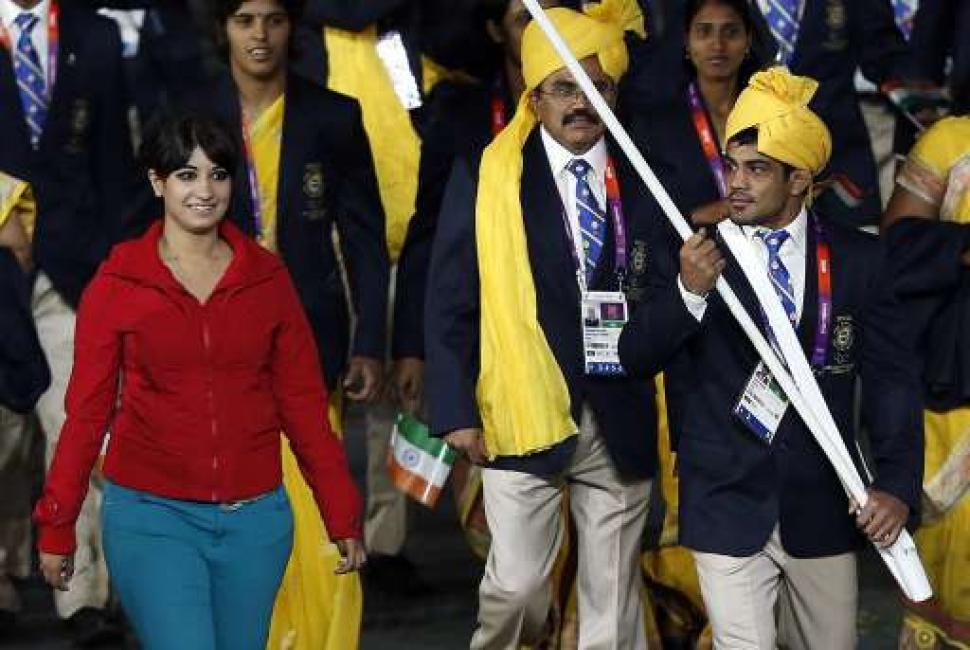
The Parade of Nations. A sacred tradition. The moment where sweat, tears, and four years of brutal training culminate in a single lap around the track. The Indian contingent emerged, proud in their yellow turbans and sharp blazers. Leading them was the legendary wrestler Sushil Kumar, the flag-bearer, carrying the hopes of over a billion people.
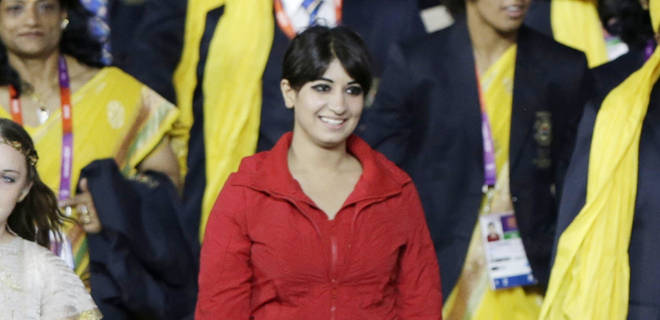
But wait. Look closer. Look at the photo above.
Who is that?
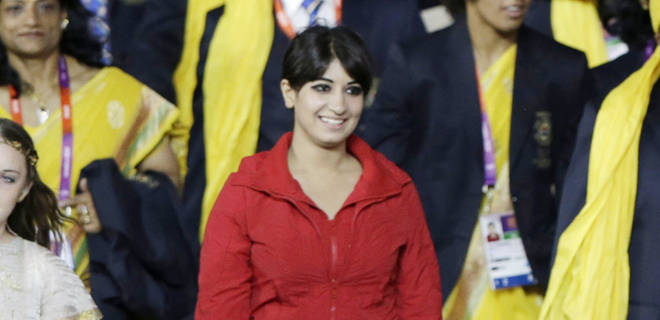
Walking right there. Front and center. A woman in a bright red sweatshirt and casual blue jeans. She is beaming. She is waving. She looks like she just wandered out of a coffee shop and decided to lead a nation into the Olympic stadium. She stands out like a neon sign in a dark room. The athletes are in uniform. She is… decidedly not.
This wasn’t just a photobomb. This was the “Mystery Woman” of London 2012. And for 48 hours, she was the most famous person on the planet who nobody could name.
The “Lady in Red” Incident: A Minute-by-Minute Breakdown
Let’s freeze the frame. The Indian contingent is marching. They are focused. Dignified. Then you have this anomaly. The contrast is jarring. The Indian team is dressed in formal attire—yellow turbans for the men, saris for the women. And right at the head of the pack, practically stealing the flag-bearer’s thunder, is a young woman looking entirely too comfortable.
She wasn’t hiding. She wasn’t sneaking around the back. She was leading the charge.
CNN-IBN broke the initial confusion. Their reporters on the ground were scrambling. Was she a diplomat? A contest winner? A lost tourist? The reports came back negative. She was neither a flower girl nor a placard carrier. She had no badge visible that matched the athletes.
Indian officials were not just confused; they were apoplectic. They were fuming. Imagine training your whole life for this moment of glory, only to have the spotlight hijacked by a random person in street clothes. It was bizarre. It was surreal.
India’s Chef de Mission, PKM Raja, who also served as the President of the All Indian Boxing Association, went on record immediately. You could hear the frustration in his voice:
“We have no clue who this woman was. Somebody from the security pushed her into the contingent. We had no idea. We were under the impression that she was part of the organization.”
Think about that for a second. The athletes thought she was with security. Security likely thought she was with the athletes. It was a perfect storm of assumption. A social engineering masterclass, accidental or otherwise.
“We were initially told that she would accompany the contingent till the track but she went on to take the entire lap,” Raja added, his disbelief growing. “There was another man also but he stayed back and did not enter the stadium.”
The Billion-Dollar Security Failure
Here is where the story gets dark. Let’s talk about the context. The 2012 London Olympics were held in a post-9/11 world. Security was not a joke. It was a military operation.
There were surface-to-air missiles stationed on the roofs of residential apartment blocks in London. There were 13,500 troops deployed—more than the UK had in Afghanistan at the time. An aircraft carrier was docked in the Thames. The budget for security alone was astronomical.
The message was clear: “Nothing gets in. Nothing gets out without us knowing.”
And yet.
One woman. One red shirt. One pair of blue jeans. She walked right through the “Ring of Steel.” She strolled onto the most protected patch of grass on Earth and walked a full lap while the world’s cameras rolled. If she had been a threat, the consequences are too terrifying to consider.
Raja didn’t hold back on this point: “We have taken strong exception to this. The march past is for the athletes and officials attached to the contingent. We are totally taken by surprise how a person could just intrude into the track.”
How indeed?
The Hunt for the Identity
The internet exploded. Before we had the lightning-fast OSINT (Open Source Intelligence) communities we have today on Twitter and Reddit, we had forums and news comment sections. Everyone became a detective. Theories ran wild.
- Theory 1: She was a protestor highlighting a cause. (But she carried no sign, shouted no slogans).
- Theory 2: It was a massive bet. A dare.
- Theory 3: She was a time traveler. (Okay, the internet always goes there, but she did look strangely out of place).
Indian media was relentless. They ran her face on loop. “Who is the Gatecrasher?” headlines screamed. It didn’t take long. The anonymity of the digital age is a myth.
She was identified as Madhura Nagendra.
She wasn’t a spy. She wasn’t a terrorist. She was a graduate student from Bangalore, India, living in London. And, crucially, she was actually part of the opening ceremony cast. This explains how she got into the stadium. She had a pass. She had clearance to be in the building as a dancer.
But she did not have clearance to become an honorary Olympian.

The “Hang Around” Technique
The investigation revealed a comedy of errors. It turns out Madhura was utilizing a strategy known in the espionage world (and by party crashers everywhere) as “acting like you belong.”
Reports indicate she was simply “hanging around” near the entrance to the arena. Chaos reigns backstage at these events. Thousands of performers, athletes, and handlers are moving in a hive mind. When the Indian flag-bearer walked past, she reportedly just… dashed to his side.
It was impulsive. It was bold.
Officials looked on, amazed. They froze. You know that feeling when you see someone doing something so audacious you assume they must be allowed to do it? That’s what happened. Everyone assumed someone else had authorized it.
Madhura enjoyed a leisurely stroll around the circuit. She waved to the crowds. She soaked in the applause meant for the wrestlers and boxers. She mingled with the athletes in the center of the stadium. By the time security realized they had been fooled—that the woman in red was not a special attaché—it was too late. The lap was done. The photos were taken.
She slipped away into the London night, leaving a media firestorm in her wake.
The Conflicting Narratives: Father vs. Organizers
As the story broke, the cleanup began. And the stories didn’t match up.
Madhura Nagendra’s father, K. Nagendra, spoke to the Press Trust of India. A father defending his daughter, or a man confused by the chaos? He claimed his daughter had been chosen to dance in director Danny Boyle’s ceremony. True. But then he dropped a bombshell speculation.
He suggested that she might have been asked by organizers to escort India’s team into the stadium.
Wait. Why? Why would a dancer in casual clothes be asked to escort the Indian team? Usually, placard bearers wear specific costumes designed for the show. They have nameplates. They look like part of the set.
“This might have hurt our team’s feelings. I feel very sorry for that,” her father was quoted as saying, trying to pour water on the fire.
But the organizers? They weren’t having it. Sebastian Coe, the Lord of the Rings (Olympic rings, that is), had to step in. He was the face of the London Games. He couldn’t admit a security breach. That would look terrible.
Coe stressed the woman had been screened. “Don’t run away with the idea that she walked in off the street,” Coe said. This was technically true—she was a cast member. But he added ominously that games officials “will have our own discussions” about the incident.
It was a classic spin. She was screened, so we are safe. But she shouldn’t have been there, so we are mad.
Deep Dive: The Psychology of the Photobomb
Why does this story stick with us years later? Why do we care about Madhura Nagendra?
Because she represents a glitch in the system. We live in a world of high control. Barriers, tickets, facial recognition, velvet ropes. We are told where to stand and when to move.
Madhura broke the script.
There is a theory circulating on modern conspiracy forums that incidents like this are “reality checks.” They remind us that for all the billions of dollars spent on organization and control, human chaos always wins. All it took was one person deciding, “I’m going to walk there,” and the entire system crumbled.
It brings up the “Main Character Syndrome” conversation we see on TikTok today. Madhura was the original main character. In her mind, for those 400 meters, she wasn’t an intruder. She was part of the show. Her smile in the photos is genuine. She doesn’t look nervous. She looks like she belongs.
The Modern “Mandela Effect” and Internet Theories
If you search for this event today on alternative history boards, you’ll find some wild takes. Some users claim they remember her being arrested (she wasn’t). Others remember her wearing a saree (she wasn’t). It’s a minor Mandela Effect.
But the most interesting modern take is the “Social Hacking” angle. Security experts now study this incident as a prime example of how uniforms (or lack thereof) and confidence can bypass strict protocols. If you walk fast enough and look confident enough, you can go almost anywhere. It’s the “carrying a ladder” trick, but on a global stage.
Also, consider the visual symbolism. The Indian team was a sea of yellow and black. Earth tones. Solemn. Traditional. Then you have the splash of Red and Blue. In color psychology, Red demands attention. It signals danger, passion, and importance. By wearing red, she subconsciously commanded the eye. The cameras had to look at her.
The Aftermath: Where is She Now?
Eventually, Madhura Nagendra returned to Bangalore. The fame was fleeting, but the infamy lasted a bit longer. She gave interviews apologizing, saying it was an error in judgment, a moment of being swept up in the excitement. She became a minor celebrity in her hometown, the girl who walked with the Olympians.
But the incident left a scar on the Indian Olympic officials. It was seen as a sign of disrespect, a symbol of how the Indian team was treated as an afterthought. “They wouldn’t have let a random person walk with the US team,” angry comments read on forums. “They wouldn’t have let someone stroll in with Team GB.”
Was it racism? Negligence? Or just sheer, random chance?
We may never know exactly what the security guard was thinking when they waved her through. But we do know this: In the history of the 2012 Games, amidst the gold medals and the world records, the Girl in the Red Shirt holds a record that will never be broken.
Gold Medal for Audacity.
So, next time you are watching a massive, televised event, look closely at the background. Look at the edges of the frame. You might just spot someone who isn’t supposed to be there, waving back at you, proving that the world is a little less organized than they want you to believe.
Originally posted 2016-03-15 08:28:11. Republished by Blog Post Promoter
![indian-woman-at-olympics-2012[1]](https://coolinterestingnews.com/wp-content/uploads/2012/07/indian-woman-at-olympics-20121.webp)