The atmosphere screamed. That’s the only way to describe it. Picture a hunk of metal the size of a Mini Cooper, hurling itself into the alien sky at thirteen thousand miles per hour. It’s a bullet. A suicide mission. A fireball tearing through the thin, rust-colored envelope of a dead world.
Then, the impossible happened.
Most people just read the headline. “NASA lands rover.” They scroll past. They check their likes on Instagram. They move on. But you? You’re here because you know that what happened above Gale Crater wasn’t just a science experiment. It was a gamble. A high-stakes poker game played against physics itself. And maybe, just maybe, against something else entirely.
The Seven Minutes of Terror
Engineers at JPL call it the “Seven Minutes of Terror.” Why? Because it takes fourteen minutes for a signal to get from Mars to Earth. By the time the “we have entry” signal pings on a screen in Pasadena, the rover is already on the ground. Alive. Or dead.
It’s a ghost signal. A phantom echo from the past.
This wasn’t like the old days with airbags bouncing around like beach balls. This was heavy metal. This was the Sky Crane. It sounds like something out of a bad sci-fi comic, right? A rocket-powered backpack that hovers over the surface, lowers the rover on nylon cords, and then—once the wheels touch the dirt—cuts the cords and flies away to crash-land somewhere else. Who signs off on that? It’s madness. Absolute, beautiful madness. But it worked.
The high-tech craft hit the top of the Martian atmosphere like a sledgehammer. Heat shields glowing cherry-red. Parachutes snapping open with enough force to shatter bone. Then, that radical floating ‘sky crane’ took over. It danced in the thin air. It lowered the precious cargo. Gently. Softly. Right into the belly of a massive crater that scientists suspect was once a lake.
The Silence Before the Scream
The news was greeted with cheers and shouts in NASA’s Pasadena Mission Control. High-fives. Tears. Blue shirts hugging other blue shirts. It was a party. For a moment, the world stopped fighting and looked up.
But within seconds, the craft had sent back the first pictures of its new home. Grainy. Hazelcam shots. Dust covers still on. Shadows stretching out across a desolate horizon. That’s when the real questions started.
We’ve been staring at the Red Planet for centuries. The Romans saw a god of war. Percival Lowell saw canals built by a dying civilization. Viking 1 saw a face staring back up at the stars. Every time we go there, we expect rocks. Just cold, dead rocks. But we’re looking for ghosts.
The NASA robot will soon begin beaming high-definition images of the Red Planet’s surface in the next day or two. Gigabytes of data. Panoramas. Drill samples. They tell us they are looking for “microbial life.” Bacteria. Slime. Ancient pond scum.
Is that really all they are looking for?
The Leak That Broke the Internet
Official channels are slow. They sanitize. They filter. They color-correct the sky to look a nice, friendly butterscotch instead of the harsh, alien salmon-pink it might actually be. They scrub the data. We know this. It’s standard procedure. “Public safety.” “Data verification.”
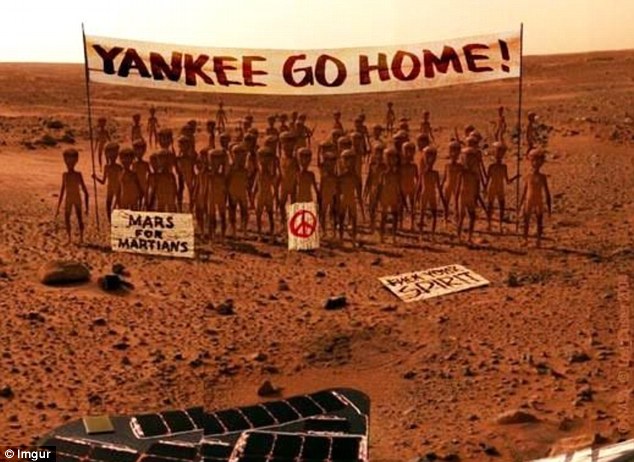
But the internet? The internet is fast. The internet is wild. While NASA was preparing their press release, the digital underground was already buzzing. We managed to get a sneak peak thanks to the guys at imgur. A leak? A hack? Or maybe just someone on the inside having a laugh? You decide.

Look at that. Just look at it.
Okay, laugh if you want. It looks like a joke. A gag. Marvin the Martian holding a protest sign? Maybe. But let’s play the “what if” game for a second. What if the first thing we saw wasn’t a rock?
History is full of things we weren’t supposed to see. The “Baghdad Battery.” The Antikythera mechanism. Out-of-place artifacts that don’t fit the timeline. Mars is the ultimate locked room mystery. We have photos from previous rovers that show shapes that look suspiciously like statues. Pyramids. Spoons. Femur bones. NASA calls it “pareidolia”—a psychological trick where your brain forces random data into recognizable shapes. You see a cloud; your brain says “bunny rabbit.” You see a rock; your brain says “alien skull.”
Convenient, isn’t it?
It’s the perfect cover. Anything strange is just your mind playing tricks on you. Nothing to see here. Move along. But when you have thousands of internet sleuths pouring over raw images, things get found. Anomalies. Geometry that nature doesn’t usually make. Right angles. Perfect circles.
The obsession with Gale Crater
Why land here? Why this specific crater? It’s huge—96 miles wide. A mountain sits in the middle of it, Mount Sharp, rising 18,000 feet from the valley floor. That’s taller than the rim of the crater itself. How does that happen?
Geologists say it’s sediment. Layers of history stacked up like a cosmic lasagna. They want to read those layers. They want to see if Mars had water. If it had an atmosphere. If it was alive.
But the alternative historians? The deep-dive theorists? They see something else. A mountain in the middle of a crater looks a lot like a citadel. A fortress. A remnant of something that stood tall while the rest of the planet burned or froze or suffocated.
Think about the speed of that landing again. 13,000 MPH. The precision required to hit that specific landing ellipse is like hitting a golf ball in Los Angeles and landing it in a cup in New York City. They didn’t just want to land “on Mars.” They wanted to be exactly right there. Why?
The Color of Conspiracy
Have you ever noticed how the color of Mars changes in photos? Sometimes it’s deep red. Sometimes it’s brown. Sometimes, weirdly, there are patches of blue or green that disappear in the “official” releases. NASA claims they use “false color” imaging to highlight mineral differences. They stretch the contrast so scientists can tell basalt from hematite.
That makes sense. Scientifically.
But it also gives them a license to paint the world whatever color they want. If the sky was actually blue—meaning there was more oxygen than they admit—would they tell us? If there were patches of lichen or moss growing in the shadow of a rock, would they tint it red to blend in? In the 1970s, the Viking landers sent back photos showing a blue sky. Later, they were “corrected” to pink. An honest mistake? Or a quick fix to keep the narrative straight?
What Are We Really Looking For?
Let’s get real. Spending billions of dollars to find a microscopic fossil of a bacteria that died three billion years ago is cool. It’s science. It changes textbooks.
But it doesn’t change us.
Finding a hubcap? A brick? A carved stone? That changes everything. That breaks religion, history, and physics in one snap. That’s the dangerous stuff. That’s the stuff that gets classified.
The image above—the “aliens on mars” joke—taps into a deep, primal fear. We are terrified of being alone in the universe. But we are even more terrified of finding out we have neighbors. Especially neighbors that might have been watching us for a long time.
Modern theories suggest that Mars wasn’t always dead. Some physicists have even suggested that the isotopic signatures in the Martian atmosphere look suspiciously like the aftermath of a massive nuclear explosion. Not a natural reactor. A weapon.
Did they blow themselves up? Did they flee to the third planet from the sun—Earth—and start over? Are we the Martians?
The Data Dump Is Coming
So, the rover is down. The wheels are turning. The high-gain antenna is pointed at Earth. The stream of data is about to become a flood. We are going to see things in 4K resolution that no human eye has ever seen.
Keep your eyes peeled. Don’t just look at the center of the photos where NASA points the camera. Look at the edges. Look at the shadows. Look at the horizon line. That’s where the truth hides.
The “sky crane” maneuver was a miracle of engineering. But the real miracle will be if we get the full story.
Stay curious. Stay skeptical. And keep watching the skies.