There are haunted houses, and then there is Loftus Hall. Most ghost stories are vague. They rely on creaky floorboards or a cold draft in the hallway. But the legend of this massive, imposing mansion on Ireland’s Hook Peninsula is different. It is violent. It is specific. And it involves a direct confrontation with the ultimate evil.
We aren’t talking about a Casper-friendly ghost here. We are talking about the Devil himself.
![image-39[1]](https://coolinterestingnews.com/wp-content/uploads/2016/03/image-391.webp)
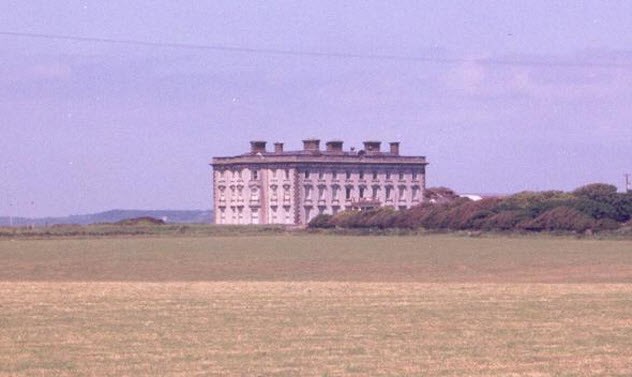
Loftus Hall is a 22-bedroom period mansion that dominates the bleak landscape of County Wexford. It sits on 60 acres of land, staring out over a lonely, jagged stretch of the South East coast where the waves crash against the rocks with a fury that shakes the ground. The house looks angry. Even from a distance, the architecture feels hostile.
For over three decades, this behemoth sat abandoned. The windows were boarded up. The wind whistled through the cracks. It was left to rot, receiving only the most basic structural repairs to keep it from collapsing entirely. But why? Why would anyone leave a multi-million dollar estate to decay?
Because the locals know better. They know what happened in the card room in 1766. And they know that some stains can’t be scrubbed out with bleach.
The Bloodlines: A History of Violence
Before we rip into the supernatural event that put this house on the map, we have to understand the ground it sits on. The energy here was wrong long before the Devil showed up.
Originally, this wasn’t Loftus Hall. It was Redmond Hall, built way back in 1350 during the time of the Black Death. Think about that. The foundations were laid while a plague was wiping out half of Europe. The Redmond family held onto the land for centuries, but it was a bloody tenure. During the Irish Confederate Wars in the 1600s, the hall was under siege. Soldiers attacked it from the sea. Cannons were fired. Men died screaming in the mud outside the gates.
It wasn’t until the 1650s that the Loftus family took over. They were English planters, gaining land through the Cromwellian confiscations. They renamed it Loftus Hall. They wanted a legacy. Instead, they got a curse.
By 1766, the Tottenham family was living there (through marriage into the Loftus line). Charles Tottenham, his wife, and his daughter Anne were the residents. They were wealthy. They were powerful. But they were isolated. And isolation makes people do strange things.
The Storm That Brought Him In
It was a dark night. That sounds like a cliché, but on the Hook Peninsula, a storm isn’t just rain. It’s a assault. The Irish Sea turns black, and the fog rolls in so thick you can’t see your hand in front of your face.
During one of these massive gales, a ship arrived at the peninsula. The waters were too rough to sail, so a young stranger came knocking at the heavy oak doors of Loftus Hall. He was seeking shelter.
In those days, hospitality wasn’t just polite; it was survival. You didn’t turn people away in a hurricane. Charles Tottenham opened the doors.
The stranger was charming. He was handsome. He was well-traveled. For Anne Tottenham, who had been stuck in that drafty house with her parents for years, he was a revelation. He was exciting.
The storm raged for weeks. The roads were flooded. The ship couldn’t leave. And the stranger stayed. He grew incredibly close to Anne. They spent long days walking the corridors and long evenings by the fire. It looked like a romance was blossoming. It looked like a fairy tale.
But the energy in the house was shifting. The servants started whispering. The dogs were on edge. Something wasn’t right about this guest.
The Game of Cards
It all came to a head in the card room. This is the moment history fractured.
The family was sitting around a heavy table, playing cards—likely Whist. The fire was roaring. The stranger was winning. He was on a hot streak that defied the odds. He was laughing, charming the father, flirting with the daughter.
Anne was dealt a hand. She was focused. During the play, she dropped a card. It fluttered off the table and landed on the floor near the stranger’s chair.
This is the detail that keeps me up at night. It’s such a mundane thing. You drop a card. You bend down to pick it up. It takes two seconds.
Anne bent down. She looked under the table.
She didn’t see boots. She didn’t see human feet. Beneath the fine silk cuffs of the stranger’s trousers, she saw a cloven hoof. A beast’s foot. Hairy, animalistic, and undeniably wrong.
Her brain snapped. She didn’t gasp. She didn’t whisper. She screamed. A blood-curdling shriek that echoed through the entire mansion. She shot up from under the table, pointing a trembling finger at the man she had been falling in love with.
“You have cloven feet!” she wailed.
The Transformation
The jig was up. The stranger didn’t try to deny it. He didn’t make an excuse. The moment he was exposed, the charm evaporated.
According to the legend—and this is recorded in local history, not just campfire stories—the man stood up. But he didn’t walk out the door. He began to change. His eyes burned. The air in the room grew instantly hot, smelling of sulfur and rotten eggs.
He shot straight up. Like a rocket. He transformed into a ball of fire and burst through the ceiling. He smashed right through the plaster, through the lath, and out through the roof, leaving a gaping hole in the structure.
The Devil had been in the house. He had broken bread with them. He had courted their daughter.
You might think, “Okay, cool story.” But here is the weird part: They could never fix the hole. For years, every time they tried to patch that section of the ceiling, the plaster would crumble. The wood would rot. It was an otherworldly scar on Loftus Hall that physically refused to heal.
The Madness of Anne Tottenham
The stranger was gone, but the horror was just starting. Anne Tottenham was broken. Her mind shattered into a thousand pieces. She had looked evil in the face and fallen in love with it.
She went into a state of shock that she never recovered from. Her family, embarrassed and terrified, did what many wealthy families did in the 1700s: they hid her.
They locked Anne in the Tapestry Room. This was her prison. For nine agonizing years, she sat in that room. She refused to eat properly. She refused to sleep in a bed. She sat on the floor, her knees pulled up to her chin, staring out the window, waiting for the stranger to come back.
She died in that room in 1775. But the tragedy didn’t end with her last breath. Because she had spent nearly a decade curled into a ball, her muscles had seized. Her joints had fused. When the undertakers came to collect her body, they couldn’t straighten her out.
They had to bury her like that. In a custom-made coffin, twisted into a fetal position. A final, gruesome indignity.
Her spirit, however, didn’t stay in the box. Anne is said to haunt the grounds to this day. She is confused. She is angry. She is incapable of coming to terms with what transpired. Visitors report seeing a young woman in period clothing, pacing the halls, looking for something she lost.
The Exorcism That Failed
The activity in the house got so bad after Anne died that the family couldn’t handle it. Poltergeist activity was rampant. Doors slamming. Screams in the night. The sound of hooves clipping down the hallway.
They called in the big guns. Father Thomas Broaders, a local priest with a reputation for handling “difficult” cases, was summoned. He performed an exorcism on the property.
Did it work? Well, the family eventually fled the house, so you tell me. Father Broaders later died, and his tombstone in the local cemetery contains an inscription that suggests he battled evil forces at the Hall. Even the church acknowledged something dark was there.
Click here to watch footage of the haunted castle
The Conspiracy: What REALLY Happened?
Now, I’m a skeptic at heart. I love a ghost story, but I also love human behavior. Historians have looked at this story and found some holes. Or rather, they’ve found a motive for the lie.
What if there was no Devil? What if the “stranger” was just a man?
Consider the era. The Tottenhams were Protestant aristocracy. The locals were Catholic. Tensions were high. Some theories suggest the stranger was a secret Catholic, or perhaps an Irish revolutionary. If Anne had fallen in love with a man of the “wrong” faith or political standing, it would have been a massive scandal.
The “cloven hoof” could have been a metaphor. In those days, people often referred to those they considered enemies or heretics as “devils.”
Here is an even darker theory that has circulated on internet forums and history blogs: Was Anne pregnant? Did she have an affair with a sailor, get pregnant out of wedlock, and get locked away by her cruel father to hide the shame? Was the “madness” just a cover story for a woman imprisoned by her own family?
When the house was renovated years later, workers reportedly found the skeletal remains of an infant hidden in the walls of the Tapestry Room. If that is true, it changes the entire narrative from a supernatural thriller to a true-crime tragedy.
The Modern Haunting
Fast forward to the 21st century. The house has changed hands multiple times. It was a nunnery for a while (ironic, right?). It was a hotel. It was abandoned. Then, in 2011, it was bought by the Quigley family.
They opened it for paranormal tours. And that is when the evidence started piling up. This wasn’t just folklore anymore. People were capturing things on camera.
In 2014, a tourist took a photo that went viral instantly. It broke the internet in the paranormal community.
The tour group was walking through the hall. The guide emptied the area. A young man snapped a quick picture of the empty doorway. But when he looked at the screen, it wasn’t empty.
Take a look at this:
![image-40[1]](https://coolinterestingnews.com/wp-content/uploads/2016/03/image-401.webp)
Do you see it? Look closely at the doorway on the left. There are two figures. One appears to be an older woman. Beside her stands a young woman. The reflection and the lighting don’t match the environment.
Is that Anne? Is she still standing there, waiting for the card game to end?
In 2011, a team of paranormal researchers produced a documentary on Loftus Hall. They recorded sudden temperature drops—we are talking 20-degree plunges in seconds. They recorded EVPs (Electronic Voice Phenomena) that sounded like a woman weeping. The famous show Ghost Adventures even investigated the location, calling it one of the most terrifying lockdowns they had ever experienced.
The House Today
In a twist that surprised everyone, Loftus Hall was put up for sale recently. Who buys a house that is famous for having the Devil over for dinner? It turns out, someone did.
The property is currently undergoing another transformation. There are rumors of it becoming a luxury resort. But good luck to the contractors. Locals say that tools go missing. Batteries drain instantly. Workers report the sensation of being watched from the upper landing.
Whether you believe in the Devil, ghosts, or just the cruelty of a father protecting his reputation, one thing is undeniable: Loftus Hall has a memory. It remembers the pain. It remembers the fear. And if you stand in that Tapestry Room long enough, you might just hear the click-clack of hooves on the floorboards behind you.
Would you spend a night there? I know I wouldn’t.
Originally posted 2016-03-28 18:47:25. Republished by Blog Post Promoter