Home Weird World Photo Galleries Proof Of Time Travellers – Gallery

Proof Of Time Travellers – Gallery

52
157

The Glitch in the Matrix: Are These Photos Ultimate Proof of Time Travel?

Time. It’s a river. It flows in one direction. Forward. Always forward. That is what they teach us in school. That is what the physics textbooks say. But what if the river has eddies? What if it loops back on itself? We have all had that feeling. Déjà vu. A memory of a place we have never been. But feelings are easy to dismiss.

Photographs are harder to ignore.

We are told that the camera never lies. It captures a split second of reality, freezing light on a chemical plate or a digital sensor. So, what happens when the camera captures something that simply should not exist? Something impossible. Something that defies the timeline of history itself.

We aren’t talking about blurry Bigfoot photos or smudges on a lens. We are talking about clear, distinct anomalies. People who stick out like a sore thumb. Technology that arrives decades too early. Outfits that scream “future” in a sea of the past.

Grab your tin foil hat. Turn off the lights. We are going deep. We are going to look at the evidence that suggests history is not as fixed as we think.

Case File #1: The Punk Rocker of 1905

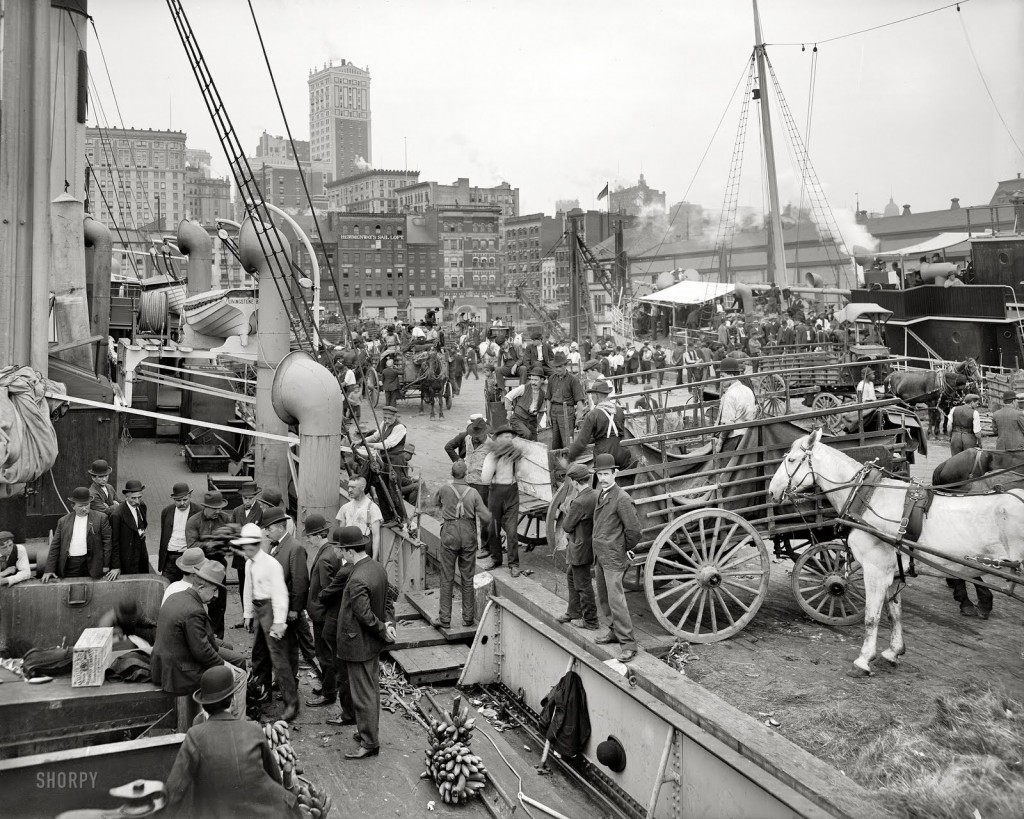
Look at the image above. Really look at it. This photo was taken in 1905. Let’s set the scene. Theodore Roosevelt is in the White House. The Wright Brothers have barely figured out how to keep a plane in the air. The world is formal. It is stiff. It is buttoned-up.

Men in 1905 didn’t dress casually. They wore suits. They wore long sleeves. They wore collars so stiff they could cut skin. Hats were mandatory. If you walked outside without a hat, you were practically naked. Look at the crowd in the photo. Look at the boat. Everyone is uniform. Everyone fits the era.

Except for him.

Center stage. The man with the white t-shirt. He is the anomaly. The glitch.

First, the hair. That is a Mohawk. A straight-up, shaved-side, punk rock Mohawk. Historians will try to tell you that this style existed in indigenous cultures for centuries. Sure. But on a white guy? On a casual boat ride in 1905 America? It’s unheard of. The Mohawk didn’t hit the mainstream counter-culture until the 1970s with the rise of the punk movement in London and New York. This guy looks like he just walked out of a CBGB show in 1977, not a steamboat ride at the turn of the century.

Then there is the shirt. Short sleeves. No collar. It looks like a modern Hanes undershirt. In 1905, men simply did not wear their underwear in public. It wasn’t done. It was scandalous. Yet here he sits, relaxed, looking completely out of place, surrounded by men in heavy wool jackets and bowler hats.

Skeptics try to wave this away. They say, “Maybe he was a stevedore taking a break.” Maybe. But does a dock worker style his hair with gel? He looks too clean. Too modern. We’d argue that this traveler probably punched in the wrong coordinates on his machine. He was aiming for a Sex Pistols concert and ended up on a banana boat.

But wait. Look closer.

There is something else in this photo. Something darker. Personally, we are way more worried about the figure sitting just in front of our punk rocker. In the foreground. The man in the hat.

Zoom in on his face. Look at the texture of his skin. Look at the side of his head. It doesn’t look right. It looks… veiny. Pulsating. Like his skull is too big for his skin. It looks like he is hiding a giant, throbbing brain under that fedora. To us, he looks exactly like a Talosian—those big-headed telepathic aliens from the original Star Trek pilot, “The Menagerie.”

Is it a trick of the light? A burn victim? Or are we looking at a meeting between a time traveler from the 1970s and an extraterrestrial observer, right there in the open in 1905? The more you look, the weirder it gets.

Case File #2: The Hipster Who Knew Too Much

If the Mohawk guy is the opening act, this next guy is the headliner. This is the photo that broke the internet. This is the image that keeps skeptics awake at night.

The Time Travelling Hipster.

Let’s look at the provenance. This isn’t a Photoshop job from Reddit. This is a legitimate photograph from the Bralorne Pioneer Museum in British Columbia, Canada. It was featured in their virtual exhibit, “Their Past Lives Here.” It was taken in 1941 at the reopening of the South Fork Bridge.

1941. World War II is raging. Fashion is utilitarian. Men wear suits, ties, and fedoras. Women wear modest skirts and hats. Look at the crowd. It is a sea of 1940s normality. Except for one man.

He stands tall. Too tall. He towers over the locals. And his outfit? It’s pure 21st-century Brooklyn.

The Glasses: He is wearing wraparound sunglasses with side shields. They look like modern Oakleys or glacier glasses. While sunglasses existed in the 40s, they were usually round wire-rims or aviators. These look molded from plastic. They look aggressive. They look modern.

The Shirt: Look at what he is wearing under that cardigan. It appears to be a faded, screen-printed T-shirt with a letter “M” or a logo on it. Graphic tees? In 1941? No way. Printed T-shirts didn’t become a thing until the 1950s, and they didn’t look like this until the 70s or 80s. It looks like comfortable cotton merch you’d buy at a concert.

The Camera: This is the smoking gun for many. Around his neck hangs a small, portable lens device. It looks surprisingly like a modern compact digital camera or perhaps a high-end 35mm from the late 20th century. The other man in the foreground is holding a camera too—but look at it. It’s a bulky, boxy thing that you have to look down into. The contrast is jarring.

Internet detectives went wild. “It’s a time traveler caught on camera in 1941! Finally, we have proof!”

Now, the debunkers came out in full force. They always do. They dug deep. They claimed the sunglasses were “safety glasses” used by welders. They claimed the shirt was a sweater emblem for the Montreal Maroons hockey team (hence the M). They claimed the camera was a rare Kodak Folding Pocket model.

But does that explain it? Does it explain the vibe?

Even if every item could theoretically exist in 1941, why is he wearing them all at once? Why does he carry himself with such modern swagger? Why does everyone else look like they are waiting for a ration book, while he looks like he is waiting for an Uber?

And here is the question that really cooks your noodle: Why there?

Why visit the reopening of a bridge in a tiny town in British Columbia? It’s not exactly the assassination of JFK or the building of the Pyramids. A cynical commenter once laughed at this, saying, “Who would waste a time machine trip on a bridge opening in Canada?”

But read this in Doc Brown’s voice: “Of course, simply because we know nothing happened there, right? But if we are considering time travel, how can we know if in some other timeline something historical happened right there?”

Maybe the bridge was supposed to collapse. Maybe that man didn’t just go to watch. Maybe he went to fix it. Maybe he saved the grandfather of someone who would go on to invent the very time machine he is using. The Butterfly Effect is real. Once you introduce the variable of time travel, the mundane becomes critical. A bridge in Canada could be the hinge upon which the fate of the world turns.

The Cell Phone in the Roaring Twenties

Let’s move from still images to moving pictures. This one is spooky because you can see the behavior. You can see the body language.

The year is 1928. The film is Charlie Chaplin’s classic, The Circus. We aren’t looking at the movie itself, but at the “behind the scenes” footage of the premiere at Mann’s Chinese Theatre in Hollywood. The camera pans across the crowd. It captures ordinary people walking by. Zebras. Horses. And then, her.

A large woman dressed in a heavy black coat and a hat that hides most of her face walks through the frame. She is alone. She is talking. And she is holding something to her ear.

Watch the clip. Look at her hand. She is cupping a small, thin, black object against her ear. Her mouth is moving. She is chatting away. She stops, turns, and keeps walking, still talking into the device.

I have studied this film for over a year now. I have shown it to over 100 people. I screened it at a film festival. I asked experts. No one can explain it. The body language is unmistakable to anyone living in the 21st century. It is the posture of a cell phone user. The cupped hand. The casual conversation with someone who isn’t there.

What are the theories?

Skeptics scream “Hearing Aid!” They point to the Western Electric carbon hearing aids of the time. Sure, those existed. But they were massive. They required a battery pack strapped to the body and wires running up the neck. And you didn’t talk into a hearing aid. You listened with it. Why is she talking?

Is she crazy? Just talking to herself while holding her hand to her face? Maybe. But the grip is so specific. It looks like a smartphone. My only theory—and the theory of many others—is simple: a time traveler on a mobile phone.

But this raises a terrifying technical question. If she is a time traveler with an iPhone, who is she talking to? There were no cell towers in 1928. No satellites. No 5G.

Unless…

Unless the device doesn’t use our primitive radio waves. If you have the technology to bend space-time, surely you have a communication device that can punch through the temporal barrier. Maybe she isn’t talking to someone in 1928. Maybe she is calling home. Maybe she’s leaving a voice memo for the future. “Arrival successful. The Chaplin premiere is loud. The clothes are itchy.”

The Ancient Astronaut of Salamanca

We leave the 20th century behind and go way back. To stone. To architecture. To things that cannot be photoshopped because they are carved into the bedrock of history.

Let’s go to Spain. The Salamanca Cathedral. This is a magnificent Gothic structure. Construction began in the 1500s and wrapped up in the 1700s. It is old. It is sacred. It is covered in intricate carvings of saints, demons, and animals.

And one astronaut.

You heard me. Carved clearly into the stone pillar near the entrance is a figure that is undeniably a 20th-century astronaut. He is wearing a bulky space suit. He has a helmet with a visor. He has the breathing tubes running from his backpack to his chest. He has the heavy moon boots with the thick tread.

How?

How could a stonemason in the 1600s carve a NASA astronaut? Did they see a vision? Did a traveler from the future land their ship in medieval Spain, inspire the locals, and then vanish?

This image circulates on conspiracy forums constantly. “Proof of Ancient Aliens!” “Proof of Time Travel!”

Now, we have to be honest here. There is an explanation for this one, but it is still fascinating. The cathedral underwent a massive restoration project in 1992. It is a tradition among stonemasons to add a “signature” of their current era when they restore a monument. The artisan, Jeronimo Garcia, chose an astronaut to represent the 20th century. He also carved a dragon eating an ice cream cone.

So, mystery solved? Perhaps. But consider this. Why an astronaut? Of all the symbols of the 20th century, why choose the one figure that represents leaving Earth? Leaving our time? It is a symbol of exploration. Maybe Garcia knew something. Maybe it was a subconscious choice.

Or maybe, just maybe, the official story is the cover-up. It is easy to say “It was added in 1992.” It shuts people up. But have you seen the weathering on that stone? It looks just as old as the saints next to it.

The John Titor Connection

You cannot talk about internet time travel mysteries without mentioning the name John Titor. In the early 2000s, a user appeared on message boards claiming to be a soldier from the year 2036. He didn’t just make vague predictions; he posted schematics of his time machine. He explained the physics (micro-singularities). He had a mission: he was sent back to 1975 to retrieve an IBM 5100 computer, which contained a hidden function needed to debug legacy code in the future.

Titor vanished as quickly as he arrived. But some of his predictions were eerily specific about civil unrest and shifting world powers. Was the “Hipster” in the 1941 photo an agent like Titor? Was the “Mohawk Man” a tourist? Was the Chaplin woman a temporal historian?

The evidence is scattered. It is messy. But it is there.

We look at these photos and we laugh. We rationalize. We say “It’s just a coincidence.” “It’s a trick of the light.” But deep down, a part of us wonders. The universe is vast. Physics is strange. Is it so impossible that the walls between now and then are thinner than we think?

Keep your eyes open. Look at old family albums. Watch the background of old newsreels. You never know who—or when—you might see.

Originally posted 2016-02-26 16:27:50. Republished by Blog Post Promoter