Home Unexplained Mysteries Ancient Mysteries Mystery surrounds cryptic sword inscription

Mystery surrounds cryptic sword inscription

0
65

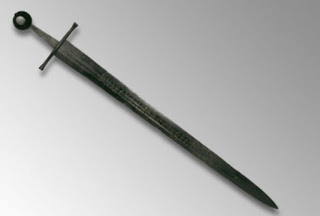
It was waiting in the mud. For six hundred years, it sat in the cold, dark silence of the River Witham, buried under centuries of silt and history. When workers finally dredged it up in 1825, near Lincoln, England, they didn’t just find a rusted piece of scrap metal. They found a killing machine. A pristine, double-edged knightly weapon that still looked ready to go to war.

But that wasn’t the scary part.

The scary part—the thing that keeps historians, cryptographers, and conspiracy theorists awake at night—is the message written on the steel. It isn’t English. It isn’t standard Latin. It’s a code. A sequence of letters inlaid in gold wire that, to this day, refuses to be broken.

The Ghost in the Steel

Look at it. This isn’t a ceremonial toy. It weighs 1.2 kg (2lb 10oz). It spans 964mm (38in) in length. It feels heavy in the hand, balanced for a specific purpose: striking from horseback. If you swung this with enough torque, you weren’t just bruising someone. You were slicing a human head in two. Cleanly.

It’s a weapon of the 13th Century. The 1200s. A time when England was burning. King John was losing his grip, the Magna Carta was being forced upon the crown, and the French were eyeing the throne. Violence was the language of the day.

And yet, amidst all that brutality, someone took the time to do something delicate. A master blacksmith heated the steel, etched a groove down the center of the blade, and hammered fine gold wire into the metal. He spelled out a sequence. Eighteen characters.

+NDXOXCHWDRGHDXORVI+

What does it mean? Why put it there? And why has every single attempt to crack it failed?

A Message to God or a Pact with Something Else?

Julian Harrison, a curator at the British Library, dropped a bombshell on the historical community a few years ago. He put the sword on display for the “Magna Carta: Law, Liberty, Legacy” exhibition and effectively challenged the world to solve the puzzle.

“An intriguing feature of this sword is an as yet indecipherable inscription,” Harrison noted. He kept it professional. But you can read between the lines. The British Library, an institution with access to some of the smartest minds on the planet, was stumped. They admitted that while it has been “speculated” to be a religious invocation, nobody actually knows. The language is unknown.

Think about that. We can read hieroglyphics. We’ve cracked the Enigma code. We understand dead languages spoken by civilizations that vanished thousands of years ago. But a sword from Lincolnshire? It remains a closed book.

The “Code” Breakers: Internet Detectives vs. Medieval Monks

When the British Library put the code online, the internet went wild. It was a digital gold rush. Everyone from serious academic linguists to guys in their basements wearing tinfoil hats took a shot at the River Witham sword.

The theories ranged from the plausible to the insane.

  • The Welsh Theory: Some armchair detectives suggested it wasn’t Latin at all, but a phonetic version of Old Welsh. A battle cry, perhaps?
  • The Sicily Connection: Others pointed to the heavy Sicilian trade routes of the 1200s, suggesting the characters are a bastardized mix of languages from the Mediterranean.
  • The Gibberish Theory: This is the most boring, but also the most unsettling possibility. What if the blacksmith was illiterate? What if a rich knight said, “Put a spell on my sword,” and the smith just hammered in random shapes that looked like letters to get paid?

But the experts don’t buy the gibberish theory. The gold work is too precise. You don’t waste gold on typos.

The Best Lead We Have: The “ND” Factor

Marc van Hasselt from Utrecht University stepped into the ring with some heavy academic firepower. He suggested that we stop looking at the sword as a unique unicorn and start seeing it as part of a pack.

“The River Witham sword could be part of a large international family,” Hasselt explained. He found a dozen other swords across Europe—from Sweden to the Netherlands—that feature remarkably similar nonsense words. It was a trend. The iPhone of the 13th century.

Hasselt’s breakdown focuses on the first two letters: ND.

In the shorthand of medieval Latin scribes, who loved acronyms because parchment (and gold wire) was expensive, ND often stood for Nostrum Dominus (Our Lord) or Nomine Domini (In the Name of the Lord).

Okay, that tracks. A knight wants God on his side before he rides out to murder people. Standard operating procedure for the Crusades era.

Then comes the XOX. No, the medieval knight wasn’t sending “hugs and kisses” to his enemies. In religious iconography, X often represents Christ (from the Greek letter Chi). So, XOX could be a reference to the Holy Trinity. Father, Son, Holy Ghost.

So, the working theory looks something like this:

“In the name of the Lord, Christ… [unintelligible gibberish]… Amen.”

But that middle part? The CHWDRGHD? That is where the theory falls apart. It’s a linguistic brick wall. Is it the name of a saint? A specific prayer lost to time? Or is it the name of the owner, coded so that only he knew the true power of the blade?

The River’s Secret: Why Throw it Away?

Here is the part of the story that doesn’t make sense. Swords in the 13th century were not cheap. They were the Ferraris of their day. A sword like this, with custom gold inlay and a finely tempered blade, would have cost a fortune. It was a status symbol. A legacy item to pass down to your son.

So why was it at the bottom of a river?

It wasn’t found near a known battle site. It wasn’t found in a shipwreck. It was found in the River Witham, a body of water that has a very strange reputation among archaeologists.

The Witham is famous for “ritual deposition.” For thousands of years, people have thrown valuable things into this river. Bronze Age shields. Viking tools. And medieval swords. This wasn’t an accident. The owner didn’t trip and drop it.

He threw it in. On purpose.

The “Excalibur” Complex

Why toss a super-weapon? There are dark theories here.

1. The Death of the Knight: When a knight died, sometimes his sword was considered “dead” too. It was cast into the water to prevent anyone else from using it. A sword bound to one soul.

2. A Bargain with God: Maybe the inscription +NDXOXCHWDRGHDXORVI+ wasn’t a passive prayer. Maybe it was a vow. “Grant me victory in this invasion, and I will give you my sword.” The knight won, survived the bloodbath of Normandy in 1203, returned home, and paid his debt to the river.

3. The Curse: This is where we get into the realm of high strangeness. Did the sword bring bad luck? Was it “cursed” leading the owner to dispose of it in running water—a classic method for cleansing supernatural attachments?

The Templar Connection?

We cannot talk about secret codes, the 1200s, and Lincolnshire without bringing up the Knights Templar. The Templars had a massive presence in Lincolnshire during this exact period. They were warrior-monks, bankers, and keepers of secrets.

The Templars were obsessed with codes. They used ciphers to transfer money and orders across Europe. Is it possible that the CHWDRGHD sequence is a Templar cipher?

Look at the letters again. W… D… R… G… H…

Some amateur sleuths have tried to map these to the names of Templar Grand Masters or specific commanderies. If this was a Templar blade, the “religious invocation” might actually be a badge of rank or a key to a safe house. When the Templars were persecuted and hunted down a century later, items like this would have been incriminating evidence. Perhaps it was thrown in the river not as an offering, but to hide the truth.

Magical Protection and the “Double Cross”

Notice the crosses at the beginning and end of the string? +ND…VI+.

This is standard for magical amulets. In the medieval mind, the cross acted as a seal. It locked the magic in. Whatever power was summoned by those letters, it was contained within the steel by those two crosses. The blade became a battery of spiritual energy.

If you were a soldier in 1203, marching into the mud of Normandy to fight the French, you didn’t trust armor alone. You wanted magic. You wanted God’s wrath in your hand. This sword was designed to be a conduit for that power.

The Blade is Still Sharp

Currently, the sword rests. It’s on loan to the British Library, sitting alongside manuscripts of the Grandes Chroniques de France. It sits next to pictures of men dying in the mud of Normandy, men who wielded weapons exactly like this one.

The steel is pitted, but the gold is bright. It taunts us. It’s a message from the grave that we are too deaf to hear.

Marc van Hasselt and the team at Utrecht are still working on the puzzle. They are using digital comparisons, looking at letter curves from swords found in Germany and Finland, trying to find the “handwriting” of the specific blacksmith.

“By putting together pieces of the puzzle from all over Europe, we might come a little bit closer to solving the mystery,” Hasselt says. He’s hopeful. “And even if we cannot decipher the inscriptions completely, they might bring us a little closer to understanding our ancestors.”

But maybe some things aren’t meant to be read. Maybe the knight who commissioned this blade, who watched the smith hammer the gold into the glowing steel, intended for the message to be between him and his God.

Or perhaps, just perhaps, we’re reading it wrong because we’re looking for Latin, when we should be looking for a code that hasn’t been invented yet. The River Witham sword keeps its secrets. And until someone cracks the code, it remains one of the most beautiful, deadly mysteries in history.

What do you think the letters mean? Is it a prayer? A curse? Or coordinates to something else entirely?

Originally posted 2015-09-18 15:41:04. Republished by Blog Post Promoter