Tuesday, May 12, 2026
HomeStrange mystery of the oldest fossil footprints!

Strange mystery of the oldest fossil footprints!

The Fossil That Shatters History: A Sandal Print in 500-Million-Year-Old Rock?

Some things just shouldn’t exist. They’re square pegs in the round hole of history, glitches in the timeline that make you question everything you thought you knew. And then there are things so utterly impossible, so defiantly out of place, that they threaten to burn down the entire library of accepted science.

This is a story about one of those things.

A rock.

But not just any rock. A slab of stone that holds a secret. A secret that could rewrite our origins, prove we are not alone, or suggest that time itself is not the straight line we believe it to be. This is the story of the Meister Print—a fossil that looks for all the world like a modern shoe print, complete with a crushed trilobite under its heel, found in rock that is over 500 million years old.

Let that sink in. Five. Hundred. Million. Years.

That’s long before the dinosaurs. Long before the first fish crawled onto land. It was a time when the most complex life on Earth was scuttling across the ocean floor. And yet, there it is. A footprint. A footprint that has no business being there.

A Summer Day, A Fateful Swing of a Hammer

The year was 1968. The place: Antelope Springs, a desolate, fossil-rich pocket of Utah, 43 miles from the town of Delta. William J. Meister, an amateur fossil collector and draftsman, was out hunting for trilobites with his family. It was a hobby, a way to connect with the deep past buried right under his feet.

He had no idea he was about to collide with it.

He spotted a promising-looking slab of Wheeler shale, a formation known for its treasure trove of Cambrian-era fossils. With a practiced swing of his rock hammer, he struck the two-inch-thick stone. It split open perfectly. Like a book.

And on the pages of that stone book was a story that no one was prepared to read.

Strange mystery of the oldest fossil footprints!

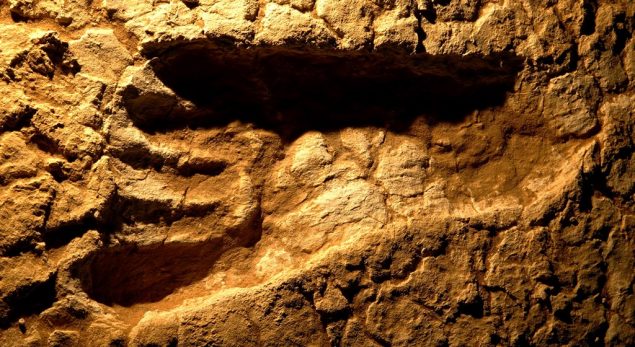
Meister stared. He must have blinked, rubbed his eyes, and looked again. There, on one side of the newly opened rock, was what appeared to be the outline of a shoe. A sandal, to be precise. It was 10-1/4 inches long, 3-1/2 inches wide. The heel was pressed in slightly deeper than the sole. It was undeniably, shockingly, the mark of a right foot.

But that wasn’t even the most mind-bending part.

Right there, crushed inside the heel print, were the distinct fossils of several small trilobites. They weren’t just near the print. They were *in* it. As if a shoe-wearing person had walked across an ancient seabed and, with a single, careless step, flattened these creatures into the mud that would one day become stone.

The other half of the slab held a perfect mold of the scene. There was no ambiguity. The evidence was right there in his hands.

Deep Dive: A Timeline Meltdown

To understand just how radical this discovery is, you have to understand the timeline. Not just our timeline, but Earth’s timeline.

Trilobites were incredible creatures. Think of them as ancient, armored sea-bugs, relatives of modern crabs and spiders. They were one of Earth’s first great success stories. They appeared during the “Cambrian Explosion” around 541 million years ago and dominated the oceans for over 250 million years. They saw entire continents shift and move. Then, they vanished completely during the “Great Dying” extinction event, about 252 million years ago. That’s 20 million years *before* the first dinosaurs even showed up.

Now, where do humans fit in? According to the standard model of evolution, our story is much, much shorter. Our earliest human-like ancestors, the hominids, appeared maybe 6 million years ago. Our own species, Homo sapiens, has only been around for about 300,000 years. And well-made shoes? We’re talking only the last few thousand years.

So, the math is simple. And horrifying.

There is a gap of at least 250 million years—a quarter of a billion years!—between the last living trilobite and the first shoemaker. Finding a human sandal print on top of a trilobite is not like finding a Viking helmet in North America. It’s like finding a smartphone embedded in the fossilized jaw of a Tyrannosaurus Rex. It’s an artifact so out of place it basically throws a grenade into every textbook on the planet.

The Experts Panic: Denial and Strange Excuses

Meister knew he had something explosive. He took the rock to Melvin Cook, a professor of metallurgy at the University of Utah. Cook was intrigued and urged him to show it to the university’s geologists. This, Meister thought, would be the moment of validation.

He was wrong.

He couldn’t find a single geologist on campus willing to seriously examine the specimen. They looked, they scoffed, they walked away. The implications were too much. It was easier to dismiss it than to confront what it meant.

Frustrated, Meister turned to the press. The Deseret News ran the story, and soon, it was national news. The academic world was forced to respond. James Madsen, then curator of the University of Utah’s Museum of Earth Science, delivered a statement that perfectly captured the mainstream position.

“There were no men 600 million years ago,” he said flatly. “Neither were there monkeys or bears or ground sloths to make pseudohuman tracks. What man-thing could possibly have been walking about on this planet before vertebrates even evolved?”

His conclusion? It had to be a natural formation. A trick of erosion. An accident. He couldn’t explain *how* that accident could perfectly mimic a size 8 sandal crushing a bug, but that was his story. Another academic, Dr. Jesse Jennings, suggested that perhaps one large trilobite had simply come to rest on top of a few smaller ones, creating the shoe-like shape. A strange theory, considering it looked nothing like that.

Think about that. An educated scientist found it more plausible that a dead sea creature coincidentally arranged itself into the shape of a shoe than to consider the alternative staring him in the face.

And Then They Found More…

If the Meister Print was a lone anomaly, it could perhaps be dismissed. A geological freak of nature. A one-in-a-billion fluke.

But it wasn’t alone.

The publicity drew other curious minds to Antelope Springs. In July 1968, only a month after Meister’s find, a consulting geologist from Arizona named Dr. Clifford Burdick went to investigate. He began splitting rocks and, incredibly, found another impossible print. This one was different. It was smaller. Barefoot.

“The impression,” Burdick reported, “was about six inches in length with the toes spreading, as if the child had never yet worn shoes… There does not appear to be much of an arch, and the big toe is not prominent.”

A child’s footprint. Fossilized in half-billion-year-old rock.

Burdick was a geologist. He knew what he was looking at. He pointed out how the rock layers, the fine laminations in the shale, were clearly bent downwards under the toes, exactly as you would expect from a weight pressing into soft mud. This wasn’t a surface feature or a random flaking of the rock. This was an impression. A track. One geologist Burdick consulted agreed it looked human; a paleontologist predictably claimed it couldn’t be biological.

The plot thickened again in August of that same year. Mr. Dean Bitter, an educator in Salt Lake City, was also exploring the now-famous site. He found two more prints of what appeared to be shoes or sandals in the same ancient shale. The story was no longer about a single, questionable rock. It was becoming a pattern.

What Are We Looking At? Exploring the Mind-Bending Theories

When you have evidence that so violently contradicts the official story, you’re left with only a few possibilities. All of them are wild. All of them change everything.

Theory 1: The Time Traveler’s Mistake

Could this be the ultimate tourist foul? Imagine someone from our distant future, clad in sandals, taking a trip back to the Cambrian period to see the dawn of complex life. They step out of their machine, take a few steps across the primordial mudflats, and *squish*. They accidentally crush a trilobite, leaving an impression that would be discovered 500 million years later by William Meister. It’s a classic sci-fi trope, but could it be real? This theory neatly explains the modern-looking shoe and the ancient context, but it opens a Pandora’s Box of paradoxes.

Theory 2: The Ancient Alien Visitor

Maybe the footprint isn’t human at all. Not from our future, anyway. What if an intelligent, bipedal species from another world visited Earth when our planet was still young? Perhaps they were explorers, scientists, or just cosmic sightseers. They walked our shores, breathed our ancient air, and left behind a single, fleeting trace of their presence. This would explain the advanced footwear without breaking our own evolutionary timeline. We weren’t here yet. But maybe someone else was.

Theory 3: The Lost History of a Forgotten World

This is perhaps the most disturbing possibility. What if our entire understanding of history is wrong? Radically, fundamentally wrong. What if an advanced, human-like civilization existed on Earth hundreds of millions of years ago? A civilization that rose, built cities, wore shoes, and then vanished so completely that almost no trace remains, save for a few impossible fossils. This is related to the “Silurian Hypothesis,” a thought experiment that asks if we could even detect an industrial civilization that existed millions of years ago. After so much time, all their cities and works would have turned to dust and been subducted into the Earth’s crust. All that might be left is a strange chemical signature in a layer of rock… or a fossilized footprint.

Theory 4: The Skeptic’s Corner (A Trick of Rock and Light)

Of course, there is the “official” explanation. The mainstream scientific view holds that the Meister Print is a geological anomaly, a product of spalling, where a chunk of the rock has naturally flaked away in a shape that, through sheer coincidence and wishful thinking, looks like a footprint. They argue that the “crushed trilobites” are just randomly placed fossils that happened to be in the part of the rock that broke off. It is, they contend, a classic case of pareidolia—our brain’s tendency to see patterns (like faces in the clouds or footprints in rocks) where none exist. But you have to ask yourself: what are the odds? The odds of a rock flaking off into a perfect shoe shape, with a deeper heel, crushing trilobites inside its outline, and then having *other* similar prints found nearby? Is the “coincidence” theory really the most logical explanation here?

The Mystery Endures in the Digital Age

For decades, the Meister Print was a fringe mystery, kept alive in books about the unexplained. But the internet has given it a new life. Today, photos of the print are dissected on forums, debated in comment sections, and featured in countless YouTube documentaries. It’s a cornerstone exhibit in the digital museum of Out-of-Place Artifacts (OOPArts).

It stands alongside other historical enigmas like the London Hammer (a modern-looking hammer found in 100-million-year-old rock) and the Coso Artifact (what appeared to be a spark plug found inside a 500,000-year-old geode). Alone, each one can be dismissed. Together, they begin to paint a very strange picture. They whisper that history might be far more complex, and far weirder, than we know.

The rock itself now resides in a creationist museum, which has unfortunately led many in the scientific community to dismiss it even more forcefully. But the location of the fossil doesn’t change what it is, or the questions it asks. It doesn’t fill in the 500-million-year gap.

So, what do you see when you look at that photograph? Is it a trick of light and shadow on a cleverly broken rock? An illusion we want to believe?

Or is it something more? A ghost from the deep past. A footprint from the far future. A calling card from another world. The only thing we know for sure is that on a summer day in 1968, William Meister cracked open a rock, and it’s been cracking open our comfortable view of the world ever since.

Arindam Mukherjee
Arindam Mukherjee
Arindam loves aliens, mysteries and pursing his interest in the area of hacking as a technical writer at 'Planet wank'. You can catch him at his social profiles anytime.
RELATED ARTICLES

1 COMMENT

- Advertisment -

Most Popular

Recent Comments

Warren Pan Abbott on The legend of the Devil Monkey !
chris davies on The McPherson Tape Mystery
Reed Reedly on ET has Internet!
Bea Houseoffashion on Proof Of Time Travellers – Gallery
Marcus2012 on ET has Internet!
Reed Reedly on ET has Internet!
LaughsAtConspiracyNuts on The 9/11 Conspiracy – Myths and Facts
Alex Sliverman on Did the ancients fly?
Doctor Wholigan on Time Traveler in 1938 film
chris davies on The McPherson Tape Mystery
Archie1954 on 10 secret UFO hideouts
chris davies on Ghosts of flight 401
Marcus2012 on ET has Internet!
jason Macdonald on Proof of Time Travel? – China
chris davies on Long-Lost Pyramids Found?
Reed Reedly on ET has Internet!
Milkman on Connected Universe
Tenmiles on Baigong Pipes Mystery
Simon Foster on Sirius – The Documentary
From the 1st April on 2013 – Alien Contact date ?
SkyWatcher on Is ET ignoring us?
I Come From The Future on Obama to make UFO Alien disclouser soon ?
Just another person on 2013 – Alien Contact date ?
Malcolm Windowcleaner on The strange case of Rudolph Fentz
Mason Servio on Strange Things on Mars
Marke Wisdom Seeker on What will we find as arctic melts?
Andrea A Elisabeth Levyne on Aliens Captured in Varginha, Brazil
Mitch Grouyeki on Amazing Space Shuttle pictures