
Home Alien Life Mysterious Artifacts That Are Allegedly Alien

Mysterious Artifacts That Are Allegedly Alien

1
68

They Were Here: The Forbidden Artifacts That Rewrite Human History

What if everything you learned in history class was a lie? A carefully curated story, stripped of the parts that don’t make sense. The parts that are too strange. Too advanced. The parts that point to a shocking truth: we were not alone. And maybe, we still aren’t.

Official history gives us a neat, clean timeline. Stone tools. Fire. The wheel. Slow, steady progress. But scattered across the globe, hidden in museum basements and buried under layers of academic denial, are objects that spit in the face of that timeline. They are the glitches in the matrix of our past. Out-of-place artifacts—OOPArts—so technologically advanced, so profoundly impossible for their time, that they leave us with only two choices: either our ancestors were geniuses far beyond our comprehension, or they had help.

This isn’t just about little green men. This is about physical evidence. Tangible objects you can hold in your hand. Objects that ask questions the mainstream is terrified to answer. Today, we’re pulling back the curtain. We’re examining the relics that shouldn’t exist. Prepare yourself. The rabbit hole is deeper than you can possibly imagine.

Life From a Fireball: The Sri Lankan Meteorite Controversy

December 29, 2012. A sleepy evening in the province of Polonnaruwa, Sri Lanka, is shattered. A brilliant fireball screams across the night sky, exploding into fragments that rain down upon the rice paddies below. Villagers collect the strange, porous stones. To them, they are just curious rocks from the heavens. To a small group of scientists, they were something more. Much more.

20

When researchers placed fragments of the Polonnaruwa meteorite under a scanning electron microscope, their jaws hit the floor. Embedded deep within the rock’s matrix were microscopic, biological structures. Not just random carbon signatures. These were organized, complex, and looked shockingly familiar. They looked like fossils. Specifically, fossils of algae and diatoms.

Fossils. In a rock that just fell from space.

A Deep Dive into Panspermia

This is where Professor Chandra Wickramasinghe enters the picture. A brilliant but controversial astronomer, Wickramasinghe has been a long-time champion of a theory called “panspermia.” The idea is simple, yet its implications are staggering. Panspermia suggests that life itself—the fundamental building blocks, the microbes, the very seeds of biology—is not unique to Earth. It exists throughout the cosmos, drifting through the void on comets and meteorites, waiting for a fertile planet to crash into. Life, in this view, is a cosmic infection. And we are the result.

For Wickramasinghe and his team, the Polonnaruwa meteorite wasn’t just a rock; it was a smoking gun. They claimed the fossils inside were undeniably extraterrestrial. They argued the complex, filamentous structures were so deeply embedded that they couldn’t possibly be a result of earthly contamination after the crash. This was it. The proof that life is universal.

The Establishment Strikes Back

The scientific establishment, predictably, was not impressed. They fired back with a vengeance. Critics immediately pointed out that the fossils discovered were… freshwater diatoms. Species almost identical to ones found in the rivers and ponds of Sri Lanka. Their explanation? The meteorite, being highly porous, simply landed in a puddle or rice paddy and acted like a sponge, soaking up modern terrestrial microbes. Contamination. Case closed.

But the story doesn’t end there. Wickramasinghe’s team doubled down, performing isotope analysis that, they claimed, proved the rock and its fossilized passengers were from beyond our world. The debate rages on in quiet corners of the internet and academia. Is it definitive proof of life from space? Or is it just a muddy rock? What if both are true? What if life on Earth began exactly this way, with a cosmic delivery billions of years ago, and this was just another, more recent, shipment?

The 300-Million-Year-Old Machine in a Lump of Coal

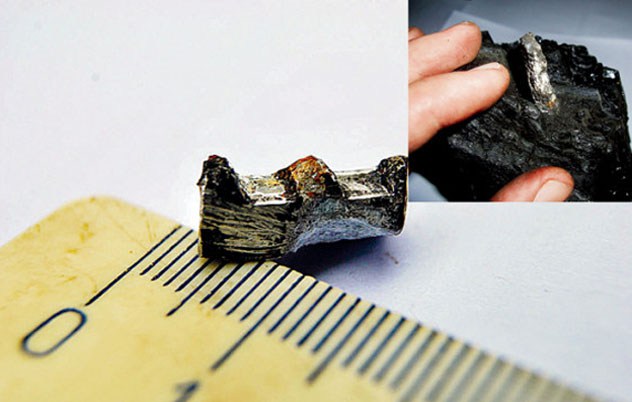
Imagine this. It’s a cold day in Vladivostok, Russia. A local man named Dmitry is getting ready to light a fire. He picks up a regular lump of coal, something he’s done a thousand times before. But this time, something is different. Something is sticking out of it. A small, metallic object with regular teeth, like a piece of a gear. Strange.

21

Curiosity piqued, he carefully extracts the object and takes it to scientists. Their analysis would send shockwaves through the fringe science community. The piece of coal it was embedded in? From the Carboniferous period. 300 million years old. And the metal object? It was 98% aluminum and 2% magnesium. A man-made alloy.

Let that sink in for a moment. Three. Hundred. Million. Years. Old. This was a time before the dinosaurs even walked the Earth. A time of giant insects and vast, swampy forests that would eventually become the coal beds of today. According to our history books, the most advanced life forms were primitive amphibians. There were no humans. No industry. Nothing that could manufacture a precision-engineered aluminum gear.

An Impossible Metal

The aluminum itself is the biggest red flag. Humans didn’t figure out how to produce industrial aluminum until 1825. Why? Because aluminum almost never appears in its pure, metallic form in nature. It’s always bonded with other elements in ores like bauxite. Extracting it requires an enormous amount of electricity and a complex process called electrolysis. It is, for all intents and purposes, a modern metal.

Yet here it was, a piece of refined aluminum, embedded in 300-million-year-old coal. How? The shape is just as baffling. It’s not a random lump. It’s a toothed rail, a piece of a machine. Some have compared its shape to parts used in modern microscopes or other delicate electronic devices.

20.5

The conclusion for conspiracy theorists and ancient alien proponents was immediate and obvious: this was a piece of an alien spacecraft or probe that crashed on Earth hundreds of millions of years ago. A tiny fragment of hyper-advanced technology, lost to time, waiting in a lump of coal to be discovered.

Skeptics, of course, cry foul. They suggest it could be a piece of modern mining equipment that broke off and was somehow pressed into a loose piece of coal. A hoax is always a possibility. Others have tried to claim it’s a fossil of a sea creature called a Crinoid, but the metallic composition and regular, machined teeth make that explanation feel desperately weak. The official scientists remain cautious, wanting to run more tests. But the questions hang in the air, thick and heavy. Who was making aluminum alloys when our ancestors were still crawling out of the sea?

Did Ancient Gods Fly Supersonic Jets?

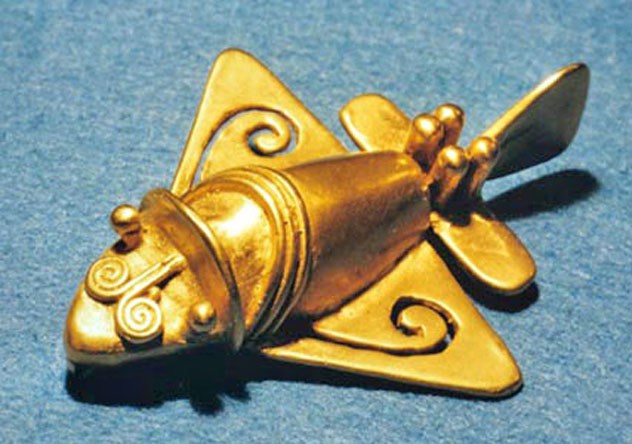
Deep in the museums of Colombia and Costa Rica lie a collection of small, golden objects. For decades, they were labeled “zoomorphic,” meaning they were assumed to be stylized representations of animals. Insects, birds, or fish. That was the safe, boring, official explanation. But then, someone looked closer. And they saw something that wasn’t an animal at all.

22

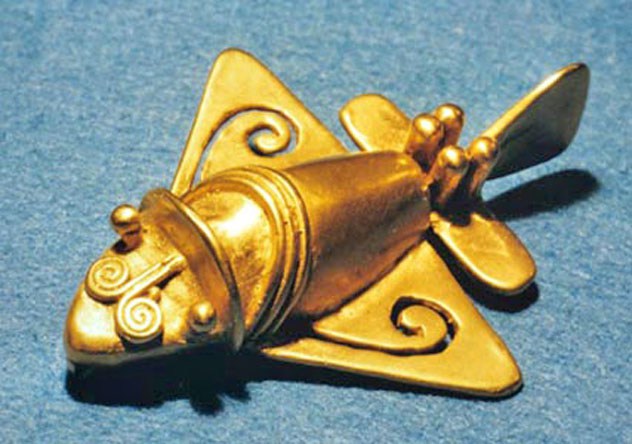
These artifacts, now known as the “Quimbaya Artifacts” or “Ancient Aeroplanes,” are over a thousand years old. And they look, for all the world, like modern jet aircraft.

Look at the features. They have a distinct fuselage. They have triangular, delta-shaped wings that look strikingly similar to those on a Concorde or a modern fighter jet. Most damning of all, they have a vertical stabilizer. A tail fin. This is the part that breaks the “it’s a bird” theory. No bird, fish, or insect on planet Earth has a single, upright, vertical tail fin like an airplane. It’s a feature specifically for aerodynamic stability in powered flight.

Taking the Theory to the Skies

This observation remained a fringe theory for years, the stuff of late-night documentaries. Then, in the 1990s, two German aeronautical engineers, Peter Belting and Conrad Lübbers, decided to put the theory to the test. They constructed exact, scaled-up radio-controlled models of the most famous of these golden trinkets. They fitted them with propellers and small engines.

The result? They flew. Perfectly.

The models were not just stable; they were capable of high-speed aerobatic maneuvers. The ancient design, it turned out, was perfectly aerodynamic. This stunning demonstration blew the doors wide open. What were the ancient Quimbaya people depicting? Were they brilliant aeronautical engineers who discovered the principles of flight a millennium before the Wright Brothers? Or were they a cargo cult, creating golden replicas of the incredible flying machines they saw their “gods” using?

23

A flying space ship?

The mainstream explanation remains stubbornly fixed on stylized animals. They say the beauty is in the eye of the beholder. But when you look at these objects, it’s hard to un-see the machine. It makes you wonder what other technologies, what other truths, are hiding in plain sight, dismissed as primitive art.

Whispers in Stone: The Faces of Our Visitors

It’s one thing to find technology. It’s another thing entirely to find portraits.

Around the world, ancient art and statuary feature bizarre figures that bear little resemblance to human beings. They are often depicted wearing strange suits, helmets, and looking out with large, almond-shaped eyes. Are these just symbolic representations of gods, or are they eyewitness sketches of ancient astronauts?

24

Many Believe That This Ancient Statue Represents An Alien Astronaut, again its 0ver 1500 years old

Take the famous 1,500-year-old “astronaut” statue discovered near Kiev. This small, stone figurine depicts a being encased in what looks for all the world like a sealed, pressurized suit. A bulky helmet covers its head, with simple circles for eyes and a breathing apparatus over the mouth. Why would an artist in the 6th century create such a figure? What in their world could have possibly inspired this? It looks more like a 1960s cosmonaut than any historical warrior or priest.

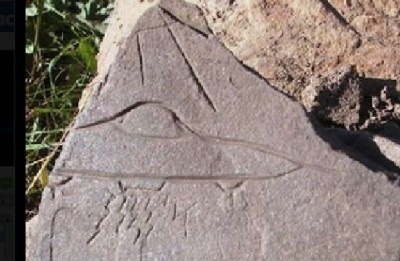
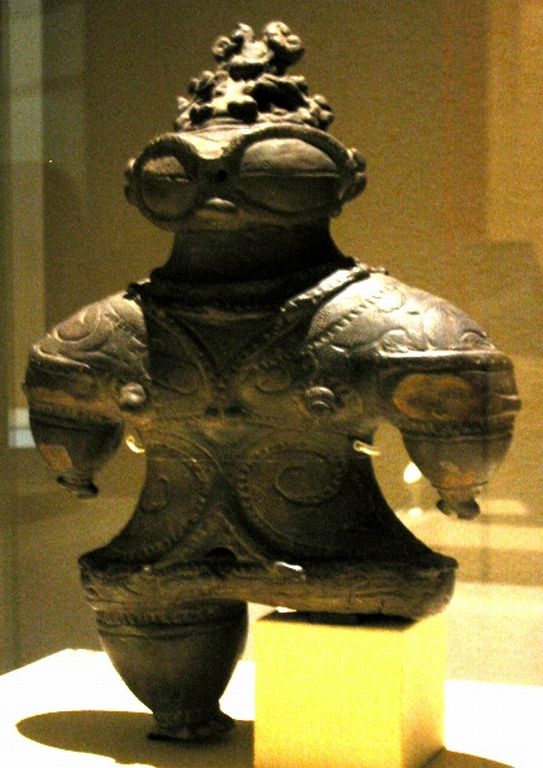
The evidence doesn’t stop there. We have the Lolladoff Plate from Nepal, a stone disc thousands of years old that appears to show a classic “Grey” alien and a flying saucer. There are the Wandjina cave paintings of Australia, with their haloed, mouthless figures and huge black eyes, which the aboriginal people explicitly say were “sky-beings.” From the Dogu figurines of Jomon period Japan with their goggled eyes and “space suits,” to carvings in Mayan temples showing kings at the controls of complex machinery, the pattern is everywhere.

26

So how did ancient man make these?

Each individual case can be dismissed. “It’s a ritual mask.” “It’s a stylized animal.” “It’s a coincidence.” But when you lay all the evidence side-by-side, a chilling picture begins to form. The sheer volume of these anomalies from every corner of the ancient world becomes impossible to ignore. It stops feeling like a collection of coincidences and starts feeling like a chorus, all singing the same song. A song about powerful beings who came from the sky, shared their knowledge, and were remembered for millennia as gods.

Are these artifacts hoaxes? Misinterpretations? Or are they the breadcrumbs left behind on purpose? A trail leading us to a bigger, more fantastic version of our own story. The evidence is out there, carved in stone and forged in impossible metals. The only question is, are you willing to see it?

Originally posted 2016-08-12 01:18:58. Republished by Blog Post Promoter