Thursday, May 7, 2026
HomeUnexplained MysteriesThe strange and creepy Roanoke Cave Mystery

The strange and creepy Roanoke Cave Mystery

The OTHER Roanoke Mystery: The Sealed Cave, Lost Children, and the Phantom in Black

Forget everything you think you know about Roanoke. No, not that one. Not the 16th-century colony that vanished into thin air, leaving only the cryptic word “CROATOAN” carved into a post. We’re going deeper. We’re going underground.

There’s another Roanoke mystery. One buried not in the sands of North Carolina, but in the heart of America—Kansas City, Missouri. It’s a story whispered in quiet neighborhoods, a local legend that refuses to die, centered on a place that has been physically, deliberately, and mysteriously sealed off from the world.

A cave.

A cave with a dark reputation. A cave that locals say swallowed children whole. A cave supposedly haunted by a tall, shadowy figure who promised treasure and delivered only terror.

This isn’t just a local ghost story. This is a rabbit hole of missing newspaper clippings, contradictory timelines, and a chilling question that hangs heavy in the Missouri air: What is being hidden behind that wall of stone?

A Park of Deceptive Peace

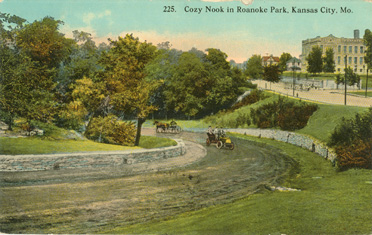
Roanoke Park in Kansas City feels like a slice of forgotten wilderness tucked inside a bustling city. It’s 36 acres of rugged beauty. Wooded ravines slice through the landscape, flanked by weathered stone cliffs. Picturesque homes, built right into the bluffs, peek through the trees, their residents likely unaware of the history churning just beneath their feet.

It’s peaceful. Quiet. The kind of place you’d walk your dog or have a picnic.

But find your way to the old, neglected tennis courts, and you’ll feel a shift in the air. Here, built into the rock face, is the scar of a story someone tried to end. A crude, but effective, stone wall plugs a gaping maw in the earth.

This is the entrance. Or, it was.

pic

This is the Roanoke Cave. And it is locked tight.

There is almost zero official information about this place. No historical markers. No tourist pamphlets. The State of Missouri’s Division of Geology and Land Survey officially acknowledges its existence—they have the GPS coordinates on file—but their records are a black hole. No maps. No history. No explanation for the seal. Just a pin on a map, marking a void.

Why seal a cave? The official story, if you can even call it that, is safety. But the unofficial stories, the ones passed down through generations, paint a far more sinister picture.

Deep Dive: The Outlaw’s Ghost and Buried Gold

Before we even get to the lost children, we have to talk about the cave’s most famous alleged resident: Jesse James.

Yes, *that* Jesse James. The legendary outlaw, bank robber, and Confederate guerrilla who terrorized the Midwest in the post-Civil War era. Local legend has long claimed that this cave system was part of his vast network of hideouts. The story goes that these tunnels connect to the larger, more famous Jesse James Cave system, providing the perfect underground highway for an outlaw on the run.

Does it hold water? Let’s break it down.

Who was Jesse James?

Jesse Woodson James was a product of a violent time. A Missouri native, he and his brother Frank were Confederate bushwhackers during the Civil War, learning a brutal brand of guerilla warfare. After the war, they applied those skills to robbing banks, trains, and stagecoaches. They were celebrities of their day—part folk hero, part boogeyman. And they were masters of evasion, using the rugged Missouri landscape to their advantage.

A Cavernous Advantage

For an outlaw gang, a sprawling cave network would be an unbelievable strategic asset. It’s a natural fortress. A place to hide from posses, stash loot, and vanish without a trace. The geography of Missouri, with its limestone bluffs and karst topography, is riddled with caves. It’s not just possible that James used them; it’s highly probable.

The legend of the Roanoke Cave as a hideout for Jesse James adds a layer of romantic danger to the place. It seeds the idea of hidden treasure. Of sacks of gold coins and stolen loot, just waiting in some forgotten chamber. And what better way to lure curious children into the dark?

Whispers from the 1940s: The Man in Black

The most detailed and terrifying accounts of the Roanoke Cave come from a more recent, more relatable time: the post-World War II boom. The 1940s and 50s. A time of renewed optimism, when kids played outside from dawn till dusk, and the horrors of the world felt distant.

But in this Kansas City neighborhood, a horror was lurking right below the surface.

The story, pieced together from the memories of those who lived there, goes like this.

Two young boys from the neighborhood went missing. Vanished. One moment they were playing near the park, the next, they were gone. Panic set in. This wasn’t supposed to happen here. The entire community turned out. For three days and three agonizing nights, they searched. They combed the woods. They called the boys’ names until their voices were raw. They searched the caves and the tunnels, their lantern beams cutting through the oppressive, silent dark.

It was hopeless.

Then, on the evening of the third day, a local man, pushing deeper into the cave system than anyone else dared, heard a faint sound. He followed it through a narrow, claustrophobic passage and found them. The two boys. Huddled together. Terrified, dehydrated, but alive.

The town celebrated. A miracle. But when the boys were finally able to speak, their story sent a fresh wave of ice through the community’s veins.

“He Promised Us Treasure”

They hadn’t just wandered in and gotten lost. They were led.

The boys claimed they were approached by a man. A very tall man, dressed all in black. He carried a light, and his voice was kind. He told them he knew a secret. He knew the location of Jesse James’s hidden treasure, deep within the cave. He would show them.

Trusting him, they followed his light into the earth. They went deeper and deeper, twisting through passages they could never hope to remember. Then, in the suffocating blackness far from the entrance, he did the unthinkable.

He just… vanished. His light winked out, and he was gone. Plunging the boys into absolute, terrifying darkness, leaving them alone and hopelessly lost.

Who was this man? A cruel prankster? A kidnapper who got spooked? Or something else entirely? The story became a cautionary tale, a local boogeyman used to keep kids away from the dangerous cave. But the questions remained. The description of the tall, dark-clad man who leads people to their doom is an archetype that echoes in folklore around the world. What did those boys actually see down there?

A Deeper, Darker History

As chilling as the 1940s incident is, it might just be a single chapter in a much longer, bloodier book. Older legends, dating back to the 1850s and 60s—the era of Jesse James himself—speak of other children.

At least four of them.

The details are murky, lost to the fog of time and the chaos of the Civil War. But the core of the legend is unwavering: four children from the area disappeared over the course of that decade. One by one. They were never seen again. No bodies were ever found. The assumption at the time was simple and tragic. They wandered into the cave and never found their way out.

But in the context of the Man in Black, that assumption feels terrifyingly incomplete. Were they lost? Or were they, too, *led*?

The Wall of Silence: A Conspiracy of Missing Records?

Here’s where the story goes from a local legend to a full-blown conspiracy. If children were repeatedly getting lost and dying in this cave, you’d expect a mountain of documentation. Frantic newspaper articles. Public warnings. City records of the decision to seal the entrance.

There is virtually nothing.

Researchers and local historians who have tried to verify these events have hit a literal wall of silence. The disappearances of the 1940s and 50s were supposedly covered in the *Kansas City Star/Times*. But all articles from before 1991 are archived on microfiche. Without a specific date—a date no one can seem to remember—searching for the story is like finding a single grain of sand on a vast beach. A nearly impossible task.

Is this just poor record-keeping? Or is it something more deliberate?

Consider the timeline of the sealing:

  • First Sealing (c. 1862): Right in the middle of the Civil War. A time of chaos, perfect for covering things up. Was it sealed to stop outlaws like the James-Younger gang from using it, or to contain something else?
  • Reopened (Date Unknown): At some point, the seal was broken. The cave was accessible again.
  • Final Sealing (c. 1957): This date lines up perfectly with the stories of the lost children from that era.

The most compelling evidence for this timeline comes not from an official source, but from a family. The Eubank family, who lived in the area during that period, distinctly remember the cave being open and accessible until about 1957. Their memory is clear: “In my memory, the cave entrance was a narrow verticle crack. It was sealed after a child (or two) were lost in the cave and (I believe) – died.”

Their testimony is a crack in the official silence. It confirms the core of the legend: children were getting lost, and the city’s response was to entomb the entrance forever.

The Postcard’s Cryptic Message

And then there’s the postcard. An old, faded postcard of the park, discovered by researchers. On the back, a chilling, handwritten sentence that seems completely out of context. Six simple words.

“He led me into the cave”

There’s no other text. No signature. No mention of the tall man in black. Just that single, haunting phrase. Who wrote it? Was it one of the boys who survived, documenting their trauma? Or is it a final, ghostly message from one of the children who *didn’t* make it out? It’s a piece of physical evidence that raises more questions than it answers, a whisper from the past that refuses to be ignored.

Modern Theories: What Lies Beneath?

Today, the mystery of the Roanoke Cave has found new life on the internet. Armchair detectives and paranormal investigators pore over the scant evidence, developing their own theories about what really happened.

  • A Human Predator: The simplest theory is the most disturbing. The “Man in Black” was a real person. A murderer or kidnapper who used the local legends of Jesse James’s gold to lure children into his trap. Sealing the cave wasn’t just about safety; it was about closing a crime scene.
  • A Paranormal Entity: The description of the tall, shadowy figure who appears and disappears at will sounds eerily similar to modern paranormal phenomena. Is this an early version of the Slender Man mythos? A genius loci, or spirit of the place, protecting its domain? Some have suggested it’s an elemental or even an interdimensional being drawn to the energy of the cave.
  • A Geomythological Event: Could the cave itself be the culprit? Some caves release gasses like carbon dioxide or radon, which can cause disorientation, hallucinations, and confusion. Perhaps the boys, lost and scared, hallucinated the figure as their minds were starved of oxygen. It’s a scientific explanation, but it doesn’t account for how they both had the same, detailed hallucination.

The wall stands as a silent challenge. To urban explorers, it’s a temptation. To historians, it’s a frustration. To the families who live nearby, it is a constant, quiet reminder that some stories don’t have an ending.

The mystery isn’t just about what happened in the past. It’s about what remains in the present. The cave is still there. The tunnels still snake their way through the dark under Kansas City. The wall is old, but perhaps not impenetrable.

And maybe, just maybe, the tall man in black is still waiting inside.

Arindam Mukherjee
Arindam Mukherjee
Arindam loves aliens, mysteries and pursing his interest in the area of hacking as a technical writer at 'Planet wank'. You can catch him at his social profiles anytime.
RELATED ARTICLES
- Advertisment -

Most Popular

Recent Comments

Warren Pan Abbott on The legend of the Devil Monkey !
chris davies on The McPherson Tape Mystery
Reed Reedly on ET has Internet!
Bea Houseoffashion on Proof Of Time Travellers – Gallery
Marcus2012 on ET has Internet!
Reed Reedly on ET has Internet!
LaughsAtConspiracyNuts on The 9/11 Conspiracy – Myths and Facts
Alex Sliverman on Did the ancients fly?
Doctor Wholigan on Time Traveler in 1938 film
chris davies on The McPherson Tape Mystery
Archie1954 on 10 secret UFO hideouts
chris davies on Ghosts of flight 401
Marcus2012 on ET has Internet!
jason Macdonald on Proof of Time Travel? – China
chris davies on Long-Lost Pyramids Found?
Reed Reedly on ET has Internet!
Milkman on Connected Universe
Tenmiles on Baigong Pipes Mystery
Simon Foster on Sirius – The Documentary
From the 1st April on 2013 – Alien Contact date ?
SkyWatcher on Is ET ignoring us?
I Come From The Future on Obama to make UFO Alien disclouser soon ?
Just another person on 2013 – Alien Contact date ?
Malcolm Windowcleaner on The strange case of Rudolph Fentz
Mason Servio on Strange Things on Mars
Marke Wisdom Seeker on What will we find as arctic melts?
Andrea A Elisabeth Levyne on Aliens Captured in Varginha, Brazil
Mitch Grouyeki on Amazing Space Shuttle pictures