The Morrisonville Enigma

0
73

The Morrisonville Gold Chain: The Impossible Artifact That Rewrites Human History

You think you know the story of us. Fire. The wheel. Agriculture. Slow, steady progress from caves to skyscrapers. A neat, clean timeline presented in textbooks and museums. It’s a comforting story. It’s also a lie.

Because sometimes, things turn up where they shouldn’t. Things that shatter the timeline. Glitches in the historical matrix. Objects so baffling, so completely out of place, that they whisper of a past so deep and strange we can barely comprehend it. They suggest we are not the first. They hint that other, advanced hands were shaping metal and weaving stories long before our accepted history even begins.

And sometimes, the most reality-shattering evidence comes from the most ordinary of places. Not a king’s tomb or a lost temple. But a simple lump of coal.

origin-lie

An Ordinary Day, An Impossible Discovery

The year is 1891. The place, Morrisonville, Illinois. Picture it. A quiet, unassuming town where life moves at the pace of a horse-drawn cart. For Mrs. S.W. Culp, it was just another day. Another chore on a long list of chores. The air was likely crisp as she went to her coal scuttle, grabbing her shovel to break up a larger lump for her stove.

It was a task she’d done a thousand times before. Shovel up. Break the coal. Feed the fire.

But not this time. This time, something was different.

As her shovel struck the lump, it didn’t just crumble. It cracked open like a geode. A perfect, clean break. And inside, nestled in a matrix of black carbon, something gleamed. It wasn’t pyrite, the fool’s gold that miners sometimes find. No. This was the unmistakable, warm glow of true gold.

It was a chain. A delicate, beautifully crafted gold chain of “elaborate workmanship.”

Her first thought was simple. Logical. Someone must have dropped it. Maybe it fell from her own neck, or a child’s, and somehow got mixed in with the coal dust. A simple mistake. But when she reached down to pick it up, the truth of the situation hit her with the force of a physical blow.

The chain wasn’t just *lying* there. It was embedded. Fused. Part of the coal itself.

The local newspaper, the *Morrisonville Times*, captured the bizarre moment perfectly in its June 11, 1891 edition. Their account removes all doubt:

“Mrs. Culp thought the chain had been dropped accidentally in the coal, but as she undertook to lift the chain up, the idea of its having been recently dropped was shown to be fallacious, for as the lump of coal broke, it separated almost in the middle, and the circular position of the chain placed the two ends near to each other; and as the lumps separated, the middle of the chain became loosened while each end remained fastened to the coal…”

Let that sink in. The chain was not a surface contaminant. Its ends were still physically cemented into the two halves of the coal lump. It had been sealed inside this rock for an eternity.

The Morrisonville Enigma

Deep Dive: The Unbreakable Paradox of the Coal

This is where a strange local story explodes into a world-changing anomaly. To understand why this is so impossible, you have to understand coal. Coal isn’t just a rock. It’s a fossil. It’s the compressed, petrified remains of ancient life. The plants and trees of a world that existed before the dinosaurs.

The coal seams mined in Illinois are from the Carboniferous Period. That name means “coal-bearing.” We’re talking about a time roughly 300 to 360 *million* years ago. A time of giant insects, vast swamp forests, and an atmosphere thick with oxygen. It was an alien world. Humanity, even in its most primitive form, was not even a whisper of a dream. Our earliest primate ancestors wouldn’t show up for another 240 million years.

So how does a finely wrought, 8-inch, 10-karat gold chain end up sealed inside a lump of coal that predates the first dinosaurs by tens of millions of years?

It doesn’t. It can’t.

And yet, it did.

This single object presents us with a set of choices, each more mind-bending than the last:

  • Option A: Our understanding of geology is completely wrong. Coal doesn’t take millions of years to form, but can somehow form rapidly around modern objects. This would require us to throw out a century of geological science.
  • Option B: Our understanding of human history is completely wrong. An advanced, metal-working civilization existed on Earth over 300 million years ago, a civilization so ancient that every trace of it has vanished, except for a few impossible artifacts.
  • Option C: Something even stranger is afoot. Time travel? Visitors from elsewhere leaving behind trinkets in our planet’s deep past?

The mainstream, of course, picks Option D: The story is a hoax or a mistake. But the contemporary newspaper account, the description of the chain being physically embedded, challenges that easy dismissal. This wasn’t a story told decades later; it was reported at the time, with witnesses.

And what happened to this impossible piece of evidence? As with so many of these timeline-shattering objects, its fate is shrouded in mystery. After being displayed by Mrs. Culp and creating a local stir, the chain was reportedly passed down to a relative. And then… it vanished. Gone. Wiped from the historical record, leaving only the ghost of a newspaper clipping to haunt orthodox history.

Not an Isolated Incident: The Pattern of Lost Time

If the Morrisonville chain were the only story of its kind, it could be easily dismissed. A fluke. A tall tale from a small town. But it’s not alone. It’s just one piece of a much larger, much more disturbing puzzle. History is littered with these out-of-place artifacts, or “OOPArts.”

Decades before Mrs. Culp ever picked up her shovel, another impossible piece of metal was blasted from the stone.

The Rutherford Quarry Gold Thread of 1844

Let’s travel back to June 22, 1844. In Rutherford, England, workmen were blasting solid granite in a quarry. After one explosion cleared the rock, they noticed something odd in the freshly exposed stone, about eight feet below the original surface. It was a golden thread.

This wasn’t a natural vein of ore. It was clearly an artificial object, woven and distinct, now fused into the rock. The discovery was so startling that it was reported in the *Times* of London. The newspaper even sent experts to investigate. Their conclusion? The object was without a doubt an artificially manufactured gold thread.

But how did it get there? The rock it was found in was estimated to be over 60 million years old. Sixty. Million. Years.

The experts, faced with this paradox, ventured no opinion. They confirmed it was man-made. They confirmed the age of the rock. They could not reconcile the two facts. Their silence speaks volumes. When faced with evidence that breaks the paradigm, the system simply freezes. It cannot compute.

Like the Morrisonville chain, the ultimate fate of this gold thread is unknown. Another piece of “evidence” conveniently lost to the winds of time.

What If The Legends Are True?

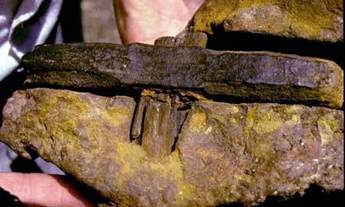
When you have a pattern, you have to look for a theory. Two nearly identical finds of manufactured gold objects in impossibly old geological strata, decades and an ocean apart. Add to them the dozens of other OOPArts—the Coso spark plug in a 500,000-year-old geode, the Dorchester Pot blasted from 600-million-year-old rock, the iron nails found in Scottish sandstone from the time of the dinosaurs—and a stunning picture begins to form.

The history we know is just the last chapter of a much, much longer book.

Theory 1: The Antediluvian Super-Civilization

This is the theory that haunts the dreams of alternative historians. The idea of a lost world. An advanced civilization that rose and fell in the impossibly deep past. Plato called it Atlantis. Others have called it Lemuria or Mu. A global, technological society that existed before a great cataclysm—a flood, a pole shift, an asteroid impact—wiped the slate clean.

Perhaps they weren’t building with stone and wood, but with materials and technologies that biodegraded over millions of years, leaving nothing behind. Nothing except their most durable possessions. Things made of noble metals like gold, which does not rust or corrode. Maybe a woman in this ancient world lost her golden chain in a vast primeval swamp, and as the millennia ticked by, that swamp compressed into coal, perfectly preserving the artifact like an insect in amber.

It’s a fantastical idea. But is it any more fantastical than a gold chain being 300 million years old?

Theory 2: Accidental Time Tourists

Let’s get even wilder. What if the artifacts aren’t from our past, but from our future? If humanity one day masters time travel, it’s inevitable that there will be tourists. And what do tourists do? They lose things.

Imagine a sightseer from the 25th century, visiting the Carboniferous Period in a protective bubble. They lean over the rail to get a better look at a giant dragonfly, and a chain slips from their neck. It falls into the murky swamp below, lost forever. Or so they think. Three hundred million years later, it ends up in Mrs. Culp’s coal scuttle in Illinois, a temporal paradox in the palm of her hand.

This theory, while seeming like science fiction, elegantly explains the “out-of-place” nature of the artifacts without requiring a lost civilization. It suggests the timeline isn’t as linear as we believe it to be.

The Skeptics Arrive: Explaining Away the Impossible

Of course, the mainstream scientific and historical communities have answers for these things. They have to. The alternative is unthinkable. Their explanations generally fall into a few predictable categories.

The Hoax Argument

The easiest dismissal is to cry “hoax!” The 19th century was rife with sensationalism, and newspapers often printed tall tales to sell copies. Perhaps Mrs. Culp or the newspaper editor simply made the whole thing up for a bit of local fame. It’s possible. But the level of detail in the report, specifically about how the chain was embedded, makes it a very sophisticated hoax for its time. They weren’t just saying they found it *in* coal; they described the specific way it was fossilized *within* it.

The Concretion Theory

Geologists will point to a phenomenon called “concretion.” This is when minerals, over long periods, can precipitate out of water and form around a nucleus—like a pebble or a fossil—creating a hard, often spherical rock. Sometimes, iron sulfides like pyrite can form crystalline structures that, to an untrained eye, might look like something artificial. Could the “gold chain” have just been a strangely shaped string of pyrite crystals? Again, it’s possible. But this flies in the face of the description of “elaborate workmanship” and the clear identification of the metal as gold, which was far more common and recognizable to people in 1891 than it is today.

Misidentification and Contamination

The simplest argument is that the chain fell into the coal bin recently and was just stuck in coal dust, and Mrs. Culp was mistaken about how deeply embedded it was. Our minds can play tricks on us. But this directly contradicts the newspaper account, which is the only primary source we have. It specifically addresses and refutes this very idea. Are we to trust our modern assumption over the direct report from the time?

The problem with all these skeptical arguments is that they require us to believe the original observers were naive, lying, or stupid. And they must be applied on a case-by-case basis to every single OOPArt, explaining each one away with a different excuse. The alternative theory—that of a lost history—is a single explanation that fits all of them.

What It All Means

So, we are left standing at a crossroads. Down one path is the safe, accepted version of history. A slow, simple climb from the stone age to the space age. It’s neat, and it makes us feel special, the pinnacle of creation.

Down the other path lies a chasm of uncertainty. A past that is deeper, more complex, and more mysterious than we ever imagined. It’s a path that suggests our great cities of steel and glass may not be the first. It hints that we are a species with amnesia, living amongst the scattered, barely recognizable ruins of our own forgotten ancestors.

The Morrisonville gold chain may be gone. But its story remains. A tiny, gleaming key that has the potential to rewrite everything we thought we knew about the human race.

The next time you look at history, remember Mrs. Culp’s lump of coal. Remember that the official story is often just the one that’s easiest to tell. The truth is often messier. Stranger. And sometimes, it’s hiding in plain sight, waiting for a sharp-eyed observer to crack the surface and see the impossible gleam within.

Originally posted 2016-03-04 16:28:11. Republished by Blog Post Promoter