Home Weird World Space Hubble spots real Space Invader !

Hubble spots real Space Invader !

0
56

Cosmic Joke or Alien Warning? The Space Invader Anomaly Hiding in Deep Space

They tell you it’s nothing. A trick of the light. A cosmic mirage. They want you to accept the neat, tidy explanation and move on.

But just look at it.

Staring back at us from the deepest, darkest void of space, an image so familiar it’s practically burned into our collective memory. A figure. An icon from a bygone era of flashing arcade lights and synthesized music. It’s a Space Invader.

And it’s two billion light-years away.

NASA, bless their hearts, chalked it up to an optical illusion. A magnificent, but ultimately random, quirk of physics. They gave it a name: Abell 68. They explained it away with complex theories. But questions linger. Questions that whisper in the back of your mind late at night when you stare up at the stars. In a universe of infinite possibilities, how can something be *that* perfect? Is it a coincidence? A message? Or is it a glitch in the very fabric of our reality, a sign that the universe is not what we think it is?

Forget what you’ve been told. Let’s look at the evidence. Let’s explore what might really be happening out there in the cold, silent dark. Because this might be more than just a picture. It might be a punchline to a joke we’re not in on. Or worse.

Much worse.

A Glitch in the Cosmic Code?

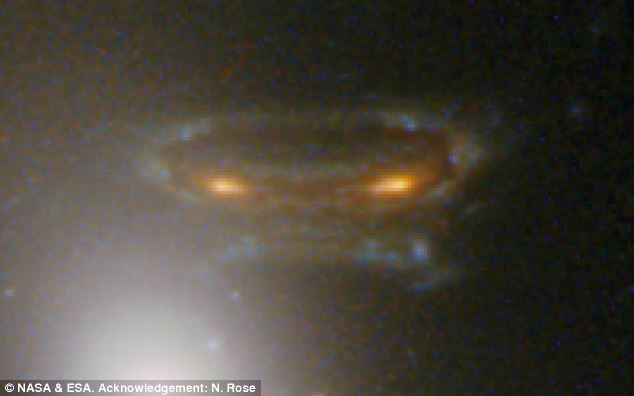
The image itself is haunting. Captured by the legendary Hubble Space Telescope, our unblinking eye in the sky, it shows a cluster of galaxies known as Abell 68. In the center, a chaotic mess of golden light—ancient galaxies, burning with the fire of trillions of stars. But that’s not what grabs you. It’s the phantom. Off to the side, a distorted, ghostly blue shape hangs in the void. Two “eyes,” a blocky body, and the unmistakable posture of an alien attacker descending from the top of an 8-bit screen.

It’s impossible to unsee.

space invader spotted

So what is the official story? Scientists say we’re witnessing one of the universe’s most spectacular magic tricks: Gravitational Lensing. The idea is that gravity, when it gets strong enough, can literally bend the fabric of space and time. And a galaxy cluster like Abell 68 is one of the most massive things imaginable.

It’s a cosmic titan. A gravitational monster.

The light from a much more distant galaxy, located billions of light-years *behind* Abell 68, has to travel past it to reach us here on Earth. As that light passes through the cluster’s immense gravitational field, space itself acts like a lens. A warped, imperfect, funhouse mirror lens. It bends, magnifies, and distorts the light, creating strange arcs, rings, and even multiple images of the same distant object.

NASA said in their release: “The gravitational field surrounding this massive cluster of galaxies… acts as a natural lens in space to brighten and magnify the light coming from very distant background galaxies.”

Simple enough, right? Case closed? Not so fast.

Deep Dive: Einstein’s Funhouse Mirror

To really get what’s going on here, you have to wrap your head around a concept that broke physics wide open. It came from the mind of Albert Einstein. He didn’t just see gravity as a force pulling things together. No. He saw it as a curvature, a dent in the fabric of reality itself.

Imagine a bowling ball on a trampoline. It creates a deep well in the fabric. Now, roll a marble nearby. The marble doesn’t get “pulled” toward the bowling ball; it simply follows the curve in the trampoline created by the ball’s weight. That’s gravity. The planets in our solar system are just marbles rolling around the massive dent created by the Sun.

Now, scale that up. Way up.

A galaxy cluster like Abell 68 isn’t a bowling ball. It’s a collection of thousands of bowling balls, all bound together by their own colossal gravity and swimming in a sea of mysterious dark matter. The dent it makes in spacetime is so profound that it can even bend a ray of light. A beam of light from a distant galaxy, traveling in a perfectly straight line for billions of years, encounters this gravitational well and is forced to follow the curve. Its path is warped.

By the time that light reaches the Hubble telescope, it has been twisted into a new shape. A spiral galaxy might be stretched into a long, thin arc. A single point of light might be split into four separate images, a phenomenon called an “Einstein Cross.”

And in the case of Abell 68, a distant spiral galaxy—a beautiful, spinning pinwheel of stars—was allegedly stretched, mirrored, and contorted into a shape that looks exactly like a digital alien from a 1978 video game. What are the odds?

NASA’s Official Story: A Little Too Neat?

The official explanation feels… convenient. They tell us that a normal spiral galaxy, seen edge-on, was warped by the lensing effect. The top part of the galaxy was mirrored and smeared into the “body” and “eyes” of the invader. It’s a perfect storm of cosmic alignment.

But does it hold up to scrutiny?

Our brains are wired for a phenomenon called pareidolia. It’s our built-in pattern-recognition software. It’s why we see faces in clouds, animals in wood grain, or the Man in the Moon. It’s an evolutionary trait that helped our ancestors spot predators hiding in the bushes. So, is this just a grand, cosmic case of pareidolia? Are we just seeing a familiar shape in a random smear of light because our brains are desperate to find order in chaos?

Maybe. But this feels different.

A face in a slice of toast is one thing. It’s vague. It’s open to interpretation. This is specific. It’s geometric. It has proportions. It aligns almost perfectly with a specific cultural artifact that represents the very idea of an alien encounter. The coincidence is so staggering it almost demands a different explanation. It’s almost too on-the-nose, like the universe itself has a sense of humor. Or a sense of dread.

What If It’s NOT a Coincidence?

This is where we leave the well-lit path of mainstream science and venture into the shadows. Let’s entertain the possibilities that the official story leaves out. Let’s ask the “what if” questions that keep people like us awake at night.

What if… It’s a Deliberate Message?

Imagine a civilization so advanced that manipulating gravity is like child’s play. A Type III civilization on the Kardashev scale, capable of harnessing the energy of an entire galaxy. To such a being, a galaxy cluster isn’t an obstacle; it’s a tool. It’s a cosmic billboard.

Could they have intentionally tweaked the gravitational field of Abell 68? Could they have precisely arranged dark matter or other massive objects to create a lens that would broadcast a specific image across the cosmos? It sounds like science fiction, but to a civilization a billion years ahead of us, it might be simple engineering.

But why this message? Why a Space Invader? Perhaps it’s a test. They broadcast a simple, universally recognizable symbol of “alien” into the void. Then they wait. They watch to see if any fledgling technological species, like ours, is smart enough to build a telescope to see it, and curious enough to question it. Maybe seeing the Invader is the first step in a galactic IQ test.

Or maybe it’s a warning. A simple, pictorial message: “We are out here. We are the invaders. Stay down.”

What if… It’s a Glitch in the Simulation?

This is a theory that has exploded across the internet in recent years. What if our entire reality—the stars, the galaxies, you, me—is not real? What if it’s an incredibly advanced computer simulation?

If that’s the case, then everything we see is just code. Rendered graphics. And like any piece of software, it can have bugs. Glitches. Errors in the code.

Could the Space Invader of Abell 68 be a graphical artifact? A misplaced asset from another part of the simulation bleeding through? Maybe it’s a celestial Easter egg, a hidden signature left behind by the programmers of our universe. A cosmic in-joke for anyone who looks closely enough. It’s a terrifying and fascinating thought: the most profound mysteries of the universe might just be bugs in the system.

What if… The Universe is Trying to Tell Us Something?

Let’s go one level deeper. Forget aliens and simulations for a moment. What if the universe itself possesses some form of consciousness? The concept of synchronicity, popularized by psychologist Carl Jung, describes “meaningful coincidences”—events that seem related but have no obvious causal connection.

Could this be a case of cosmic synchronicity? The universe manifests a symbol—the Invader—that we, as a species, would instantly recognize. And it does so at the exact point in our history when we have developed the technology (the Hubble telescope) to see it. It’s as if the cosmos is communicating with us through symbols, using the laws of physics as its language. The message isn’t from an alien intelligence, but from the fabric of reality itself.

A Pattern of Strangeness Across the Stars

If Abell 68 were a one-off anomaly, it would be easier to dismiss as a fluke. But it’s not alone. Our telescopes are finding more and more of these cosmic oddities, things that look suspiciously familiar.

  • The Galactic “Smiley Face”: Galaxy cluster SDSS J1038+4849 contains two bright galaxies for eyes and a distorted arc of light from gravitational lensing that forms a perfect, smiling mouth. It’s cheerful. And deeply unsettling.
  • The Cosmic Question Mark: More recently, the James Webb Space Telescope spotted a formation of stars and galaxies deep in space that perfectly resembles a giant question mark. Is the universe asking us a question? Or is it mocking our search for answers?
  • The Eye of Sauron: The star Fomalhaut is surrounded by a massive dust ring, with a planet clearing a path through it, creating an uncanny resemblance to the fiery, all-seeing eye from fantasy lore.

One is an anomaly. Two is a coincidence. But three or more? That starts to look like a pattern. The universe is littered with pareidolia on a scale we can barely comprehend. It’s almost as if it’s designed to be interpreted, to be seen, to make us wonder.

So… Are They Playing Games With Us?

We are left where we began, staring at a ghostly image from the edge of time. NASA tells us it’s physics. A beautiful, random accident of light and gravity. And they may be right. It is, without a doubt, the simplest explanation.

But is it the most compelling?

The Space Invader of Abell 68 challenges us. It forces us to confront the sheer scale of the unknown. It dangles the possibility of something more, something beyond our current understanding. Whether it’s a message from an ancient intelligence, a crack in the code of our simulated reality, or a sign from a conscious cosmos, it serves a profound purpose. It makes us look up. It makes us ask questions. It fuels our imagination.

So the next time you see that image, don’t just accept the easy answer. Let your mind wander. Consider the possibilities. Because the official story is that a random alignment of a galaxy cluster and a background spiral galaxy, viewed from a tiny planet two billion light-years away, just happens to perfectly replicate a piece of our pop culture.

And you have to ask yourself: Do you really believe in coincidences that perfect?

Originally posted 2016-05-01 16:28:15. Republished by Blog Post Promoter