Home Unexplained Mysteries Ancient Mysteries Strange new mystery over Turin Shroud discovered.

Strange new mystery over Turin Shroud discovered.

0
153

Strange mystery of the Turin Shroud: The DNA That Changes Everything

image

Look at that face. Really look at it.

You are staring at the single most controversial, argued-about, and scientifically frustrating object on planet Earth. For hundreds of years, the Shroud of Turin has been the ultimate prize in a cage match between faith and physics. On one side, you have millions of believers who swear this is the burial cloth of Jesus of Nazareth, capturing the precise moment of a miraculous resurrection. On the other side? Skeptics who are dead certain it’s the greatest con job of the Middle Ages.

Usually, these debates go nowhere. They spin in circles. Faith says one thing; carbon dating says another. Stalemate.

But recently? The chessboard got flipped over.

A massive genomic study came out of nowhere and dropped a bomb on everything we thought we knew. We aren’t talking about carbon dating anymore. That is old news. We are talking about DNA. We are talking about the invisible dust of the world, vacuumed out of the ancient fibers of this linen. The results are not just confusing. They are impossible.

If the science is right, this cloth has traveled further than any medieval peasant ever could. It has seen things it shouldn’t have seen. And it holds secrets that might rewrite history books from scratch.

The Crime Scene: Dust, Pollen, and Impossible Journeys

Let’s set the scene. The Shroud isn’t just a picture. It’s a crime scene. A biological recording device.

For centuries, it has absorbed the atmosphere of every place it has ever been. Every time it was displayed, hidden, moved, or touched, it grabbed onto microscopic particles. Pollen. Dust. Mites. Human skin cells. These particles work like a GPS tracker that never runs out of battery.

Enter Dr. Gianni Barcaccia and his team from the University of Padova. They didn’t want to cut the cloth (that is strictly forbidden). Instead, they used a vacuum. They pulled dust from the space between the Shroud and its backing cloth, and from the edges.

Then, they sequenced the DNA.

If the skeptics are right—if this is just a fake painted by a French artist in the 1300s—the DNA should be boring. It should be French. Maybe some Italian dust from its time in Turin. That’s it. Case closed.

But that is not what they found.

The genomic analysis revealed a chaotic, global map that makes zero sense. They found plant DNA from the Mediterranean. Okay, expected. They found DNA from India. Weird, but maybe explainable. They found DNA from Turkey. Fits the legends.

But then they found the anomaly. The data point that screams “impossible.”

They found DNA from the Americas.

The American Anomaly: A Time Travel Paradox?

Stop. Read that again.

How does a burial cloth, supposedly from 33 AD Jerusalem—or even 1350 AD France—have biological traces of plants that only exist in the New World?

Dr. Barcaccia’s team identified traces of the Black Locust tree. This isn’t a European tree. It is native to Appalachia in the Eastern United States. It did not exist in Europe during the time of Christ. It didn’t exist in Europe during the Middle Ages. It wasn’t introduced to the European continent until the early 1600s.

So, how did it get there?

This single finding opens up a Pandora’s box of wild theories. Let’s look at the possibilities, from the safe to the insane.

Theory 1: The Modern Contamination (The Boring Answer)

Science tries to take the path of least resistance. The most logical answer is that the Shroud was contaminated recently. The cloth has been displayed publicly many times in the last century. It has been exposed to the open air. Did pollen from an American tourist drift onto the linen? Is there a Black Locust tree growing in a park in Turin, and the wind carried a single spore through a window?

It is possible. The researchers admit that this is the most likely scenario for the American DNA. But it proves something scary for the conservators: the Shroud is not sealed. It is “open” to the world. It is still recording data today.

Theory 2: The Forbidden History

But what if it wasn’t modern? This is where alternative history enthusiasts lose their minds. Is it possible that the trade routes of the ancient world were far more connected than we think? Could a traveler from the Americas—or a Viking who had been there—have brought materials back that eventually brushed against this holy relic?

It sounds crazy. But the Shroud is full of crazy things.

The India Connection: Smashing the “French Fake” Theory

Let’s forget the Americas for a second and look East. The DNA results showed a massive amount of plant groups native to India and East Asia.

This is a massive problem for the “Medieval Hoax” theory.

Think about it. If a guy in 1350s France wanted to fake a burial shroud to make some quick cash from pilgrims, he would go down to the local market. He would buy French linen. He would paint it. Done.

Why would a French forger use expensive, high-quality linen that was manufactured in India or woven from thread that had traveled the Silk Road? The presence of Asian DNA suggests the cloth itself originated far to the East. It supports the idea that the linen was manufactured in India or the Near East, then transported toward the Mediterranean.

This aligns perfectly with what we know about first-century Judea. Wealthy families (like Joseph of Arimathea, who supposedly bought the linen) wouldn’t use rough, local wool. They would buy fine, imported linen. The DNA map tracks a path from India, through the Middle East, to Turkey, and finally to Europe.

It fits the legend. It does not fit the hoax.

The Turkish Trail and the “Image of Edessa”

The DNA also flagged plants from Turkey. Why does this matter? Because it connects the Shroud to the “missing years.”

History loses track of the Shroud for centuries. But there are legends of the “Mandylion” or the “Image of Edessa”—a cloth with the face of Jesus that was kept in Turkey for hundreds of years before being taken to Constantinople. The DNA evidence backs this up. The dust of Turkey is embedded in the fibers. The timeline is starting to solidify.

The Image That Physics Can’t Explain

While the DNA tells us where the cloth has been, it doesn’t answer the big question: How was the image made?

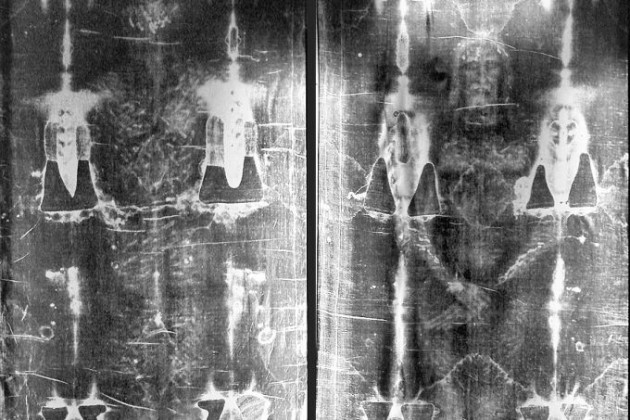
This is the part that keeps physicists awake at night. If you walk up to the Shroud, it looks blurry. Faint. Almost like a scorch mark. But the moment you change how you look at it, the reality shifts.

An archive negative image of the Shroud of Turin (L) is shown next to one recreated by an Italian scientist and released in Pavia October 5, 2009. REUTERS/Turin Diocese (L) and Luigi Garlaschelli/Handout

In 1898, an amateur photographer named Secondo Pia was allowed to photograph the Shroud for the first time. He set up his big box camera. He took the shot. Later, alone in his darkroom, he dipped the glass plate into the developer chemicals.

He almost dropped the glass.

On the negative plate, the blurry, faint face transformed. It became sharp. Detailed. Real. The shadows and highlights flipped. Secondo Pia realized that the Shroud itself was a negative. By taking a picture of it (making a negative of a negative), he had revealed the positive image for the first time in history.

Ask yourself: How does a medieval forger paint a photographic negative 500 years before photography was invented? How do you paint “light” backwards?

The NASA Connection: 3D Data Encoded in Flax

It gets weirder. Much weirder.

In 1976, a team of scientists known as STURP (Shroud of Turin Research Project) got access to the cloth. They brought a piece of equipment called the VP-8 Image Analyzer. This was tech used by NASA to map the topography of the moon and Mars. It takes brightness and converts it into vertical height (3D relief).

If you take a photo of your face or a painting like the Mona Lisa and put it in the VP-8, the result is a distorted mess. A nose isn’t “brighter” than a cheek, so the machine can’t make a 3D shape out of it.

They put the Shroud photo under the lens.

The screen didn’t show a mess. It showed a perfect, anatomically correct 3D relief of a human form. The distance information was encoded in the image intensity. The closer the cloth was to the body (the tip of the nose), the darker the image. The further away (the eye sockets), the lighter.

This is impossible to paint. To do this by hand, you would need to calculate the distance between a cloth and a body at every single millimeter and adjust the pigment density perfectly. No artist has ever done it. No forgery has ever replicated it.

The “Event Horizon” Theory: A Burst of Light?

So, if it’s not paint, and it’s not dye, what is it?

The image sits on the absolute surface of the fibers. It is only 0.2 micrometers thick. It doesn’t soak in. It’s a chemical change in the linen itself—rapid dehydration and oxidation. It’s like a micro-scorch.

The leading theory among the “believer” scientists is terrifying. They call it the Radiation Hypothesis.

Physicists like John Jackson have proposed that the body wrapped in the shroud dematerialized. Turned into pure energy. For a fraction of a nanosecond, the body emitted a burst of vacuum ultraviolet radiation. This flash was incredibly short and incredibly bright.

This burst carried the “information” of the body and scorched it onto the linen. It explains the negative image. It explains the 3D encoding. It explains why there is no paint.

Some have compared it to the “nuclear shadows” found in Hiroshima—where the intensity of the flash bleached the walls, leaving shadows of people behind. Is the Shroud a nuclear shadow of the Resurrection? Science can’t prove a miracle, but the physics of the cloth matches a high-energy event.

The Blood That Is Still Red

Skeptics used to say the “blood” was just red ochre paint. That theory is dead.

We now know it is real human blood. It is Type AB. This is rare, but interestingly, it matches the blood type found on the Sudarium of Oviedo, a small head-cloth kept in Spain that has a documented history going back to the 7th century.

But the blood tells a brutal story. It contains high levels of bilirubin. The liver pumps this out when the body is being beaten, tortured, and starved of fluids. The man in the Shroud didn’t just die; he suffered massive trauma before death.

And then there is the anatomy.

Look at medieval paintings of the crucifixion. The nails are always in the palms of the hands. Always. But modern anatomy tells us that if you nail a man through the palms, the weight of the body will rip the nails right through the fingers. The body would fall.

To keep a man on a cross, you have to nail through the wrists, specifically a spot called Destot’s space. The Shroud shows the blood flow coming from the wrists, not the palms. The thumbs are folded under (a natural reflex when the median nerve in the wrist is pierced). The Shroud gets the anatomy 100% correct, contradicting every painting made in the Middle Ages.

The Carbon-14 Glitch

“But wait!” the skeptics yell. “What about the 1988 Carbon Dating? It proved it was medieval!”

Ah, the 1988 test. The moment the world stopped caring.

Three labs dated a corner of the cloth to between 1260 and 1390 AD. Case closed, right? Not so fast. In the years since, that test has been ripped apart.

The sample was cut from the corner. The edge. The single most handled part of the cloth. People held it there for centuries to show it to crowds. It is the dirtiest part of the shroud.

More importantly, textile experts found that the corner had been repaired. In the middle ages, nuns used a technique called “French Invisible Reweaving” to fix tattered edges. They wove dyed cotton in with the old linen. It is so seamless you need a microscope to see it.

If the labs tested a sample that was 50% Jesus-era linen and 50% Medieval cotton, the date would come out… Medieval. They may have dated the patch, not the Shroud.

The Conclusion: A Mystery That Won’t Die

So, what are we left with?

We have a cloth with a global passport, carrying DNA from the Americas to India. We have a photographic negative created centuries before photography. We have a 3D hologram encoded in flax fibers. We have blood that screams of torture and matches the rare AB type.

The DNA study didn’t solve the puzzle. It made the puzzle infinitely more complex. It stripped away the simple explanation of “local French forgery” and replaced it with a global mystery.

Is it the burial cloth of God? Is it a piece of lost technology from a forgotten civilization? Or is it a fluke of nature—a perfect storm of biology, chemistry, and time?

The Shroud of Turin refuses to speak. It just stares back at us, holding its secrets in the dark, daring us to catch up.

Science tries to break it. History tries to debunk it. But every time we look closer, we find something new that shouldn’t be there. And that is why we can’t look away.

Originally posted 2015-11-20 11:20:25. Republished by Blog Post Promoter