The infamous Bender family appeared quietly in southeastern Kansas in the spring of 1872. They didn’t appear to be anything special, just another immigrant family that had escaped the confines of the eastern cities to try their hand out west. Like so many others, they merely wanted to make new lives and fortunes in the untamed west. However, their methods for obtaining such fortunes differed greatly from most of the other homesteaders.
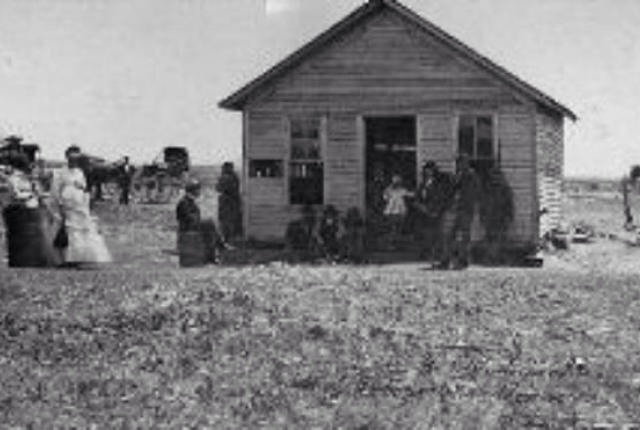
The Bender’s constructed a home between the towns of Thayer and Galesburg in Neosho County. It was not a fancy place, but was a general store and a wayside inn that could provide both food and a bed for travelers. The house was made up of one large room that was divided by a canvas curtain. This separated the grocery store and inn from the family’s living quarters in the back. Old man Bender, his wife and their dull-witted son spoke little to the strangers who passed through, save for an occasional greeting along the local roads or to sell them canned goods and coffee. Old man Bender and his raw-boned wife, aged between 50 and 60, were thought to have been immigrants from Germany but they spoke with such guttural accents that no one could be certain.
A special seat!
The danger of dining with the BENDERS came when seated with your back to the canvas wall. Some travelers complained of hearing strange sounds from behind the curtain while they ate. They didn’t realize what might be coming their way for dessert. Kate would also place her spiritualist clients with their backs to the curtain. In the darkened room, she made all sorts of strange manifestations appear, usually with her family’s earthly assistance, and managed to keep the sitter transfixed in place for an extended period of time. However, some of the sitters became unnerved with their backs against the canvas wall. One man was so scared that he insisted on being moved to another seat. Kate became so angry with him that he stayed put. Finally though, after hearing what he believed were otherworldly whispers on the other side of the sheet, he jumped up and ran from the inn.
The murder inn
Many travelers were not so discerning though. If a diner, overnight guest or séance participant appeared to be wealthy, he was given a seat of honor with his back to the curtain. While Kate distracted him, Old Man Bender or his son would sneak up to the curtain with a sledgehammer. They would then strike a savage blow to the top of the man’s head, killing him instantly. The body was then dragged back beneath the canvas and stripped. A trap door that led to an earthen cellar was opened and the body was dumped below until it could be buried somewhere on the prairie. A favorite burying ground was apparently an orchard that was located on the property.
This system of murder worked well for more than 18 months. Kate drew a number of victims to their door with her offers of spirit communication and her brother often accosted travelers on nearby roads. He would strike up a conversation with them and convince them that spending the night at the inn was preferable to journeying on.
A victims story
One victim who was persuaded to enjoy the Bender’s hospitality (on a permanent basis) was Dr. William York. He was actually returning to visit the inn, and most likely to see Kate again, in the spring of 1873. He had stayed there once before on his trip west and informed his brother, Colonel York of Fort Scott, that he would be staying with the Bender’s again on his return journey. Not surprisingly, Dr. York never returned home.
A short time after his brother’s disappearance, on May 4, 1873, Colonel York arrived at the Bender home. York explained that his brother had disappeared and he asked the family about whether or not he had passed through the area. He thought that the doctor had planned to stay with them. Had they seen him?
They answered that they hadn’t and suggested that perhaps he was delayed, or had run into trouble with Indians. York agreed that all of this was possible and ate a hearty dinner. Later on that night, while sitting alone in the front room, he happened to notice something glittering underneath one of the beds. He pulled the object out and saw that it was a locket on a gold chain. He opened it and was startled to see the faces of his brother’s wife and daughter inside! He recognized the locket then as a trinket that his brother wore on his watch chain. He quickly realized that the inn might have been the last place that his brother had ever been seen alive.
York was in the front part of the inn by himself and so quietly, he slipped out the front door. He would ride to the nearest town and notify the authorities, he decided. Using his clout as a military officer, they would get to the bottom of what was going on at the Bender house. He walked across the dirt yard to the stable and out of the corner of his eye, spotted a lantern swinging back and forth in the dark orchard. York walked in the direction of the light and as he got closer, he crept up on it. In the trees, he saw Old Man Bender and his son digging a hole in the ground. Nearby was a large object wrapped in canvas that looked suspiciously like a body.
The shocking discovery
York returned to the Bender property the next morning, shortly after sunrise. He did not come alone though. He had convinced the sheriff to send a contingent of deputies and local men from town. The posse planned to investigate the inn and the surrounding area, especially the orchard. When they arrived however, they found that the house was empty. The Bender’s, apparently aware that York had disappeared the night before, had packed up and left the place. The men searched the building but almost everything was gone. York inspected the cellar and noted with alarm that the dirt floor was coated with dried blood. The stench of the place was overpowering.
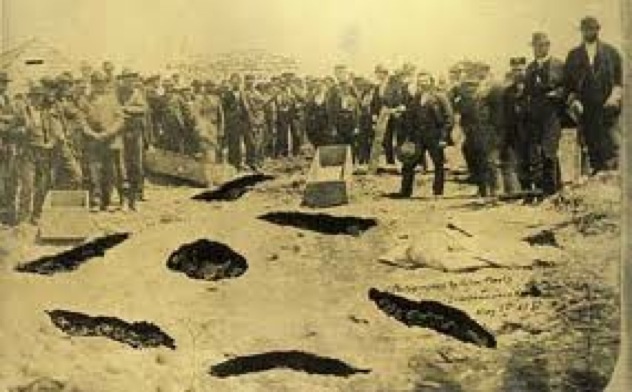
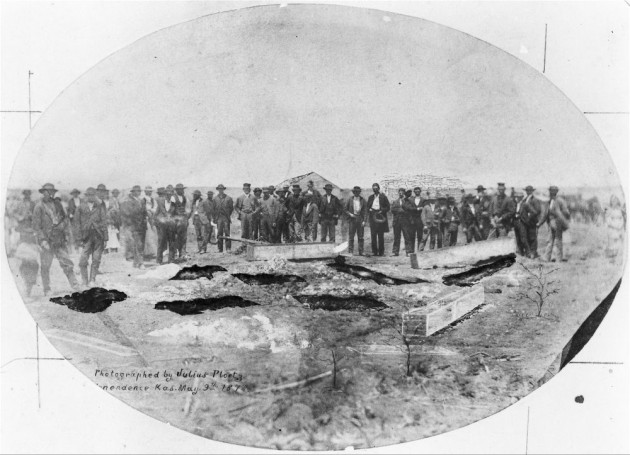
The men set to work searching the fields and the orchard around the house. Among the trees, they found 11 mounds of oddly shaped earth. Several of them appeared to be fresh. The posse began to dig and tragically, the body of Colonel York’s brother was found in the first grave that was opened. More graves were found by walking about the edge of the prairie and taking end gate rods from wagons and sticking them in the ground. Here and there, they would strike a soft place and in every instance, these places proved to be graves. More than two dozen bodies were allegedly found but how many went undiscovered remains unknown.