The Lost Souls of Willard: 400 Suitcases Reveal the Haunting Secrets of a Forgotten Asylum
Picture it. An attic. Not the kind where you store holiday decorations, but a vast, forgotten space suffocating under a century of dust. The air is thick, heavy with the ghosts of forgotten memories. A single beam of sunlight cuts through a grimy window, illuminating a universe of dancing dust motes. And in that light, you see them.
Rows upon rows of them.
Suitcases. Hundreds of them. Leather, cracked and brittle. Cardboard, softened by a hundred years of humidity. They sit in silent vigil, like coffins for lives that ended the moment their owners passed through the asylum doors.
This isn’t a scene from a horror movie. This was a real discovery in 1995, deep in the forgotten wings of the Willard Asylum for the Insane in Upstate New York. An employee, tasked with clearing out the derelict buildings of the recently closed institution, stumbled upon this graveyard of luggage. Four hundred suitcases, each a perfect time capsule, each a story brutally cut short.
What dark secrets were packed away with these faded photographs and worn-out shoes? And what do they tell us about the thousands of people society decided to lock up and throw away the key?
A Knock on the Attic Door
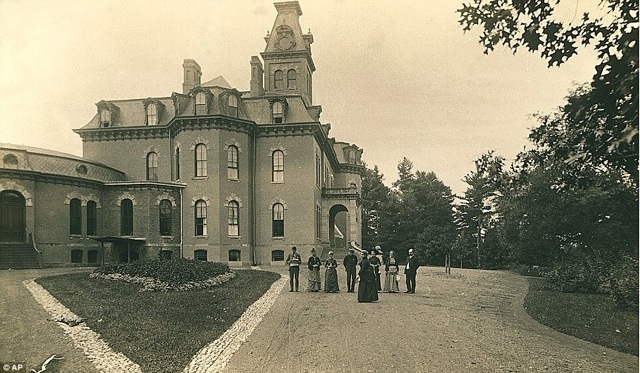
The year was 1995. The Willard Asylum, a sprawling campus of imposing brick buildings on the shore of Seneca Lake, had finally shuttered its doors after 126 years of continuous operation. The State of New York was in the process of decommissioning the facility, turning the grim task of cleanup over to its employees.
One of these workers, a woman named Lisa, was assigned to an upper-floor ward. Prying open a door that had likely been sealed for decades, she wasn’t prepared for what she found. It wasn’t just a room. It was a tomb.
Four hundred of them. Lined up. Stacked. Waiting. Suitcases belonging to people who arrived between 1910 and 1960. They had packed what they thought they would need, perhaps for a short stay. A favorite book. A shaving kit. A wedding dress. They arrived, their bags were taken from them, and they were swallowed by the system.
Most never left Willard alive.
The average stay was not a few months. Or even a few years. It was thirty years. A lifetime. When a patient died, their body was often buried across the road in a cemetery filled with nameless graves, marked only by a small concrete number. Their worldly possessions, the last tangible pieces of their identity, were locked away in this attic. Forgotten. Until now.

Willard Asylum: A City of the Forgotten
To understand the suitcases, you have to understand Willard. This wasn’t just a hospital. It was a self-contained universe. When it opened in 1869, it was hailed as a revolutionary step forward in mental healthcare. A grand experiment in “moral treatment.”
Before places like Willard, the mentally ill were often treated worse than animals. They were chained in the basements of county poorhouses, living in their own filth, regarded as hopeless cases. Willard was supposed to change that. It was designed as a peaceful retreat, a place where patients could work on the farm, engage in therapeutic activities, and be treated with a measure of dignity.
For a time, perhaps it was. But the dream quickly soured.
Society began using asylums as a dumping ground. A place to hide its inconvenient people. The population swelled. By the 20th century, Willard was massively overcrowded, underfunded, and understaffed. The noble experiment in “moral treatment” gave way to custody, control, and the grim reality of warehousing human beings. With its own farms, power plant, movie theater, bowling alley, and morgue, Willard became a city unto itself, a sprawling prison for those whose only crime was being different.
Crimes of the Mind: The Shocking Reasons for Commitment
Why were people sent here? The reasons will turn your stomach. We’re not talking about violent, criminally insane individuals. The criteria for being locked away for life were terrifyingly broad and often had nothing to do with actual mental illness.
It was a tool of social control.
A Woman’s “Hysteria”
Were you a young woman who was considered “promiscuous”? Did you defy your husband or father? Did you suffer from postpartum depression after childbirth? In the early 20th century, any of these could earn you a diagnosis of “hysteria” or “moral insanity.” A trip to Willard was the prescribed cure. For many, it was a one-way ticket, a convenient way for a family to dispose of a troublesome female relative.
The Grief Deadline
Imagine the unimaginable. You lose a child. The grief is an ocean, and you are drowning. In those days, society had a stopwatch. If you couldn’t “get over” your profound grief in three months, you could be deemed melancholic and committed. There was no understanding of trauma, no concept of compassionate care. Just a cold, institutional solution for messy human emotions.
The Crime of Being Different
Epilepsy, a neurological disorder causing seizures, was misunderstood as a form of madness. Epileptics were routinely institutionalized for their entire lives. Were you gay or lesbian? That was classified as a mental disorder, a “deviancy” to be locked away from public view. Even “novel reading” was listed as a potential cause for insanity in some asylum logs. The message was clear: conform, or be erased.
Unpacking a Ghost: Inside the Willard Suitcases
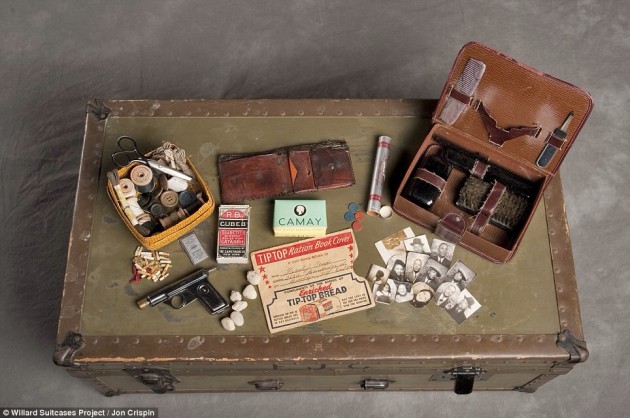
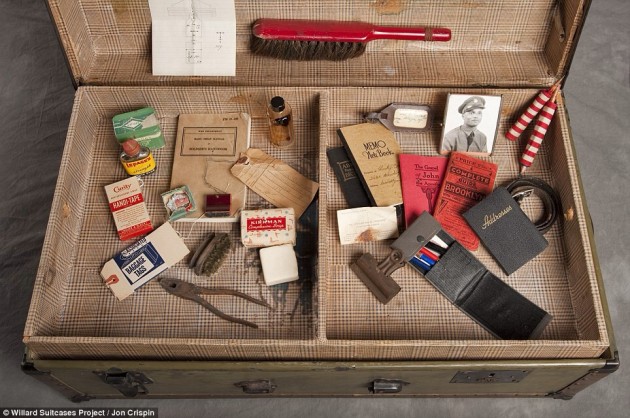
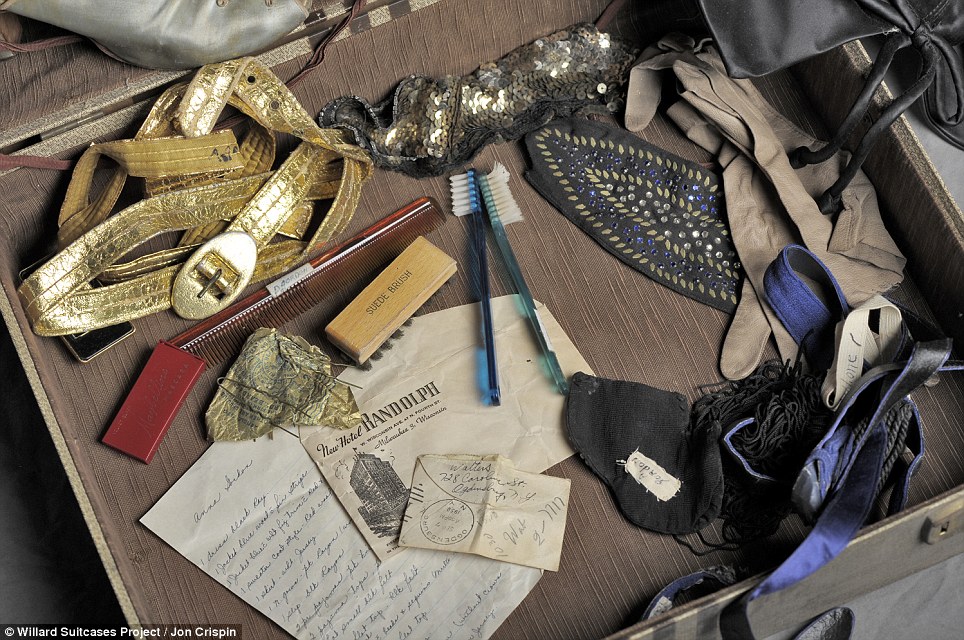
The discovery of the suitcases caught the attention of the New York State Museum. They realized these were not just old bags; they were priceless archaeological artifacts of human lives. They partnered with photographer Jon Crispin, who spent years painstakingly documenting the contents of each case, preserving the stories held within.
Opening one is like opening a tomb. The contents are so personal, so mundane, yet so profoundly heartbreaking.

One case belonged to a woman named Freda. Inside, her entire life. Sewing supplies, neatly wrapped. A pair of elegant shoes, perhaps for a dance she dreamed she’d one day attend. Letters from her mother, filled with hope for her recovery. Freda never recovered. She died in Willard after decades of confinement.
Another case held the meticulously kept possessions of a World War I veteran. His uniform, neatly folded. His medals. Photographs of his family, a life he fought for and was then denied. He was likely suffering from what we now call PTSD, then crudely labeled “shell shock.” His reward for service was to be locked away.
In another, a child’s doll. A teacup. A rosary. A diary with only the first few pages filled, the author’s story cut short before it could truly be written.
What If? The Stories We Can Only Imagine
Looking at these items, you can’t help but invent the stories. Who was the man who packed three different pipes but no clothes? Was he arrested and brought here straight from his study? What about the woman who packed only her finest china and silverware? Did she believe she was going to a grand hotel for a short vacation?
Each object is a clue. A phantom limb reaching out from the past. These weren’t “lunatics.” They were people. People who loved, who dreamed, who had hobbies, who mattered. They were bakers, soldiers, mothers, and musicians. And the system, in its cold indifference, stripped them of everything, leaving only these leather-bound ghosts in an attic.

The Cemetery of Numbers: Buried and Erased
The final, brutal insult came after death. Just across the road from the grand asylum buildings lies the patient cemetery. For decades, there were no names here. Just rows and rows of small concrete blocks, each stamped with a number.
Patient #5113. Patient #7219.
Families, crippled by the social stigma of having a relative in an asylum, often abandoned them completely. They didn’t claim the bodies. So Willard buried them. Anonymously. It was the ultimate erasure. Your name, your identity, your entire existence, reduced to a four-digit number in a forgotten field.
In recent years, projects like the Willard Cemetery Memorial Project have worked tirelessly to cross-reference asylum records and finally put names to these numbers, to restore a sliver of the dignity that was stolen from them. But for thousands, their only real memorial, the only proof of who they were, remained locked in that attic. The suitcases are their true headstones.
Whispers from the Wards: The Haunting of Willard Today
What happens when a place accumulates so much pain, so much sorrow, so much despair? Does it just dissipate? Or does it stain the very walls?
Today, the main Willard campus is used as a drug rehabilitation facility for state prison inmates. A place of confinement has become a place of confinement once again. And according to staff and inmates, the old residents never truly left.
The stories are endless. People report hearing disembodied voices echoing down the long, empty corridors of the abandoned wards. The sounds of women crying, men shouting. The chilling feeling of being watched by unseen eyes is a common complaint. Doors are said to slam shut on their own, and objects have been seen moving with no explanation.
Modern internet theories and paranormal investigations point to Willard as one of the most active haunted locations in the country. Is it any surprise? Thousands of people lived and died here, their lives stolen, their stories silenced. Perhaps these echoes are not ghosts in the traditional sense, but a psychic imprint of immense human suffering, a trauma so deep it became permanently etched into the environment.
The suitcases in the attic are more than just a sad discovery. They are a profound and disturbing warning. They are a testament to how easily we can discard the people we don’t understand. They remind us that behind the cold statistics and the clinical diagnoses, there were always human beings, with lives and loves and hopes packed neatly into a suitcase, waiting for a day of release that, for most, would never come.
It makes you wonder. What other secrets are still locked away in the attics of our history, waiting for someone to finally turn the key?
Originally posted 2015-11-12 13:02:08. Republished by Blog Post Promoter