According to Hendrick Van der Decken Message…………………………..
Our ship, after touching at the Cape, went out again, and soon losing sight of the Table Mountain, began to be assailed by the impetuous attacks of the sea, which is well known to be more formidable there than in most parts of the known ocean. The day had grown dull and hazy, and the breeze, which had formerly blown fresh, now sometimes subsided almost entirely, and then recovering its strength, for a short time, and changing its direction, blew with temporary violence, and died away again, as if exercising a melancholy caprice. A heavy swell began to come from the southeast. Our sails flapped against the masts, and the ship rolled from side to side, as heavily as if she had been water-logged. There was so little wind that she would not steer.
At two p.m. we had a squall, accompanied by thunder and rain. The seamen, growing restless, looked anxiously ahead. They said we would have a dirty night of it, and that it would not be worth while to turn into their hammocks. As the second mate was describing a gale he had encountered off Cape Race, Newfoundland, we were suddenly taken all aback, and the blast came upon us furiously. We continued to scud under a double reefed mainsail and foretopsail till dusk; but, as the sea ran high, the Captain thought it safest to bring her to. The watch on deck consisted of four men, one of whom was appointed to keep a lookout ahead, for the weather was so hazy, that we could not see two cables’ length from the bows. This man, whose name was Tom Willis, went frequently to the bows, as if to observe something; and when the others called to him, inquiring what he was looking at, he would give no definite answer. They therefore went also to the bows, and appeared startled, and at first said nothing.
But presently one of them cried, “William, go call the watch.”
The seamen, having been asleep in their hammocks, murmured at this unseasonable summons, and called to know how it looked upon deck. To which Tom Willis replied, “Come up and see. What we are minding is not on deck, but ahead.”
On hearing this, they ran up without putting on their jackets, and when they came to the bows there was a whispering.
One of them asked, “Where is she? I do not see her.”
To which another replied, “The last flash of lightning showed there was not a reef in one of her sails; but we, who know her history, know that all her canvass will never carry her into port.”
By this time, the talking of the seamen had brought some of the passengers on deck. They could see nothing, however, for the ship was surrounded by thick darkness, and by the noise of the dashing waters, and the seamen evaded the questions that were put to them.
At this juncture the chaplain came on deck. He was a man of grave and modest demeanor, and was much liked among the seamen, who called him Gentle George.
He overheard one of the men asking another, if he had ever seen the Flying Dutchman before, and if he knew the story about her. To which the other replied, “I have heard of her beating about in these seas. What is the reason she never reaches port?”
The first speaker replied, “They give different reasons for it, but my story is this: She was an Amsterdam vessel, and sailed from that port seventy years ago. Her master’s name was Vanderdecken. He was a staunch seaman, and would have his own way, in spite of the devil. For all that, never a sailor under him had reason to complain; though how it is on board with them now, nobody knows. The story is this, that in doubling the Cape, they were a long day trying to weather the Table Bay, which we saw this morning. However, the wind headed them, and went against them more and more, and Vanderdecken walked the deck, swearing at the wind. Just after sunset, a vessel spoke him, asking if he did not mean to go into the Bay that night. Vanderdecken replied, ‘May I be eternally d__d if I do, though I should beat about here till the day of judgment!’ And to be sure, Vanderdecken never did go into that bay; for it is believed that he continues to beat about in these seas still, and will do so long enough. This vessel is never seen but with foul weather along with her.”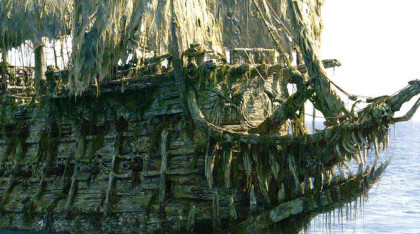
To which another replied, “We must keep clear of her. They say that her Captain mans his jolly boat, when a vessel comes in sight, and tries hard to get alongside, to put letters on board, but no good comes to them who have communication with him.”
Tom Willis said, “There is such a sea between us at present, as should keep us safe from such visits.”
To which the other answered, “We cannot trust to that, if Vanderdeckcn sends out his men.”
Some of this conversation having been overheard by the passengers, there was a commotion among them. In the meantime, the noise of the waves against the vessel, could scarcely be distinguished from the sounds of the distant thunder. The wind had extinguished the light in the binnacle, where the compass was, and no one could tell which way the ship’s head lay.
The passengers were afraid to ask questions, lest they should augment the secret sensation of fear which chilled every heart, or learn any more than they already knew. For while they attributed their agitation of mind to the state of the weather, it was sufficiently perceptible that their alarms also arose from a cause which they did not acknowledge.
The lamp at the binnacle being re-lighted, they perceived that the ship lay closer to the wind than she had hitherto done, and the spirits of the passengers were somewhat revived.
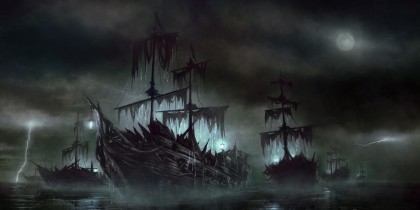
Nevertheless, neither the tempestuous state of the atmosphere, nor the thunder had ceased; and soon a vivid flash of lightning showed the waves tumbling around us, and, in the distance, the Flying Dutchman scudding furiously before the wind, under a press of canvass. The sight was but momentary , but it was sufficient to remove doubt from the minds of the passengers.
One of the men cried aloud, “There she goes, top-gallants and all.”
The chaplain had brought up his prayer book, in order that he might draw from thence something to fortify and tranquillize the minds of the rest. Therefore, taking his seat near the binnacle, so that the light shone upon the white leaves of the book, he, in a solemn tone, read out the service for those distressed at sea. The sailors stood round with folded arms, and looked as if they thought it would be of little use. But this served to occupy the attention of those on deck for a while.
In the meantime, the flashes of lightning becoming less vivid, showed nothing else, far or near, but the billows weltering round the vessel. The sailors seemed to think that they had not yet seen the worst, but confined their remarks and prognostications to their own circle.At this time, the Captain, who had hitherto remained in his birth, came on deck, and, with a gay and unconcerned air, inquired what was the cause of the general dread. He said he thought they had already seen the worst of the weather, and wondered that his men had raised such a hubbub about a capful of wind. Mention being made of the Flying Dutchman, the Captain laughed. He said he would like very much to see any vessel carrying top-gallant-sails in such a night, for it would be a sight worth looking at.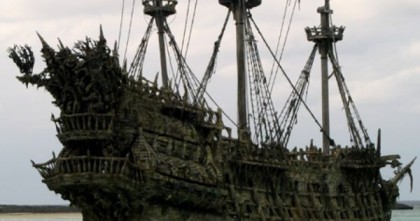
The chaplain, taking him by one of the buttons of his coat, drew him aside, and appeared to enter into serious conversation with him. While they were talking together the Captain was heard to say, “Let us look to our own ship, and not mind such things,” and accordingly, he sent a man aloft, to see if all was right about the foretop-sail yard, which was chafing the mast wit a loud noise.
It was Tom Willis who went up; and when he came down, he said that all was tight, and that he hoped it would soon get clearer; and that they would see no more of what they were most afraid of.
The Captain and first mate were heard laughing loudly together, while the chaplain observed, that it would be better to repress such unseasonable gaiety. The second mate, a native of Scotland, whose name was Duncan Saunderson, having attended one of the university classes at Aberdeen, thought himself too wise to believe all that the sailors said, and took part with the captain. He jestingly told Tom Willis, to borrow his grandam’s spectacles the next time he was sent to keep a lookout ahead.
Tom walked sulkily away, muttering, that he would nevertheless trust to his own eyes till morning, and accordingly took his station at the bow, and appeared to watch as attentively as before.
The sound of talking soon ceased, for many returned to their births, and we heard nothing but the clanking of the ropes upon the masts, and the bursting of the billows ahead, as the vessel successively took the seas.
But after a considerable interval of darkness, gleams of lightning began to reappear. Tom Willis suddenly called out, “Vanderdecken, again! Vanderdecken, again! I see, them letting down a boat.”
All who were on deck ran to the bows. The next flash of lightning shone far and wide over the raging sea, and showed us not only the Flying Dutchman at a distance, but also a boat coming from her with four men. The boat was within two cables’ length of our ship’s side. The man who first saw her, ran to the Captain, and asked whether they should hail her or not. The Captain, walking about in great agitation, made no reply.
The first mate cried, “Who’s going to heave a rope to that ship?”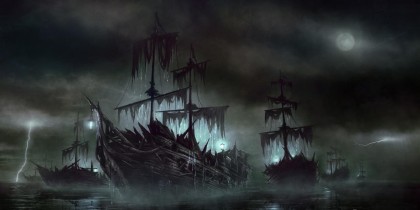
The men looked at each other without offering to do anything. The boat had come very near the chains, when Tom Willis called out, “What do you want, or what devil has blown you here in such weather?”
A piercing voice from the boat replied in English, “We want to speak with your Captain.”
The Captain took no notice of this, and Vanderdecken’s boot having come close alongside, one of the men came upon deck, and appeared like a fatigued and weather-beaten seaman, holding some letters in his hand.
Our sailors all drew back. The chaplain, however, looking steadfastly upon him, went forward a few steps, and asked, “What is the purpose of this visit?”
The stranger replied, “We have long been kept here by foul weather, and Vanderdecken wishes to send these letters to his friends in Europe.”
Our Captain now came forward, and said as firmly as he could, “I wish Vanderdecken would put his letters on board of any other vessel rather than mine.”
The stranger replied, “We have tried many a ship, but most of them refuse our letters.”
Upon which, Tom Willis muttered, “It will be best for us if we do the same, for they say, there is sometimes a sinking weight in your paper.”
The stranger took no notice of this, but asked where we were from. On being told that we were from Portsmouth, he said, as if with strong feeling, “Would that you had rather been from Amsterdam. Oh that we saw it again! — We must see our friends again.”
When he uttered these words, the men who were in the boat below, wrung their hands, and cried in a piercing tone, in Dutch, “Oh that we saw it again! We have been long here beating about; but we must see our friends again.”
The chaplain asked the stranger, “How long have your ship been at sea?”
He replied, “We have lost our count; for our almanac was blown overboard. Our ship, you see, is there still; so why should you ask how long we have been at sea? for Vanderdecken only wishes to write home and comfort his friends.”
To which the chaplain from the shipreplied, “Your letters, I fear, would be of no use in Amsterdam, even if they were delivered, for the persons to whom they are addressed are probably no longer to be found there, except under very ancient green turf in the churchyard.”
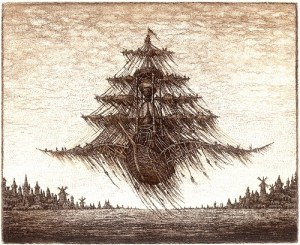
The unwelcome stranger then wrung his hands, and appeared to weep; and replied, “It is impossible. We cannot believe you. We have been long driving about here, but country nor relations cannot be so easily forgotten. There is not a raindrop in the air but feels itself kindred to all the rest, and they fall back into the sea to meet with each other again. How then, can kindred blood be made to forget where it came from? Even our bodies are part of the ground of Holland; and Vanderdecken says, if he once were come to Amsterdam, he would rather be changed into a stone post, well fixed into the ground, than leave it again; if that were to die elsewhere. But in the meantime, we only ask you to take these letters.”
The chaplain from the ship, looking at him with astonishment, said, “This is the insanity of natural affection, which rebels against all measures of time and distance.”
The stranger continued, “Here is a letter from our second mate, to his dear and only remaining friend, his uncle, the merchant who lives in the second house on Stuncken Yacht Quay.”
He held forth the letter, but no one would approach to take it. Tom Willis raised his voice, and said, “One of our men here says that he was in Amsterdam last summer, and he knows for certain, that the street called Stuncken Yacht Quay, was pulled down sixty years ago, and now there is only a large church at that place.”
The man from the Flying Dutchman, said, “It is impossible; we cannot believe you. Here is another letter from myself, in which I have sent a banknote to my dear sister, to buy some gallant lace, to make her a high headdress.”
Tom Willis hearing this, said, “It is most likely that her head now lies under a tombstone, which will outlast all the changes of the fashion. But on what house is your banknote?”
The stranger replied, “On the house of Vanderbrucker and Company.”
The man, of whom Tom Willis had spoken, said, “I guess there will now be some discount upon it, for that banking house was gone to destruction forty years ago; and Vanderbrucker was afterwards a-missing. — But to remember these things is like raking up the bottom of an old canal.”
The stranger called out passionately, “It is impossible. We cannot believe it! It is cruel to say such things to people in our condition. There is a letter from our Captain himself, to his much-beloved and faithful wife, whom he left at a pleasant summer dwelling, on the border of the Haarlemer Mer. She promised to have the house beautifully painted and gilded before he came back, and to get a new set of looking-glasses for the principal chamber, that she might see as many images of Vanderdecken, as if she had six husbands at once.”
The man replied, “There has been time enough for her to have had six husbands since then; but were she alive still, there is no fear that Vanderdecken would ever get home to disturb her.”
On hearing this the stranger again shed tears, and said, if they would not take the letters, he would leave them; and looking around he offered the parcel to the Captain, chaplain, and to the rest of the crew successively, but each drew back as it was offered, and put his hands behind his back. He then laid the letters upon the deck, and placed upon them a piece of iron, which was lying near, to prevent them from being blown away. Having done this, he swung himself over the gangway, and went into the boat.
We heard the others speak to him, but the rise of a sudden squall prevented us from distinguishing his reply. The boat was seen to quit the ship’s side, and, in a few moments, there were no more traces of her than if she had never been there. The sailors rubbed their eyes, as if doubting what they had witnessed, but the parcel still lay upon deck, and proved the reality of all that had passed.
Duncan Saunderson, the Scotch mate, asked the Captain if he should take them up, and put them in the letter bag. Receiving no reply, he would have lifted them if it had not been for Tom Willis, who pulled him back, saying that nobody should touch them.
In the meantime the Captain went down to the cabin, and the chaplain having followed him, found him at his bottle-case, pouring out a large dram of brandy. The Captain, although somewhat disconcerted, immediately offered the glass to him, saying, “Here, Charters, is what is good in a cold night.”
The chaplain declined drinking anything, and the Captain having swallowed the bumper, they both returned to the deck, where they found the seamen giving their opinions concerning what should be done with the letters. Tom Willis proposed to pick them up on a harpoon and throw it overboard.
Another speaker said, “I have always heard it asserted that it is neither safe to accept them voluntarily, nor when they are left to throw them out of the ship.”
“Let no one touch them,” said the carpenter. “The way to do with the letters from The Flying Dutchman is to case them upon deck, by nailing boards over them, so that if he sends back for them, they are still there to give him.”
The carpenter went to fetch his tools. During his absence, the ship gave so violent a pitch, that the piece of iron slid off the letters, and they were whirled overboard by the wind, like birds of evil omen whirring through the air. There was a cry of joy among the sailors, and they ascribed the favorable change which soon took place in the weather, to our having got quit of Vanderdecken. We soon got underway again. The night watch being set, the rest of the crew retired to their births.