
Monday, June 8, 2026
HomeWeird WorldParanormalThe Salem Witch Trials and the Hauntings in Salem

The Salem Witch Trials and the Hauntings in Salem

The Salem Nightmare: What Really Happened in 1692?

It didn’t start with a monster. It didn’t start with a bang. It started with a shiver. A whisper. A fit.

In the cold, god-fearing winter of 1692, a darkness fell over the small Puritan settlement of Salem Village, Massachusetts. Not a darkness of the sky, but of the soul. It was a contagion of fear that would erupt into one of America’s most infamous and terrifying chapters. The Salem witch trials. An event so bizarre, so brutal, that its echoes still scream at us from across the centuries.

We think we know the story. We’ve seen the plays, the movies. But the truth is far stranger, and far more disturbing, than you can possibly imagine. This wasn’t just a simple case of mistaken identity. It was a perfect storm of religious fanaticism, social paranoia, and possibly something else entirely. Something hidden in the shadows of history.

Forget what you learned in school. We’re going deeper.

A Village Holding Its Breath

To understand the fire, you have to understand the kindling. Salem Village in the late 17th century was not a happy place. It was a community teetering on the edge. Tense. Frightened. The world outside their tiny, isolated settlement was a terrifying wilderness, which they believed was the literal domain of the Devil.

Think about it. Bitter disputes over land and property festered between neighbors. A deep-seated rivalry simmered between the poorer, farm-based Salem Village and the more prosperous, merchant-driven Salem Town. On top of that, the bloody King William’s War was raging on the northern frontier. Refugees, including young children who had witnessed unspeakable violence at the hands of Native American tribes, were trickling into the area, bringing their trauma with them.

This was a world where God was an active, daily presence. And so was Satan. They saw his work everywhere—in a failed crop, a sick child, a strange shadow in the woods. They were primed for a fight with evil. They just needed someone to point out the enemy.

The Spark in the Minister’s Kitchen

The trouble began in the home of Salem Village’s minister, Reverend Samuel Parris. A strange sickness, a bizarre affliction, fell upon his nine-year-old daughter, Betty Parris, and his eleven-year-old niece, Abigail Williams.

It was terrifying.

The girls would scream for no reason. They would contort their bodies into impossible shapes. They would throw things, make animal noises, and complain of being bitten and pinched by invisible forces. When a local doctor, William Griggs, was called, he found no physical cause. His diagnosis? The “Evil Hand” was upon them.

Witchcraft.

The word hung in the air like frost. Soon, other young women in the village, like Ann Putnam Jr., began to show the same horrifying symptoms. The community was gripped by a single, terrifying question: Who was doing this to them?

Deep Dive: The Fortune-Telling Game

Modern historians and internet sleuths often point to a single, forbidden act. It’s believed the girls, along with Reverend Parris’s slave from Barbados, Tituba, had been experimenting with folk magic. Specifically, a form of divination involving an egg white dropped in a glass of water, used to see the face or profession of a future husband. But legend says one of the girls saw something else entirely. A coffin. A specter of death. Was this childish game the psychological trigger that sent them spiraling into genuine hysterics, forcing them to deflect blame for their dabbling in the dark arts?

The First Accusations: The Outcasts

Pressured relentlessly by magistrates Jonathan Corwin and John Hathorne, the “afflicted” girls finally named their tormentors. The first three people accused were, tellingly, the village’s most vulnerable and marginalized members:

  • Sarah Good: A homeless beggar, known for muttering to herself.
  • Sarah Osborne: An elderly, bedridden woman who had angered her neighbors over an inheritance dispute and hadn’t attended church in years.
  • Tituba: Reverend Parris’s slave, a woman from a foreign land with different cultural beliefs. An easy target.

Good and Osborne vehemently denied the charges. They were good Christian women, they insisted. But Tituba, after days of likely brutal questioning (and possibly coaching from her master), did something that sealed Salem’s fate.

She confessed. And she didn’t just confess. She told them a story.

It was a terrifying, vivid tale. She spoke of signing the Devil’s book. Of a tall man from Boston in black clothes. Of a black dog, a red cat, and flying on a stick. She claimed there were other witches in the village, working alongside her in service to Satan. It was exactly what the Puritan leaders wanted to hear. It confirmed their deepest fears. The Devil was here. And he had followers.

Tituba’s confession was like gasoline on a flame. The witch hunt had begun.

“Spectral Evidence” and Courtroom Chaos

The situation exploded. The accusations flew thick and fast, moving beyond outcasts to ensnare respected members of the community. Martha Corey, a devout churchgoer. Rebecca Nurse, a pious and elderly matriarch. Even a four-year-old girl, Dorcas Good, was accused and thrown in jail, where she was kept in chains.

The court, known as the Court of Oyer and Terminer, accepted a type of “evidence” that was impossible to defend against: Spectral Evidence.

What was it? The accusers claimed that the witch’s spirit, or specter, was leaving their physical body to attack them. So, an accused person could be locked in jail, yet the afflicted girls could scream in the courtroom, claiming that very person’s specter was choking them, pinching them, or tempting them to sign the Devil’s book right there in front of everyone.

How do you prove your ghost wasn’t somewhere it shouldn’t be? You can’t. It was a prosecutor’s dream and a defendant’s nightmare.

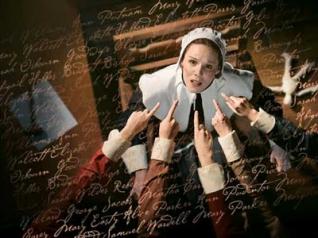
The courtroom became a theater of the macabre. The afflicted girls would writhe and scream on the floor. If an accused woman bit her lip, the girls would cry out that their lips were being bitten. If she shifted her feet, they would mimic the movement. It was a terrifying, synchronized performance that convinced the magistrates, and much of the public, that they were witnessing a genuine spiritual battle.

Nineteen people, men and women, were convicted and hanged on Gallows Hill. Several more died in the squalid prisons. But one man suffered a different, even more brutal fate.

The Crushing of Giles Corey

Giles Corey was an 81-year-old farmer. A stubborn and often-litigious man. When he was accused, he knew the game was rigged. He refused to enter a plea of “guilty” or “not guilty.” In the legal system of the time, this was a massive problem. A trial could not proceed without a plea. So, the court turned to a medieval punishment to force one from him: *peine forte et dure*. Pressing.

They took him to an open field, stripped him, and placed a heavy wooden board on his chest. Then, one by one, they piled heavy stones onto the board. For two days, they tortured him, demanding a plea. His only reply, according to legend, was a defiant, gurgling cry: “More weight!”

Giles Corey was pressed to death. He never entered a plea. Why? Because by refusing, his trial never happened, and he could not be legally convicted of witchcraft. This meant his property and farm could not be seized by the state, and would instead pass to his sons. In his final, agonizing act, he beat the corrupt system.

What REALLY Caused the Hysteria? The Modern Theories

For centuries, people have asked: what in God’s name was actually happening? Was it really witchcraft? Or was it something else? Something more scientific… or more sinister.

Theory #1: The Ergot Poisoning Hypothesis

This is a big one. In the 1970s, a graduate student named Linnda Caporael proposed a startling biological theory. The symptoms described by the afflicted girls—convulsions, muscle spasms, hallucinations, a crawling sensation on the skin—are remarkably similar to the effects of ergotism. Ergot is a fungus that grows on rye, a staple grain for the Puritans. The damp, swampy growing season of 1691 would have been perfect for this fungus to thrive. Is it possible the girls were not possessed, but poisoned by their own bread? This theory has been debated for decades, but it remains a chillingly plausible explanation for the initial outbreak.

Theory #2: A Land Grab and Social Warfare

Follow the money. And the power. If you map out the accusers and the accused, a fascinating pattern emerges. Many of the accusers, led by the powerful Putnam family, lived in the rural, less-affluent Salem Village. A surprising number of the accused were connected to the wealthier, more commercially-focused Salem Town, particularly the Porter family. These two factions were already locked in a bitter political and economic struggle. Some historians argue that the witchcraft accusations were not about religion at all, but were a convenient, deadly weapon used by the Putnams and their allies to eliminate their rivals and settle old scores.

Theory #3: Post-Traumatic Stress and Mass Psychosis

Remember those frontier wars? Many of the “afflicted girls” were refugees or had lost family in brutal conflicts. They were living in a constant state of anxiety and terror. Some psychologists and historians suggest the “fits” were a manifestation of severe, unresolved trauma—a form of PTSD. In a hyper-religious society with no concept of mental health, their very real psychological pain was interpreted as demonic possession. Once the pattern was established, it snowballed into a case of mass sociogenic illness, where the symptoms of hysteria spread like a virus through the suggestible and stressed-out population.

The Fever Breaks

So what stopped the madness? Eventually, the accusers got too bold. They started pointing fingers at people who were too powerful, too well-respected. The wife of Governor William Phips was named. The Reverend John Hale’s wife was accused. Suddenly, the elite men running the trials began to doubt. Could all these fine, upstanding people truly be in league with the Devil?

Influential Boston ministers like Increase Mather began to publicly condemn the use of spectral evidence, calling it unreliable and unholy. He famously wrote that it “were better that Ten Suspected Witches should escape, than that one Innocent Person should be Condemned.”

The tide turned. In May of 1693, Governor Phips ordered the release of all remaining prisoners accused of witchcraft and officially disbanded the court. The trials were over. But the damage was done.

The Hauntings: Salem’s Restless Spirits

The trials may have ended, but the story didn’t. Salem is considered one of the most haunted places in America. Coincidence? Or is the profound, violent injustice of that year still staining the very land itself? The paranormal energy reported here is off the charts.

Gallows Hill: The site where the 19 victims were hanged is now a park. But visitors and paranormal investigators report sudden cold spots, the feeling of being watched, and disembodied whispers on the wind. Glowing orbs of light are a common photographic anomaly, believed by many to be the restless souls of the condemned.

The Joshua Ward House: This building sits on the former property of Sheriff George Corwin, the man responsible for the arrests and executions, including the pressing of Giles Corey. It is said to be haunted by multiple spirits, most notably Corwin himself and one of his witch trial victims, whose spirit allegedly tries to choke visitors in her former prison cell in the basement.

Saint Mary’s Cemetery: While not directly from the trials, this location is infamous for a pervasive feeling of dread and evil. People report hearing strange noises and seeing a fast-moving, glowing light darting between the tombstones. Is it a concentration of the negative energy that has plagued this town for centuries?

The Salem Witch Trials were a human tragedy born from a perfect storm of fear. It stands as a terrifying warning of what can happen when superstition, paranoia, and a failure of due process collide. Whether you believe in poisoned bread, political conspiracies, or actual ghosts, one thing is certain: the events of 1692 tore a hole in the fabric of a community. And some say, that hole has never truly closed.

Amit Ghosh
Amit Ghoshhttps://coolinterestingnews.com
Aloha, I'm Amit Ghosh, a web entrepreneur and avid blogger. Bitten by entrepreneurial bug, I got kicked out from college and ended up being millionaire and running a digital media company named Aeron7 headquartered at Lithuania.
RELATED ARTICLES
- Advertisment -

Most Popular

Recent Comments

Warren Pan Abbott on The legend of the Devil Monkey !
chris davies on The McPherson Tape Mystery
Reed Reedly on ET has Internet!
Bea Houseoffashion on Proof Of Time Travellers – Gallery
Marcus2012 on ET has Internet!
Reed Reedly on ET has Internet!
LaughsAtConspiracyNuts on The 9/11 Conspiracy – Myths and Facts
Alex Sliverman on Did the ancients fly?
Doctor Wholigan on Time Traveler in 1938 film
chris davies on The McPherson Tape Mystery
Archie1954 on 10 secret UFO hideouts
chris davies on Ghosts of flight 401
Marcus2012 on ET has Internet!
jason Macdonald on Proof of Time Travel? – China
chris davies on Long-Lost Pyramids Found?
Reed Reedly on ET has Internet!
Milkman on Connected Universe
Tenmiles on Baigong Pipes Mystery
Simon Foster on Sirius – The Documentary
From the 1st April on 2013 – Alien Contact date ?
SkyWatcher on Is ET ignoring us?
I Come From The Future on Obama to make UFO Alien disclouser soon ?
ÛñK?øWn on 2013 – Alien Contact date ?
Just another person on 2013 – Alien Contact date ?
Malcolm Windowcleaner on The strange case of Rudolph Fentz
Mason Servio on Strange Things on Mars
Marke Wisdom Seeker on What will we find as arctic melts?
Andrea A Elisabeth Levyne on Aliens Captured in Varginha, Brazil
Mitch Grouyeki on Amazing Space Shuttle pictures









