The Lost Sleepers of Ephesus: History’s First Accidental Time Travelers?
Forget H.G. Wells. Forget wormholes and fancy machines.
What if the first documented case of time travel didn’t involve science, but a nap? A very, very long nap. We’re talking about a story so old, so profound, it’s revered by billions, yet it hides a mind-bending possibility that most people have never considered. This isn’t just a religious fable. It’s a temporal anomaly, an unexplained event that blurs the line between miracle and something far stranger.
Seven young men went into a cave to hide. They fell asleep.
When they woke up, two centuries had vanished. Their world was gone, replaced by a future they couldn’t possibly comprehend. Were they saints? Or were they victims of a glitch in the very fabric of reality?
Buckle up. We’re going back to the ancient world to investigate a mystery that time itself has tried to forget.

These seven dudes traveled in time!
A World of Blood and Gods
To understand how they got lost in time, you first need to understand the world they were desperate to escape. We’re in the Roman Empire, around the year 250 AD. The man in charge is Emperor Decius, and he has a serious problem.
The Empire is creaking. It’s under attack from the outside and rotting from within. Decius, a military man, believes the solution is a return to tradition. A return to the old gods. Jupiter. Mars. Venus. He believes the people’s wavering faith has angered the pantheon, bringing plague and invasion upon them. His solution? A loyalty test.
He issues an edict that ripples across the known world. Every single person—man, woman, and child—must perform a public sacrifice to the Roman gods. Burn some incense, pour a little wine, say a prayer. In return, you get a certificate, a *libellus*, proving your loyalty. It’s a simple act. Unless you can’t do it. Unless your faith forbids it.
The Crime of Being a Christian
For the growing Christian community, this was an impossible choice. Sacrificing to a pagan god was a betrayal of their one true God. Refusal meant you were an enemy of the state. A traitor. And the punishment was swift and brutal. Arrest. Torture. Execution.
This was the world of the Seven Sleepers. Imagine the paranoia. Your neighbor could be an informant. The friendly legionary on the street corner could be the one to drag you away. The magnificent city of Ephesus, a jewel of the Aegean coast with its grand libraries and the breathtaking Temple of Artemis, had become a cage.
Seven young men of good families, their traditional names recorded as Maximian, Malchus, Martinian, John, Dionysius, Exacustodianus, and Antoninus, made their choice. They refused to sacrifice. They refused to bend. And so, they had to run.
The Cave at the Edge of Time
Hunted by Roman authorities, they fled the city, scrambling up the slopes of Mount Pion. They found refuge in a place of shadows and silence. A cave.
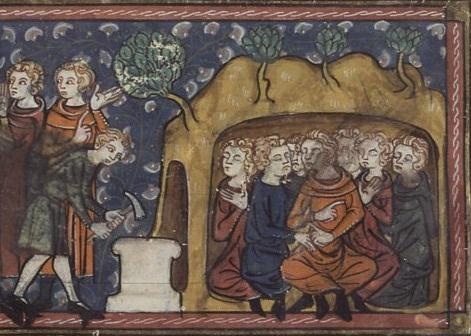
They huddled together in the cool darkness, the sounds of the city fading into a distant hum. They prayed. They waited. According to the legend, the Emperor, furious at their defiance, ordered the mouth of the cave to be sealed with massive stones. A living tomb. He left them to starve, their faith their only companion in the suffocating blackness.
And then… they fell asleep.
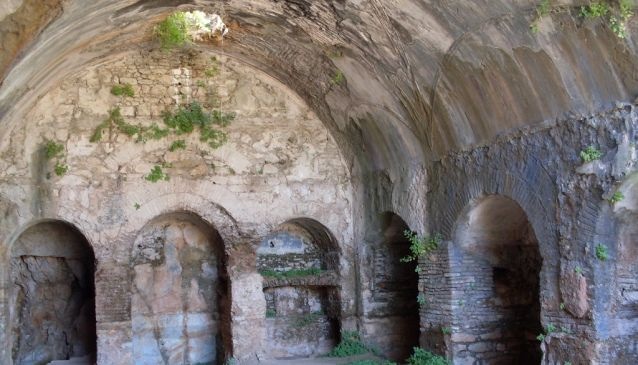
Cave of the seven time travelers
A Sleep Deeper Than Death
This is where the story takes a hard right turn into the bizarre. This wasn’t ordinary sleep. Days, weeks, years, decades… they all melted away while the seven men lay motionless. Outside their stone prison, the world burned and was reborn.
The Roman Empire fractured. Emperor Decius was killed in battle. Persecutions flared and then faded. An emperor named Constantine saw a cross in the sky, converted, and changed the course of human history forever. The very faith that the seven had been willing to die for was now the official religion of the most powerful empire on Earth.
But inside the cave? Nothing. Just stillness. Just silence.
Was this a divine miracle, God placing his servants in a protective stasis? Or was something else at play? Modern physics talks about gravitational distortions and temporal pockets where time flows at a different rate. Could this cave on Mount Pion have been a natural anomaly, a place where the fabric of spacetime was thin, weak, and easily bent? Could they have stumbled into a fold in reality and simply… slipped through the cracks?
Waking Up in the Future
The story goes that nearly 200 years later, around 447 AD, a local landowner decided to use the stones blocking the cave to build a cattle pen. As his workers hauled the massive rocks away, they broke the seal. Sunlight, for the first time in generations, pierced the darkness.
And the men woke up.
They stretched, yawning. They felt hungry. To them, it had been a single night. They assumed the danger had passed and decided one of them, Malchus, should sneak back into Ephesus to buy bread. He took a few old coins from his purse and, cautiously, made his way down the mountain.
What he saw must have broken his mind.
The Shock of a New World
Everything was wrong. The buildings were different. The people’s clothes were strange. But the most jarring thing? He saw large, ornate crosses mounted on the city gates and atop buildings. The very symbol that got people killed was now displayed with pride. Everywhere. He thought he was dreaming, or perhaps had wandered into a different city entirely.
Shaking with confusion, he went to a baker. He offered his payment. The baker took one look at the coin and his eyes went wide. He huddled with his friends, pointing at Malchus, whispering.
The coin bore the image and name of Emperor Decius. A relic. An antique. They accused Malchus of being a treasure hunter, of having found a secret hoard of ancient gold. They didn’t believe his frantic story about buying bread for his friends. They dragged him before the city’s bishop.
The truth that unspooled in the bishop’s chambers was more shocking than any hidden treasure. As Malchus told his story, as he described the persecutions of Decius, the names of officials long dead, a stunning realization dawned. This man wasn’t a liar or a madman. He was a ghost. A living fossil from a forgotten age.

A Miracle for a Doubting Age
A procession of stunned citizens followed the bishop and Malchus up the mountain to the cave. There they found the other six, just as confused as Malchus had been. The story was undeniable.
The timing was perfect. At that very moment, a fierce theological debate was raging in the Byzantine Empire. Influential groups were arguing that the resurrection of the body after death was just a metaphor, not a literal event. And then, seven men literally wake up after what was essentially death.
Emperor Theodosius II, who ruled from Constantinople, heard the news and traveled to Ephesus. He spoke with the sleepers, declaring them to be living proof of the resurrection. Their reappearance was hailed as one of the greatest miracles in history. Having fulfilled their divine purpose, the seven men, now ancient beyond their years, blessed the Emperor, lay back down in their cave, and died peacefully, this time for good.
They were buried in the cave that had been their tomb, their sanctuary, and their time machine. It became one of the most sacred pilgrimage sites in the Christian world.
The Echo in Islam: The Companions of the Cave
But the story doesn’t end there. It’s too powerful. Centuries later, the tale reappears, transformed, in the heart of another of the world’s great religions: Islam. An entire chapter of the Qur’an, Surah 18, *Al-Kahf* (“The Cave”), is dedicated to them. They are known as the *Ashab al-Kahf*, the Companions of the Cave.
The Islamic version shares the core elements: young men of faith fleeing a tyrannical king, taking refuge in a cave, and being put to sleep by God for a vast period. But there are fascinating differences.
- The Dog: The Qur’anic telling adds a faithful dog, often named Qitmir in Islamic tradition, who guarded the entrance to the cave, also asleep for the entire duration. This loyal companion has become a beloved figure in Islamic folklore.
- The Timespan: The account is more specific about the duration. It states they slept for “three hundred years and add nine,” which many interpret as 300 solar years or 309 lunar years.
- A Lesson in Humility: The exact number of sleepers is left intentionally vague by God in the text (“Some will say there were three, their dog the fourth… Say, ‘My Lord is most knowing of their number.'”). This serves as a lesson against pointless speculation and a reminder that only God holds all knowledge.
The story’s presence in both the Bible and the Qur’an gives it an incredible weight. This isn’t some obscure local legend. It’s a foundational story for billions of people. But does that make it true?
The Skeptic’s View: Deconstructing the Legend
So, what really happened in that cave? Let’s strip away the layers of miracle and faith for a moment and look at the cold, hard possibilities.
Was it just an allegory? The most straightforward explanation is that it’s a powerful morality tale. A story created to inspire faith during times of persecution and to serve as a convenient “proof” for theological arguments like the resurrection. Over time, the story became so popular that people started believing it was literal history.
A medical anomaly? Could the men have fallen into a coma, perhaps from a lack of oxygen in the sealed cave? It’s a stretch, but not entirely impossible. A two-century coma, however, is far beyond anything known to medical science.
Suspended animation? Some modern theorists have proposed that unique atmospheric conditions or even subterranean gases in the cave could have induced a state of natural cryosleep or suspended animation. They didn’t age, they didn’t need sustenance. They were, for all intents and purposes, paused.
Or was it a genuine temporal event? This is the theory that sends shivers down your spine. If we entertain the idea that time isn’t a straight line, that it can bend and warp, then the Seven Sleepers become the ultimate accidental astronauts of the fourth dimension. They didn’t travel through space; they traveled through years. The cave was their vessel. Their awakening wasn’t a resurrection; it was a re-entry.
The Mystery That Refuses to Die
Today, you can visit the supposed site of the Cave of the Seven Sleepers. Well, one of them. Several locations, from Ephesus in Turkey to sites in Jordan and even Tunisia, claim to be the *real* cave, adding another layer of confusion to the story.
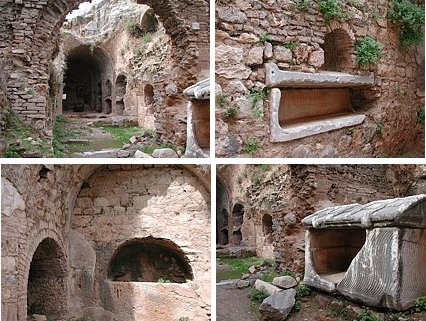
The Grotto of the Seven Sleepers in Ephesus is a haunting complex of rock-cut tombs, a place heavy with the whispers of history. Archaeologists have excavated it, finding hundreds of graves from centuries of pilgrims who wished to be buried near the holy time travelers.
So what are we left with? A pious fable? A garbled historical account? Or a chilling report of a temporal paradox that our ancestors could only explain as a miracle?
The story of the Seven Sleepers is a perfect enigma. It sits at the crossroads of history, faith, and the fantastic. It challenges our understanding of the world and the rules we think govern it. Whether they were touched by the hand of God or simply stumbled into a wrinkle in time, their story has achieved a kind of immortality they never could have imagined. They went to sleep as fugitives in one world and woke up as legends in another.
And it leaves us with one unsettling question: if a cave could swallow two hundred years, what other thin places exist in our world, waiting for the next person to simply fall asleep?