Thursday, May 7, 2026
HomeUnexplained MysteriesModern MysteriesMystery surrounds ‘mummified’ body of adventurer found in abandoned yacht!

Mystery surrounds ‘mummified’ body of adventurer found in abandoned yacht!

The Ghost Ship of the Pacific: The Mummified Sailor and the Mystery That Won’t Die

The ocean keeps its secrets. It swallows ships, hides forgotten treasures, and sometimes, just sometimes, it offers up a mystery so chilling it burns itself into our collective memory. This is one of those stories.

Imagine this.

You’re a fisherman. The sun is beating down on the Philippine Sea. It’s just another day, another catch. But then you see it. A yacht, adrift. Its sail is shredded, a ghostly white rag flapping against a broken mast. It’s silent. Too silent. As you draw closer, a sense of dread creeps in. This isn’t just an abandoned vessel. It’s a tomb.

This was the scene that greeted two unsuspecting fishermen in February 2016. What they found inside would spark a global firestorm of questions, theories, and pure, raw horror. They found a man. A dead man, frozen in time, perfectly preserved by the very elements that likely killed him.

A Glimpse into a Floating Grave

The 40-foot yacht was named the Sayo. It was a vessel that had once been a home, a vessel of adventure. Now, it was a wreck. The cabin was partially submerged, a chaotic slurry of seawater, canned goods, and personal belongings. Family photo albums floated alongside tattered clothes. A life, capsized and scattered.

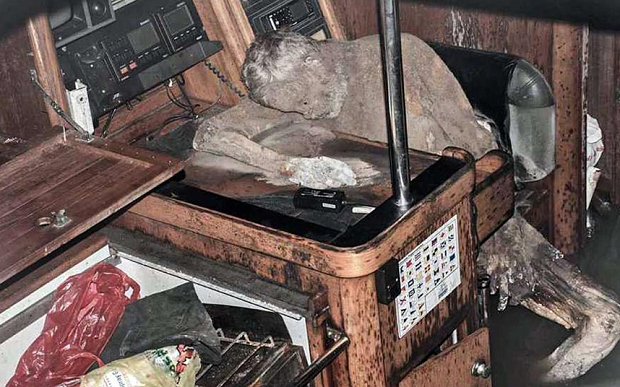
But the chaos in the main cabin was nothing compared to the eerie stillness of the radio room. There, slumped over a desk as if he had just nodded off, was the body of the ship’s captain. His skin was gray and leathery. His posture was locked in his final, desperate moment. His hand was outstretched, hovering just above the radio telephone. He was trying to make one last call.

A call that never went through.

image-25

Police were baffled. The deputy police chief of Barabo, the town where the body was brought, simply said, “It is still a mystery to us.” The man showed no obvious signs of foul play. No wounds. No weapons. Just a silent figure, mummified by the sea.

Who Was Manfred Fritz Bajorat?

The paperwork on the boat identified him as Manfred Fritz Bajorat, a 59-year-old German adventurer. This wasn’t some weekend sailor who got in over his head. Bajorat was the real deal. A veteran mariner who had spent the better part of two decades crisscrossing the globe on the Sayo. He had navigated the treacherous waters of the Atlantic, the calm expanses of the Caribbean, and the vast, blue emptiness of the Pacific.

For twenty years, the sea was his home. He knew its moods, its dangers, its beauty. He was, by all accounts, a man who had mastered his world.

So what happened?

The last confirmed sighting of Manfred Bajorat was in 2009. For seven long years, he was a ghost. A man sailing off the edge of the map. Where had he been? What had he seen? The logbooks were waterlogged and useless. His journey had become a blank page.

A Heartbreak at Sea

To understand Manfred’s final years, you have to understand his greatest loss. For most of his voyages, he wasn’t alone. He sailed with his wife, Claudia. They were a team, partners in a life of sun, salt, and endless horizons. But in 2010, their shared journey came to a tragic end when Claudia died of cancer.

Manfred was shattered. The sea, once a source of shared joy, now became his solitary refuge. His escape. A friend later recounted that Manfred couldn’t bear the thought of living on land without her. The ocean was all he had left.

Buried deep within the wreckage of the Sayo, investigators found a heartbreaking clue. A note, a small memorial written by Manfred to his lost love. It read:

“Thirty years we’ve been together on the same path. Then the power of the demons was stronger than the will to live. You’re gone. May your soul find its peace. Your Manfred.”

This wasn’t just a sailor. This was a heartbroken man, adrift in his own grief, sailing toward an unknown fate.

Dissecting the Scene: The Science and the Silence

The condition of Bajorat’s body was, for many, the most shocking part of the story. How could a body remain so perfectly preserved for so long? The answer is a grim cocktail of natural forces.

The Perfect Preservation Chamber

Forensic experts explained that the unique conditions at sea created a natural mummification process. Think about it. The constant, dry ocean winds. The high, baking temperatures inside the cabin. And most importantly, the salt in the air. This combination effectively acted like a giant dehydrator, sucking the fluids from his body before major decomposition could set in. It was a freak occurrence, turning his final resting place into a perfect preservation chamber. He wasn’t decaying; he was simply drying out.

What Took Down the Sayo?

The broken mast points to a violent event. Seasoned sailors believe the yacht was likely caught in a squall or a sudden, powerful storm. The force required to snap a mast like that is immense. The boat would have been thrown about like a toy, water crashing over the deck, systems failing.

This is the leading theory for what initiated the crisis. A storm appears, the mast breaks, the boat is disabled, and Manfred is left stranded, at the mercy of the ocean.

The Investigation: Official Answers vs. Lingering Questions

Eventually, an official autopsy was performed. The results seemed to provide a clean, simple answer to the mystery. But did they really?

The Official Cause of Death: A Heart Attack

The final report concluded that Manfred Fritz Bajorat died of an acute myocardial infarction. A heart attack. The report suggested he likely died suddenly, perhaps just a week before his body was found. The doctors were confident. Case closed, right?

Wrong. This is where the story gets messy.

If he died only a week before being found, what about the seven years he was missing? Where was he all that time? The official timeline just doesn’t seem to fit the known facts. His last known contact was in 2009. The yacht was in a state of advanced decay. Yet the medical examiner suggests a death that was almost immediate? It doesn’t add up.

The Internet’s Deep Dive into Darker Waters

When the official story feels thin, the internet rushes in to fill the void. And the theories surrounding Manfred Bajorat are as deep and dark as the ocean he sailed.

  • The Pirate Theory: The waters around the southern Philippines are notorious for piracy. Some online sleuths argue that Bajorat was attacked. They point to the ransacked cabin as evidence. Maybe a struggle ensued, the stress of which triggered a fatal heart attack. Perhaps the pirates, seeing he was dead, simply took what they could and left the boat adrift. It’s a compelling narrative, but police found no evidence of other people on board or signs of a violent struggle on the body.
  • The Slow Catastrophe Theory: This theory is perhaps the most tragic. What if the mast broke months, or even a year, before he was found? Bajorat, an expert sailor, would have tried to survive. He would have rationed his food and water, tried to rig a jury sail, and constantly worked the radio. But as days turned into weeks, and weeks into months, despair would set in. His health would fail. The final heart attack wasn’t a sudden event in a storm, but the final flicker of a life that had been slowly extinguished by hopelessness and starvation. His final pose at the radio wasn’t one last desperate call, but the final act of a man who had tried, and failed, for a very long time.
  • The Timeline Conspiracy: Some believe the “last seen in 2009” detail is being misinterpreted. He was active on a sailor’s forum in 2013, and a friend claimed to have had contact with him via Facebook that same year. If that’s true, the “missing” period shrinks considerably. But it still leaves a huge gap. Why would a man who lived his life on the water suddenly go silent for years before his death?

What If? Painting a Picture of the Final Moments

We may never know the exact sequence of events. But we can imagine. Let’s explore a few possibilities of what might have happened in those final, terrifying hours aboard the Sayo.

Scenario 1: The Sudden Fury

The sky darkens without warning. A storm rolls in, violent and fast. The Sayo is tossed by monstrous waves. A deafening crack echoes as the mast splinters and falls. Water pours into the cabin. Manfred is thrown against a wall, the shock and physical exertion putting an immense strain on his heart. He stumbles to the radio, knowing it’s his only chance. As he reaches for the microphone, a crushing pain explodes in his chest. He collapses, his hand outstretched, his last breath a silent plea for help.

Scenario 2: The Lonely End

The boat has been disabled for weeks. The sun beats down relentlessly. His supplies are gone. His body is weak from dehydration and lack of food. He has lost all track of time. His thoughts drift constantly to Claudia. He looks at her photo, tucked away near the navigation table. He feels a strange peace settling over him. He sits at the radio, not to call for help, but as a familiar comfort. He slumps over, his body finally giving up the ghost, his mind already with the woman he loved. The heart attack is just the final, biological step in a death that began weeks earlier.

A Sailor’s Final Port of Call

The story of Manfred Fritz Bajorat is more than just a ghost ship tale. It’s a story of adventure, of profound love, and of heartbreaking loss. It’s a chilling reminder of the raw power of nature and the profound fragility of human life.

His daughter, Nina, had to fly to the Philippines to identify her father’s mummified remains. She was the one who had to sort through the waterlogged photo albums, seeing images of her parents in happier times, living a dream that ended in a nightmare.

We have the official story. A heart attack. A storm. But when you look at that haunting image of a man frozen in time, reaching for a connection that never came… you have to wonder. Does the ocean ever truly give up all its secrets?

Or does it just create more questions?

Arindam Mukherjee
Arindam Mukherjee
Arindam loves aliens, mysteries and pursing his interest in the area of hacking as a technical writer at 'Planet wank'. You can catch him at his social profiles anytime.
RELATED ARTICLES
- Advertisment -

Most Popular

Recent Comments

Warren Pan Abbott on The legend of the Devil Monkey !
chris davies on The McPherson Tape Mystery
Reed Reedly on ET has Internet!
Bea Houseoffashion on Proof Of Time Travellers – Gallery
Marcus2012 on ET has Internet!
Reed Reedly on ET has Internet!
LaughsAtConspiracyNuts on The 9/11 Conspiracy – Myths and Facts
Alex Sliverman on Did the ancients fly?
Doctor Wholigan on Time Traveler in 1938 film
chris davies on The McPherson Tape Mystery
Archie1954 on 10 secret UFO hideouts
chris davies on Ghosts of flight 401
Marcus2012 on ET has Internet!
jason Macdonald on Proof of Time Travel? – China
chris davies on Long-Lost Pyramids Found?
Reed Reedly on ET has Internet!
Milkman on Connected Universe
Tenmiles on Baigong Pipes Mystery
Simon Foster on Sirius – The Documentary
From the 1st April on 2013 – Alien Contact date ?
SkyWatcher on Is ET ignoring us?
I Come From The Future on Obama to make UFO Alien disclouser soon ?
Just another person on 2013 – Alien Contact date ?
Malcolm Windowcleaner on The strange case of Rudolph Fentz
Mason Servio on Strange Things on Mars
Marke Wisdom Seeker on What will we find as arctic melts?
Andrea A Elisabeth Levyne on Aliens Captured in Varginha, Brazil
Mitch Grouyeki on Amazing Space Shuttle pictures