They Were Here: The Definitive Guide to Alien Artifacts History Tried to Forget
Forget what you learned in history class. Forget the neat, tidy timelines and the simple explanations for ancient wonders. Peel back the curtain of academic consensus, and you find… things. Things that shouldn’t exist. Artifacts that whisper of a past far more complex, far more technological, and far more… alien than we’ve ever been told.
This isn’t just a question anymore. It’s a breadcrumb trail.
For decades, the idea of ancient astronauts was relegated to late-night television and the dusty corners of bookstores. But the evidence, carved in stone and forged in gold, refuses to stay silent. It screams a single, world-shattering truth: we were not alone. They came, they saw, and they left things behind. Tangible proof.
So, what did they leave? Let’s turn over the rocks the history books tell you to ignore. Let’s look at the puzzle pieces that just don’t fit. Prepare yourself. Because once you see it, you can’t unsee it.
Life From The Stars? The Polonnaruwa Meteorite Riddle
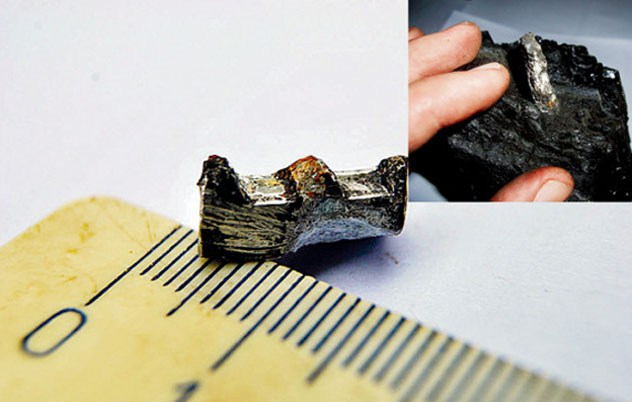
It began with a fireball. On December 29, 2012, a blazing object tore through the sky over the village of Polonnaruwa in Sri Lanka. It wasn’t just a light show. It exploded, raining down fragments of smoky, strange-smelling rock. Local villagers collected the pieces. To them, it was just a curiosity. A stone from the heavens.
But to scientists, it was a bombshell.

When researchers from the Buckingham Centre for Astrobiology got their hands on these fragments, they put them under an electron microscope. What they found stopped them cold. The rock wasn’t just rock. It was a tomb. Encased within the stone matrix were microscopic, fossilized structures that looked eerily familiar. They looked like life.
Deep Dive: The Panspermia Problem
This discovery threw gasoline on one of science’s oldest and most controversial fires: Panspermia. The idea is simple, yet profound. Life didn’t start on Earth. It came from somewhere else. It drifts through the cosmos as microbial spores, hitching rides on comets, asteroids, and meteorites, seeding planets like a cosmic gardener. When a seeded rock crashes into a habitable world like ours… life begins.
Think about it. The universe is 13.8 billion years old. Earth is only 4.5 billion. That leaves an eternity—over 9 billion years—for life to have started somewhere else first. Why must we assume Earth was the starting line? It’s far more likely we were just one stop on an interstellar highway of biology.
Professor Chandra Wickramasinghe, the lead researcher on the Polonnaruwa study, announced his findings to a stunned world. He claimed these were not just any fossils; they were complex, structured diatoms (a type of algae) that could only have formed in liquid water. Since the rock was from space, the conclusion was inescapable: this was fossilized alien life.
The implications are staggering. It means life is not a miracle unique to our planet. It’s common. It’s everywhere. And it has been for a very, very long time.
The Official Story vs. The Truth
Almost immediately, the mainstream scientific community pushed back. Hard. They pointed fingers at Wickramasinghe, a known and vocal supporter of Panspermia, suggesting he was seeing what he wanted to see. The critics’ main argument? Contamination.
They claimed the fossils were nothing more than modern, freshwater diatoms that got into the porous rock after it landed on Earth. They argued that the creatures found were identical to species found in Sri Lankan reservoirs. A simple case of a space rock falling into a puddle.
But the story isn’t that simple. Wickramasinghe’s team fired back. They showed that the fossils were embedded deep within the rock matrix, not just sitting on the surface. They pointed to the nitrogen levels in the samples, which were significantly lower than in modern organisms, suggesting ancient origins. They argued that the speed at which the meteorite entered the atmosphere would have sterilized its surface, making contamination unlikely.
So who do you believe? The scientific establishment, desperate to maintain the status quo that Earth is a special, isolated cradle of life? Or the researchers who held the physical evidence in their hands, evidence that suggests our planet’s biology—and perhaps humanity itself—has cosmic origins?
The Polonnaruwa meteorite remains a hot potato of science. But it sits there, a silent stone witness, suggesting that the first aliens to visit Earth weren’t in silver ships. They were microbes. Our oldest, most distant ancestors.
Colombia’s Golden Jets: Blueprints of Ancient Aircraft?
Deep in the heart of South America, long before the Spanish conquest, the Quimbaya civilization flourished. Living in what is now modern-day Colombia between 500 BCE and 1000 CE, they were master artists and goldsmiths. They left behind thousands of exquisite golden objects, most of them depicting animals, people, and insects.
Most of them.
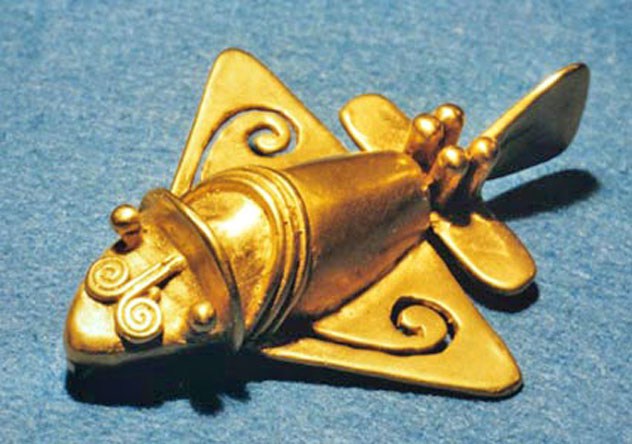
Among the collection of golden trinkets, archaeologists found a handful of objects that made no sense. They were about two inches long and looked like nothing in the animal kingdom. For years, they were labeled “zoomorphic figures,” a fancy way of saying “animal-shaped objects,” and then filed away in the Gold Museum in Bogotá. The official explanation? They were probably stylized flying fish or insects.
And then someone looked closer.

A flying fish? Really? Since when does a fish have a perfectly vertical tail fin, like the rudder on a modern airplane? Since when does an insect have swept-back, delta-shaped wings, a defined fuselage, and stabilizing tailplanes? These weren’t just “stylized animals.” They looked, for all the world, like blueprints for high-performance jet aircraft.
The “What If” Experiment That Changed Everything
The theory simmered in ancient astronaut circles for years. But it was just a theory. Until 1996. German aeronautical engineers Peter Belting and Conrad Lubbers decided to put the theory to the ultimate test. They didn’t just analyze the golden figures. They built them.
They created perfectly scaled-up, radio-controlled models of the most aircraft-like Quimbaya artifacts. They didn’t alter the core design; they simply added a propeller for propulsion. They took their models to a runway. They launched them.
And they flew. Perfectly.
The models weren’t just stable; they were highly aerodynamic, capable of high-speed maneuvers and smooth landings, even with the engine cut for gliding. The strange shapes weren’t artistic fancy. They were functional aerodynamic designs. The Quimbaya hadn’t just made a pretty trinket; they had, somehow, recorded the precise design of a flying machine thousands of years before the Wright brothers.
So where did they get the design? It’s highly unlikely the Quimbaya, a culture without the wheel, developed jet propulsion on their own. The logical leap is as terrifying as it is exciting. They weren’t the engineers. They were just witnesses. They saw these machines tear through their skies, and like any awe-struck people, they recreated what they saw in the most precious material they had: gold.

The “experts” will still tell you they’re bees or fish. They ask you to ignore the vertical stabilizers, the cockpits, the delta wings. They ask you to believe that it’s all just a coincidence. As always, the truth is laid out before you. Is it an insect? Or is it an ancient fighter jet?
The Spacemen of Ancient Japan: Decoding the Dogu Dolls
Let’s travel across the world, and back in time. Way back. To the Jomon period of prehistoric Japan, a culture that lasted from roughly 10,000 BCE to 300 BCE. They were a hunter-gatherer society, known for their distinctive pottery. And for something else. Something far stranger.
The Dogu.
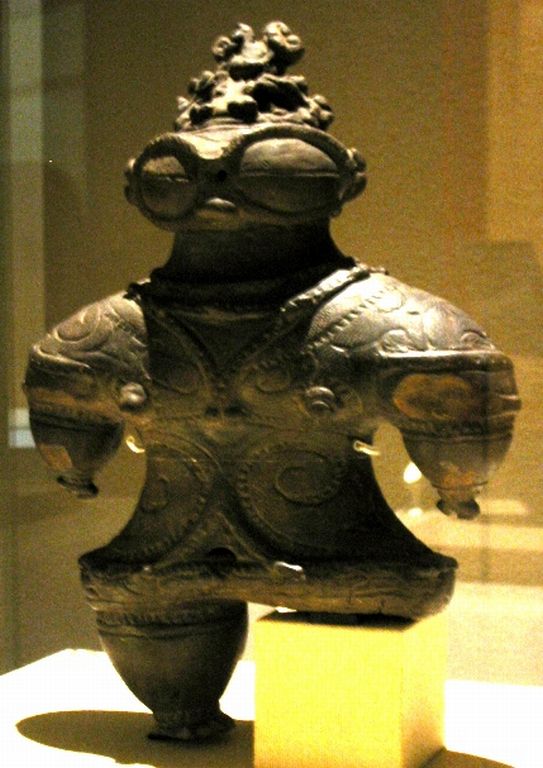
These are small humanoid figurines, crafted from clay. Thousands have been found all across Japan. And they are bizarre. They have wildly oversized heads, tiny arms, and stout bodies. But it’s the faces that make you stop. They have enormous, slit-like eyes that look exactly like goggles. Their mouths are often just a small hole or slit, resembling a respirator. They seem to be wearing bulky, patterned suits and large, domed helmets.

Mainstream archaeology calls them fertility goddesses or shamanic figures. They suggest the big eyes represent a state of spiritual trance. Some say they were effigies used in healing rituals, as many have been found broken, suggesting a limb was snapped off to cure a corresponding ailment in a real person.
Plausible? Maybe. But look at them again. Really look.

Forget the textbook explanation for a moment and just use your eyes. What do you see? You see a figure in a puffy, technological suit. You see a helmet with optical lenses. You see something that looks exactly like a modern astronaut. Or, more accurately, an ancient one.
Why would a primitive Stone Age culture, for over ten thousand years, consistently create thousands of figures that look like visitors from another world? Were these fertility goddesses? Or were they depictions of the “gods” themselves? Gods who descended from the sky in bright lights, wearing strange suits that allowed them to breathe our air. Gods who were not divine, but were simply travelers from a more advanced world. The Jomon people, with no other frame of reference, carved what they saw. They carved the Star-People.
The Mayan Astronaut: King Pakal’s Final Flight
No list of ancient alien evidence is complete without a trip to Palenque, Mexico. Deep in the jungle sits the stunning Temple of the Inscriptions. For centuries, it was thought to be just a pyramid with a temple on top. But in 1952, archaeologist Alberto Ruz Lhuillier noticed something odd about a stone slab in the temple floor. It had holes for lifting.
What he found beneath it was a secret stairway, deliberately filled with rubble, leading deep into the heart of the pyramid. After four years of clearing the passage, his team broke into a crypt. Inside was a massive, intricately carved limestone sarcophagus. It held the remains of K’inich Janaab’ Pakal, or Pakal the Great, the most powerful ruler of Palenque.
But it wasn’t the king’s jade-adorned skeleton that caused a global sensation. It was the lid of his coffin.

The five-ton slab is covered in one of the most complex and baffling carvings ever discovered. Mayanists will give you the standard interpretation: It shows King Pakal at the moment of his death, falling into the jaws of the underworld monster. The cross-like object he is seated on is the World Tree, which connects the heavens, the earth, and the underworld. The bird on top is the Celestial Bird. The “flames” at the bottom are the roots of the tree plunging into the darkness.
It’s a beautiful, poetic interpretation. It’s also, possibly, complete nonsense.
In his 1968 book “Chariots of the Gods?”, Erich von Däniken proposed a radically different idea. He told people to stop thinking like archaeologists and start thinking like engineers. Turn the image on its side. What do you see now?
You see a man in a cockpit. He is semi-reclined, in a position identical to that of a modern astronaut during high-G launch. His hands are at a control panel, manipulating levers. His left foot is on a pedal. An oxygen tube or breathing apparatus is fitted to his nose. He is focused, looking intently forward. And behind him, blasting from the bottom of his craft, are fire, smoke, and exhaust. It is, without a shadow of a doubt, a perfect depiction of a man piloting a rocket ship.
Which explanation makes more sense? A complex, abstract mythological scene that requires a deep understanding of a dead culture’s symbolism? Or a literal carving of an event? Perhaps the king wasn’t just a king. Perhaps he was one of the Sky People. And this wasn’t a depiction of his death, but of his departure. His final flight home. To the stars.
The Trail Never Goes Cold
This is just the beginning. A tiny fraction of the evidence. We haven’t touched the Dendera Lightbulb in Egypt, the 2,000-year-old Baghdad Battery, or the impossible stonework of Puma Punku. Each artifact is a puzzle piece. On its own, it can be explained away, dismissed as coincidence, or mislabeled as a religious symbol.
But when you put the pieces together, a picture emerges. It’s a picture of our past that is radically different from the one we’ve been fed. A past where advanced beings walked the Earth, interacted with our ancestors, and left their technological fingerprints all over the ancient world.
The evidence is there, hidden in plain sight in museums and archaeological sites around the globe. The official story is that our ancestors were primitive. But the artifacts tell a different tale. They tell of gods in flying machines, visitors in strange suits, and a level of knowledge that shouldn’t have existed.
The question is no longer *if* they were here.
The only question left is… when are they coming back?
Originally posted 2016-05-04 09:14:07. Republished by Blog Post Promoter