Home Weird World Strange Stories Mysterious Meteorite Hits Earth

Mysterious Meteorite Hits Earth

0
54

A Jewel Box From a Dead World: The Impossible Beauty of the Fukang Meteorite

Some things aren’t meant for this world. They arrive unannounced, screaming through our atmosphere in a blaze of glory, ancient travelers from a time before humanity, before the Earth even knew what life was. Most are just rocks. Charred, pitted, uninteresting lumps of iron and stone. But every now and then, one arrives that defies belief. A cosmic treasure chest. A message in a bottle from a long-dead planet.

This is the story of one such visitor.

The Fukang meteorite.

The Moment of Discovery

Imagine it. The year is 2000. You’re in the Gobi Desert, a place of extremes. Blistering heat, bone-chilling cold, and an endless, soul-crushing expanse of rock and sand. The Xinjiang Province of China. You stumble upon a strange-looking boulder. It doesn’t quite fit. It has a presence. A weight that feels heavier than stone. This isn’t from around here.

This is likely how it happened. No official report, no grand expedition. Just a chance encounter in one of the most remote places on Earth. An anonymous hiker, a prospector, maybe a local nomad. They found a rock weighing over 1,000 kilograms—more than a small car. For all they knew, it was just an odd-looking iron deposit.

They had no idea they had just found one of the most beautiful and scientifically profound objects ever to fall from the sky. They had no idea that the real secret, the impossible treasure, was locked inside.

Deep Dive: What Exactly Is a Pallasite Meteorite?

So what makes this space rock so special? The Fukang meteorite isn’t just any old chunk of space debris. It belongs to an incredibly rare class of meteorites called pallasites.

Think about it. Fewer than 1% of all meteorites ever found are pallasites. They are rarer than diamonds, rarer than gold. They are remnants of cosmic violence on an unbelievable scale.

Scientists believe pallasites are born at the boundary between the core and the mantle of ancient, shattered worlds. Picture a small, emerging planet, a “planetesimal,” forming in the early solar system, billions of years ago. It develops a molten metallic core (like Earth’s) and a rocky, silicate mantle. In a very specific “Goldilocks zone” between these two layers, the liquid metal of the core mixes with the crystalline olivine of the mantle.

It’s a cosmic lava lamp. A swirling mixture of heavy metal and lighter, gem-like crystals.

Then, catastrophe. A massive impact from another body shatters this young world to pieces. The explosion flings its guts across the solar system. Most of it is just plain iron from the core or plain rock from the crust. But a few precious fragments—the pieces from that perfect boundary layer—are sent tumbling through the void. These are the pallasites. They are, quite literally, the frozen heart of a dead planet.

And the Fukang meteorite might be the most magnificent pallasite ever discovered.

The Great Unveiling

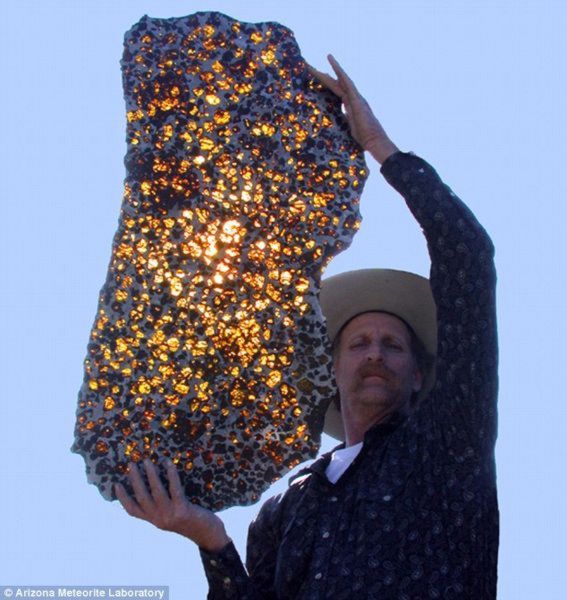
When this massive Gobi Desert boulder was finally put to the saw, the world held its breath. The moment the blade cut through the final section and the two halves fell away must have been staggering. It wasn’t rock. It wasn’t metal. It was a celestial mosaic.

Mysterious Meteorite

Inside was a breathtaking sight. A silvery, honeycomb-like matrix of nickel-iron, polished to a mirror shine. And suspended within that metal web were huge, translucent crystals of a mineral called olivine. But this wasn’t the dull green olivine we sometimes find on Earth. This was cosmic olivine. Space gems. When held up to the light, they glowed with a golden, otherworldly fire.

It looked like stained glass designed by a god.

The effect was immediate and profound. This was a piece of the sky, a 4.5-billion-year-old artifact from the birth of our solar system, and it was more beautiful than anything made by human hands. The journey this rock had taken was almost impossible to comprehend. For billions of years, it had drifted through the cold, silent emptiness of space. It had witnessed the formation of planets, survived the chaos of the asteroid belt, and dodged the gravitational pull of giants like Jupiter. Finally, its long journey ended with a fiery plunge through Earth’s atmosphere, landing in a desolate wasteland to wait for thousands of years before a human being laid eyes on it.

The $2 Million Mystery: Why Didn’t It Sell?

Naturally, an object this rare and beautiful quickly became a commodity. The main mass was moved to the United States and began to be sliced up. Thinner and thinner slices were cut, polished, and sold to wealthy collectors and museums around the world. Each slice, a window into another world, fetched astronomical prices.

The crown jewel, the largest remaining piece, weighed a staggering 925 pounds (about 420 kg). In 2008, this colossal chunk of cosmic art went up for auction at Bonham’s in New York. The pre-auction estimate? A cool $2 million.

The stage was set. The world’s richest collectors were watching. And then… nothing. It didn’t sell.

Why? Why would a treasure this unique fail to find a buyer? The official story is that the reserve price wasn’t met. Simple economics. But in the world of high-stakes collecting, things are rarely that simple. This is where the story gets strange. Whispers started circulating.

Theory 1: The Collector’s Greed

The simplest explanation is often the right one. The anonymous owner, having seen how much smaller slices were selling for per gram, simply got too greedy. They set the minimum price so high that even the most enthusiastic billionaires balked. It’s a classic story of killing the golden goose. Or, in this case, the golden meteorite.

Theory 2: The Curse of the Space Rock

Let’s get weird. Artifacts of great power and age are often said to carry curses. Think of the Hope Diamond or King Tut’s Tomb. Could the Fukang meteorite, a piece of a shattered world’s soul, carry some kind of cosmic bad luck? Perhaps the super-rich are also super-stitious. They might be happy to own a small, sanitized slice, but the “heart” of the meteorite? The main mass? Maybe that was a risk no one was willing to take. You don’t invite the ghost of a dead planet into your living room without consequences.

Theory 3: The Secret Sale

This is the one that keeps people up at night. What if it *did* sell? What if the “failed auction” was just a cover story? A piece this significant might attract the attention of buyers who don’t operate in the public sphere. Shadowy government agencies. Secret societies. Private collectors who value anonymity above all else. A public auction would create a paper trail. By staging a “failed” sale, the object could quietly “disappear” into a private collection, its location unknown, its secrets safe from prying eyes. Why would they do this? That’s the real question.

Cosmic Codes and Internet Whispers

The story doesn’t end there. In the years since the auction, the Fukang meteorite has become a legend online. It’s a touchstone for conspiracy theorists, alternative historians, and mystery lovers.

The central question they all ask is this: What if it’s more than just a pretty rock?

Think about the structure. A perfect metallic matrix holding crystalline data storage units. The olivine crystals, formed under immense pressure and heat, are incredibly stable. Could they hold information? Is the specific pattern of crystals a message? A star map? A blueprint? A warning?

It sounds like science fiction, but science is getting stranger every day. Scientists are already experimenting with storing data in quartz crystal and even DNA. Who’s to say an ancient, far more advanced civilization wouldn’t use the very building blocks of planets to store their records? To create a library that could survive the death of its own world and travel the cosmos for billions of years?

Recent internet theories have pointed out the strange geometric perfection of the nickel-iron “honeycomb” structure, known as a Widmanstätten pattern. This pattern can only form as molten metal cools over millions of years in the zero-gravity, vacuum of space. But some argue the regularity in the Fukang meteorite is *too* perfect. Almost engineered.

Is it possible this isn’t a natural artifact at all? Could it be a piece of unimaginably ancient technology? A fragment of a ship, a probe, or something we can’t even comprehend, that fell to Earth and waited patiently for a species intelligent enough to cut it open and wonder?

A Piece of Heaven, For a Price

Today, the legacy of the Fukang meteorite is scattered. You can’t see the main mass. Its location is a closely guarded secret, held by that same anonymous collector. But you can own a piece of it. If you have the money.

Small, polished slices and even tiny fragments embedded in jewelry are sold online by meteorite dealers. The body of this magnificent visitor has been carved up and distributed among the wealthy. There’s a certain sadness to it. A singular, breathtaking object of cosmic wonder, dismembered for profit.

It raises a difficult question: Who owns the sky? When a messenger from 4.5 billion years ago arrives on our doorstep, does it belong to the person who finds it? The country it lands in? Or does it belong to all of humanity? Should the Fukang meteorite have been preserved whole in a museum for everyone to see and study, rather than being sliced up like a loaf of bread to adorn the desks of the elite?

We may never know the full story of this celestial traveler. We don’t know the name of the planet it came from. We don’t know the story of its cataclysmic death. We don’t know why it failed to sell at auction or where its heart rests today. All we know is that for a brief moment, we were allowed to look inside a rock and see the universe staring back at us.

It’s a reminder. The universe is ancient, it is beautiful, and it is full of secrets. And sometimes, those secrets fall right into our laps. We just have to be willing to look inside.

Originally posted 2016-04-09 08:29:33. Republished by Blog Post Promoter