Home Unexplained Mysteries Modern Mysteries Intact’ WWII Carrier Found in Pacific

Intact’ WWII Carrier Found in Pacific

0
64

The Atomic Ghost: Has America’s Most Secretive Sunken Warship Finally Been Found?

Some ships refuse to die. They fight, they bleed, they earn their place in history, and when their time is up, they slip beneath the waves. But some… some don’t go quietly. They take their secrets with them. They wait.

Half a mile down, in the crushing blackness off the coast of California, one of these ghosts has been sleeping. A World War II aircraft carrier. A decorated veteran of the Pacific War. A survivor of not one, but two atomic bomb blasts. For over 60 years, it was lost to the world, a forgotten casualty of the Cold War’s darkest chapter. Until a robot probe pierced the gloom and laid eyes on the impossible.

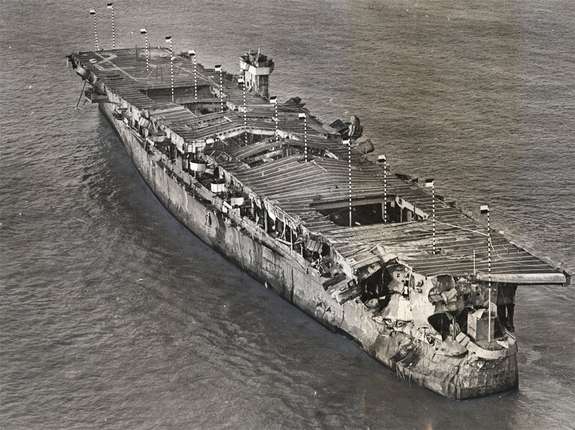
The USS Independence. And it’s sitting upright, on the seafloor, looking almost ready to launch its planes.

The official story is just the beginning. The truth? The truth is far stranger, and a lot more dangerous. What was this ship really carrying on its final, one-way voyage to the bottom?

A Ghost on the Sonar

The year is 2015. Scientists with the National Oceanic and Atmospheric Administration (NOAA) are methodically scanning a deep-water graveyard known as the Gulf of the Farallones National Marine Sanctuary. It’s a place of currents and secrets, home to an estimated 300 shipwrecks. But they were looking for one in particular. A big one.

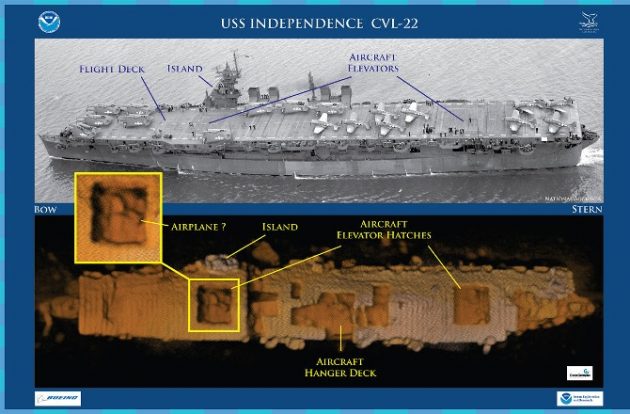
Then, a shape materializes on their screens. It’s massive. Unmistakable. The clean, sharp lines of a flight deck. The silhouette of an island superstructure. It wasn’t a crumpled heap of steel, as so many wrecks are. This was something else entirely. It was a ship. Whole.

They sent down the “Echo Ranger,” a 18.5-foot autonomous underwater vehicle, a robotic drone programmed to get a closer look. For hours, it methodically crisscrossed the target zone, its sonar pulses painting a picture of what lay in the abyss. When the data came back, the team was stunned.

image-1

“After 64 years on the seafloor, Independence sits on the bottom as if ready to launch its planes,” exclaimed an astonished James Delgado, the chief scientist on the mission. It rests in 2,600 feet of frigid water, listing only slightly. A ghost frozen in time.

But the most tantalizing detail was a shadow within a shadow. A dark shape spotted in what appeared to be the carrier’s hangar bay. Could it be? An intact World War II warplane, sealed in a deep-sea tomb?

Deep Dive: The Ship That Shouldn’t Have Existed

To understand the mystery of the Independence, you have to go back to the darkest days of World War II. After Pearl Harbor, America was desperate for aircraft carriers. The sprawling Essex-class fleet carriers took too long to build. The Navy needed flattops, and they needed them *now*.

The solution was a stroke of wartime genius, or madness. They took the fast, light hulls of cruisers already under construction and slapped a flight deck on top. The result was the *Independence*-class of light carriers. They were smaller, carried fewer planes, and were more vulnerable than their larger cousins. But they were fast. And they were available.

The USS Independence (CVL-22) was the first of her kind. Commissioned in 1943, she was immediately thrown into the meat grinder of the Pacific theater. She wasn’t just a ship; she was a symbol of America’s industrial might, a testament to a generation that built weapons of war with breathtaking speed. Her planes fought in the skies over Rabaul, Tarawa, and the Philippines. She earned her battle stars the hard way, surviving kamikaze attacks and torpedoes that sank other ships around her. She was a survivor. A fighter.

Little did her crew know, her greatest test would come not in the heat of battle, but in the eerie calm of a post-war world obsessed with a terrifying new weapon.

Survivor of the Apocalypse: Operation Crossroads

The war ended. But for the USS Independence, the fight was far from over. In 1946, she was selected for a truly hellish assignment. She, along with a fleet of over 90 captured and surplus warships, was sailed to a remote Pacific paradise called Bikini Atoll.

This was no vacation. This was Operation Crossroads.

The United States wanted to see what its new atomic bombs would do to a naval fleet. The Independence was painted, prodded, and packed with instruments and live animals. Then, she was anchored in a lagoon and left to face the atom.

Test Able & Test Baker

She survived the first blast, “Able,” an airburst dropped from a B-29. The bomb missed its target, and while the Independence was scorched and battered by the shockwave, she remained afloat. A tough ship.

The second test, “Baker,” was different. This was the stuff of nightmares. An atomic bomb was detonated 90 feet *underwater*. It vaporized millions of tons of water and seabed, throwing a radioactive column of spray and steam over the entire fleet. The Independence was slammed by a radioactive tsunami, her steel structure twisted, her decks and compartments drenched in a toxic, invisible poison.

The blast was one of the first major nuclear disaster events in history. The ships were so “hot” with radiation that sailors couldn’t safely approach them for days. The Independence, miraculously, was still floating. But she was mortally wounded. She was now a radioactive ghost, too contaminated to be properly scrapped or even studied up close.

She was towed back to San Francisco, a relic of one war and a terrifying test subject for the next. For five years she sat, her secrets festering, her hull glowing with unseen energy. The Navy studied her from a distance, trying to learn how to wash the atomic poison from a warship. They couldn’t.

So, they decided to bury her at sea.

The Final, Secret Mission

On January 26, 1951, the USS Independence was towed out past the Farallon Islands and scuttled. The official Navy record is sparse. They say she was sunk with conventional explosives. A simple disposal of a contaminated asset.

But that story has never sat right with researchers and conspiracy theorists. Not by a long shot.

Why tow a radioactive ship all the way out there? Why sink it in such deep water? And why was the exact location kept so secret for so long? The discovery by NOAA raises more questions than it answers. The most pressing one is this: What *else* was on board when she went down?

image-e1462094324246

The Nuclear Waste Dump Theory

Here’s where things get dark. We now know that from 1946 to 1970, the waters around the Farallon Islands were used as America’s largest offshore nuclear waste dump. The government has admitted to dumping at least 47,800 drums of low-level radioactive waste in the area. Fifty-five-gallon steel drums, just dropped over the side.

Many believe the scuttling of the Independence was part of this program. That the Navy saw a perfect opportunity. They had a huge, contaminated steel box they needed to get rid of. Why not use it as a massive coffin for *other* nuclear waste?

Online forums and deep-web investigators have theorized for years that the ship was packed with barrels of radioactive material from the nation’s burgeoning nuclear weapons program before its final voyage. If true, the Independence isn’t just a shipwreck. It’s a concentrated nuclear waste site sitting less than 30 miles from a major American city.

Think about it. The ship is “amazingly intact.” That means whatever is inside is likely still inside. Sealed. For now.

What Lies in the Darkness?

This leads us back to the shadows on the sonar. The mysteries waiting in the deep.

  • The Plane in the Hangar: The sonar appears to show at least one aircraft, likely a Grumman F6F Hellcat, in the hangar bay. Why was it left there? Was it simply too radioactive to move? Or was it part of a final experiment, its instruments loaded to gather data on the ship’s final plunge?
  • The Secret Cargo: Are there sealed compartments filled with those 55-gallon drums of waste? The sonar can’t penetrate the steel hull. No one knows for sure what’s packed inside the ship’s bowels. The only way to find out is to go down there.
  • A Ticking Time Bomb?: For over 70 years, the carrier has been resting in the cold, preserving deep. But nothing lasts forever. Saltwater is relentless. What happens when the hull eventually gives way? If the ship is indeed packed with barrels of waste, a catastrophic breach could release a plume of radioactive material into a vital marine ecosystem and the Pacific Ocean food chain.

The discovery of the Independence was hailed as a great archaeological find. But it could also be the rediscovery of a long-forgotten environmental threat. The government has been quiet on the issue, stating only that the wreck is being monitored. But what does that monitoring entail? And what are they not telling us?

The USS Independence isn’t just a piece of history. It’s a monument to the dawn of the Atomic Age and the frantic, often reckless, secrecy that surrounded it. It’s a war hero sent to a lonely, toxic grave. It sits on the ocean floor, a silent king on a forgotten throne, guarding a cargo of atomic secrets.

And in the crushing darkness, half a mile down, it waits.

Originally posted 2016-05-04 07:15:45. Republished by Blog Post Promoter