Home Unexplained Mysteries Ancient Mysteries Hitlers secret Nazi base discovered in Arctic

Hitlers secret Nazi base discovered in Arctic

0
67

The Frozen Ghost: Hitler’s Secret Arctic Base and the Treasure It Was Hunting

Picture it. A landscape of crushing, unending white. A place so remote, so hostile to human life, it might as well be another planet. This is Alexandra Land, a frozen tooth of rock jutting out of the Arctic Ocean, 1,000 kilometers from the North Pole. A place where the sun vanishes for months and the silence is broken only by the shriek of the wind. A forgotten corner of the globe.

Or was it?

Because in this desolate wasteland, something was discovered. Something that history books had forgotten. A ghost from the most violent conflict in human history. The ruins of a secret Nazi base, code-named ‘Schatzgräber’.

Treasure Hunter.

The official story is simple. It was just a weather station. But since when did the Third Reich give something so mundane such a tantalizing name? What treasure was Hitler hunting at the very top of the world?

Hitlers secret Nazi base discovered in Arctic

The Discovery That Shocked the World

For over 70 years, it was a whisper. A footnote in captured German documents. Most historians dismissed it, writing it off as a minor, insignificant outpost swallowed by the ice, if it ever existed at all. Then, in 2016, a team of Russian scientists from the Russian Arctic National Park set foot on Alexandra Land. They weren’t looking for Nazis. They were studying the flora and fauna of this brutal environment. But they found something else entirely.

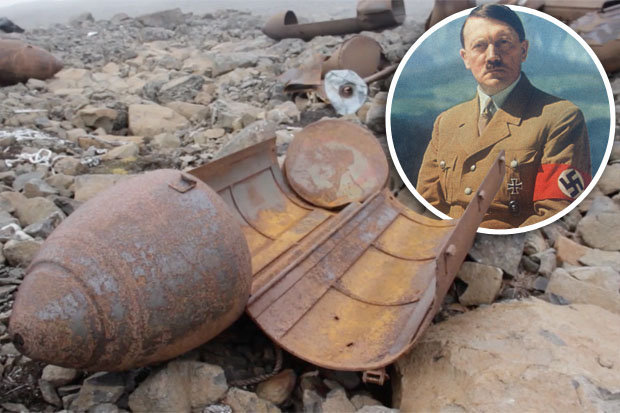
Scattered across the permafrost were the bones of a forgotten operation. The collapsed ruins of bunkers, their wooden beams splintered by decades of polar storms. Rusted fuel canisters, still smelling faintly of petrol. Rotting leather boots and scraps of uniforms. And bullets. Lots of bullets.

In total, over 500 separate artifacts were unearthed from their icy graves. Preserved with eerie perfection by the constant, deep-freeze temperatures. They found documents, their paper still legible, covered in official Reich letterheads. They found meteorological equipment. They found personal items, things that made the faceless soldiers who lived here real. But everything they found was stamped with a chilling symbol.

The swastika.

Evgeny Ermolov, a senior researcher on the expedition, put it bluntly: “Before, it was only known from written sources, but now we also have real proof.” The ghost had a body. The legend was real.

A Weather Eye on the War

The mainstream explanation for Operation Schatzgräber is strategically sound, if a little boring. The base, built in 1942 and operational from 1943, was a highly advanced weather station. Why build a weather station in a place that’s practically a synonym for “bad weather”?

Because weather wins wars. Especially at sea.

The Third Reich’s U-boat wolf packs were terrorizing Allied shipping convoys in the North Atlantic and the Barents Sea. These convoys were the lifeline for Great Britain and the Soviet Union, carrying essential supplies, weapons, and food. To effectively hunt these ships, German naval commanders needed accurate, long-range weather forecasts. Storms could scatter a convoy, making it easy prey. But they could also scatter the wolf pack, or worse, sink a U-boat.

The weather systems that battered Northern Europe and the Atlantic often originate in the Arctic. Having a station at the top of the world was like having an eye in the sky. It gave the German war machine a massive predictive advantage, allowing them to plan U-boat movements and Luftwaffe attacks with far greater precision.

It was a vital piece of the military puzzle. A secret, frozen ear listening to the whispers of the wind.

The Grisly End of the Treasure Hunters

The official record states that the base was abandoned in July 1944. But the men didn’t just pack up and leave. They were evacuated in a desperate race against death, brought down not by Allied commandos, but by a polar bear.

Supplies were running dangerously low. The men, isolated and starving, shot and killed a polar bear for food. In their desperation, they ate the meat raw. A fatal mistake. The meat was riddled with Trichinella worms, parasites that cause a horrific, debilitating disease known as trichinosis.

One by one, the crew fell violently ill with intense pain, fever, and paralysis. An urgent distress call was sent out, and a German U-boat was dispatched to rescue the surviving men. They were evacuated, and the base was left to the ice, never to be reoccupied. A grim, bizarre end to a top-secret mission.

A tidy story, right? Case closed.

But the questions are just beginning.

What If It Wasn’t Just About the Weather?

Let’s go back to that name. ‘Schatzgräber’. Treasure Hunter. You don’t name a simple weather station ‘Treasure Hunter’. You just don’t. It’s like calling your garden shed “The Citadel of Ancient Secrets.” The name itself is a giant, flashing red light, a clue screaming at us from across the decades.

What if the weather operations were just a cover story? A plausible excuse to have a military presence in one of the most remote places on Earth. What kind of “treasure” could possibly be hiding under the Arctic ice?

Deep Dive: The Ahnenerbe and the Hunt for Aryan Myths

To understand what the Nazis might have been looking for, you have to understand who they were. The leaders of the Third Reich, particularly SS chief Heinrich Himmler, were not just politicians and military men. They were obsessed with the occult. They believed they were the descendants of a mythical, god-like Aryan race.

Himmler created an entire SS organization called the Ahnenerbe—the “Ancestral Heritage” society. Its official job was to research the anthropological and cultural history of the Aryan race. Its *real* job was to scour the globe for proof of their bizarre mystical theories and to find ancient artifacts of immense power, like the Ark of the Covenant and the Holy Grail.

The Ahnenerbe believed that the original Aryan homeland was not in Germany, but in the far north. A lost land of ice and legend. They were fascinated by the myth of Thule, or Hyperborea—a supposed ancient civilization near the North Pole, a place where god-men lived in a temperate paradise before some catastrophe froze it over. They believed that survivors of this super-race had migrated south, their bloodline eventually leading to the German people.

Could “Treasure Hunter” have been an Ahnenerbe mission? Were they searching not for gold or jewels, but for a lost city under the ice? A gateway to another world? Proof of their own divine origins? Suddenly, a base on Alexandra Land doesn’t just seem strategic. It seems destined.

Nazi-Arctic-Base-in-Antarctic

A Base for Wonder Weapons?

The theories get even wilder. Some researchers point to the Nazis’ relentless pursuit of ‘Wunderwaffen’—wonder weapons. They were developing jet aircraft, guided missiles, and were desperately trying to build an atomic bomb. But some of their more exotic research involved stranger concepts.

Internet forums and alternative history books are filled with talk of “Die Glocke” (The Bell), a supposed anti-gravity device, and the Haunebu and Vril flying saucers. Official history scoffs at these ideas. But the rumors persist. These technologies, if they existed, would have required immense energy and absolute secrecy for testing.

What better place to test a revolutionary new propulsion system or energy weapon than a location so remote that no prying eyes or ears could ever detect it? A place where the magnetic anomalies of the pole might even play a role in the technology itself. The weather station story would have been the perfect cover for moving men and materials to a place literally off the map.

The Arctic-Antarctic Connection: A Global Network of Secrets

You cannot talk about secret Nazi bases without mentioning Antarctica. The story of Base 211, or Neuschwabenland (New Swabia), is a cornerstone of modern conspiracy theory. Legend says that in 1938-39, the Nazis launched a massive expedition to Antarctica, claiming a huge chunk of the continent and establishing a secret, impregnable fortress in ice caves warmed by geothermal springs.

This is where, the story goes, Hitler and other top Nazis fled after the war, using advanced U-boats to create a breakaway civilization, continuing their research into flying saucers and other wonder weapons.

So where does the Arctic base fit in?

Could Schatzgräber have been the northern bookend to a global plan? A test run for building and operating a base in extreme polar conditions? Was it a vital refueling and resupply station for long-range U-boats traveling between Germany and the secret Antarctic fortress? The journey is immense. A hidden stopover at the top of the world would make perfect sense.

The two poles, linked by a network of secrets, hidden beneath a blanket of ice and denial. It’s a mind-bending possibility. The war we know might have just been one part of a much larger, stranger conflict.

Clues Frozen in Time

Let’s go back to the evidence on the ground. The 500 artifacts. While most are mundane—bunkers, cans, shoes—they still pose questions. The paper documents, preserved by the cold, are the most tantalizing. What secrets do they hold? Many are likely just weather logs and supply requests. But could there be a coded message? A hidden journal? A map?

The sheer amount of material suggests this wasn’t a small, temporary camp. It was a well-established, long-term facility. The number of bullets found is also interesting. Were they just for hunting and defense against polar bears, or were they expecting a different kind of visitor?

The base’s existence was verified. The official story is on the record. But the *why* remains shrouded in mystery. The name ‘Treasure Hunter’ continues to mock the simple, clean explanation of a weather station. It hangs in the air, a question mark frozen in time.

What we do know is this: in the midst of a world-spanning war, the Nazi regime diverted men, resources, and shipping to build a secret base in one of the most inaccessible places on the planet. They gave it a name that evokes myth and legend. And its story only came to light because a handful of scientists stumbled upon its frozen remains 72 years later.

What else is still out there, buried beneath the ice, waiting to be found? How many other secrets does the deep cold keep? The ghost of Schatzgräber proves that sometimes, the wildest stories have a terrifying habit of being true.

Originally posted 2016-10-26 13:50:26. Republished by Blog Post Promoter