Is H.P. Lovecraft’s Nightmare God Cthulhu Real? The Evidence is Unsettling.
Some stories are just stories. Bedtime fables. Campfire tales. Harmless fiction designed to give you a quick chill before you drift off to sleep in a safe, warm bed.
And then there are the other stories. The ones that don’t feel like stories at all.
They feel like warnings.
They feel like memories from a past we were never meant to know. Whispers from the abyss that found their way into the mind of a reclusive, strange man from Providence, Rhode Island. A man named Howard Phillips Lovecraft.
In the early 20th century, Lovecraft wrote tales of cosmic dread, of ancient, god-like beings, and of humanity’s complete and utter insignificance in a hostile universe. His most famous creation? A monstrous, bat-winged, squid-faced entity dreaming in a sunken city beneath the waves. A name that even today is spoken in hushed tones by those who look a little too deeply into the shadows.
Cthulhu.
The official story is that Lovecraft invented it all. A brilliant work of horror fiction. But what if that’s the greatest lie ever told? What if Lovecraft wasn’t an author, but a receiver? A psychic antenna, plagued by nightmares that were actually transmissions from a slumbering god deep in the Pacific Ocean?
Forget what you think you know. We’re going to look at the evidence, the strange coincidences, and the terrifying real-world events that suggest the Great Old One is more than just a scary story. He is waiting. And he might be waking up.
So, What Exactly Is This Thing?
You’ve seen the statues. The t-shirts. The pop culture references.

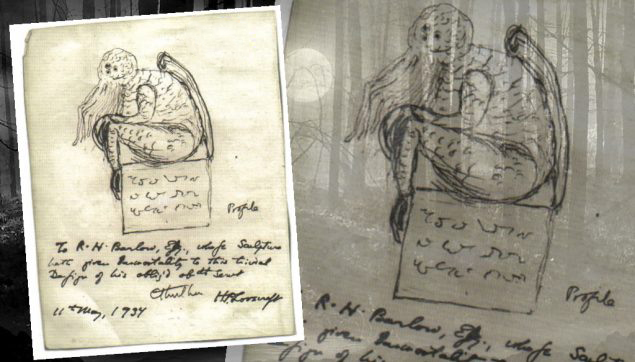
A pulpy, tentacled face. A bloated, scaly body. Immense claws and crude, leathery wings. But to call Cthulhu a mere monster is to miss the point entirely. It’s like calling a black hole a “dent” in space.
Lovecraft, in his seminal 1928 story “The Call of Cthulhu,” gave us the first chilling glimpse. He described it as: “A monster of vaguely anthropoid outline, but with an octopus-like head whose face was a mass of feelers, a scaly, rubbery-looking body, prodigious claws on hind and fore feet, and long, narrow wings behind.”
Think about that combination. It’s not random. It’s a violation of nature.
- The Octopus: A creature of the deep. Alien, intelligent, boneless. It represents the unknown, the flexible, the ancient horrors of the sea.
- The Dragon: A symbol of immense power, greed, and ancient, mythic terror that exists in the cultural memory of nearly every civilization on Earth.
- The Human Form: This is the most disturbing part. Its “vaguely anthropoid outline” is a mockery of humanity. It suggests we are a pale, pathetic imitation of some greater, more terrible form.
But the physical description is only a kindergarten sketch of the true horror. Cthulhu isn’t just made of flesh and bone. It’s suggested his very form is made of something else, something not quite of our dimension. He can change shape, regenerate from almost any wound, and his very presence is a psychic poison that drives mortals insane.
He isn’t just a big monster. He is a High Priest to even more terrible forces—the Outer Gods who writhe and gibber at the center of infinity. Cthulhu is merely their gatekeeper on Earth, waiting for the stars to align so he can open the door for his masters to feast.
Deep Dive: R’lyeh, The Nightmare Corpse-City
Every monster needs a lair. Cthulhu has a tomb. A prison. A city.
R’lyeh.
According to Lovecraft’s “channelings,” this cyclopean city of impossible geometry lies hidden beneath the waves of the South Pacific. It was built eons ago by Cthulhu’s star-spawn. And then, something happened. A cosmic shift, a war with other entities, or a simple change in the celestial alignment caused the city to sink, trapping Cthulhu in a death-like sleep.
He is not dead. He is dreaming. And his dreams leak out into our world, inspiring cultists, driving artists mad, and giving sensitive people like Lovecraft crippling nightmares.
The Impossible Coordinates
This is where it gets weird. Lovecraft wasn’t vague. He gave us a location. In “The Call of Cthulhu,” the city is found at 47°9′S 126°43′W. Go look that up on a map right now.
You’ll find… nothing. Just a vast, empty stretch of the Pacific Ocean. It’s one of the most remote places on the planet, a “pole of inaccessibility.” The perfect place to hide a nightmare city.
Or is it?
In 1997, the U.S. National Oceanic and Atmospheric Administration (NOAA) detected a sound from this exact region. A sound so powerful it was picked up by hydrophones over 5,000 kilometers apart. It was a deep, ultra-low-frequency noise that rose in pitch over about one minute. They called it “The Bloop.”
Scientists scrambled for an explanation. An underwater volcano? A secret military submarine? An earthquake? None of them fit. The audio profile of The Bloop was unique. It sounded… organic. The official explanation, years later, settled on the cracking of a giant ice-shelf. An “icequake.”
But there’s a problem. The Bloop was detected in 1997. The icequake theory wasn’t solidified until years later. And many online sleuths point out that the sound’s location is thousands of miles from Antarctica. Could a breaking piece of ice really make a sound that powerful, that structured, that far away?
Or was it something else? Something massive, stirring in its sleep from the “nightmare, corpse-like city of R’lyeh”?
The coordinates that Lovecraft—a man writing in the 1920s with no access to deep-sea mapping—pinpointed as the location of his fictional monster’s tomb is unnervingly close to the origin point of the most powerful, mysterious underwater sound ever recorded. Coincidence? Or a psychic bullseye?
The Global Cult: Are They Still Out There?
A sleeping god is no threat unless someone tries to wake him up. And that’s the other piece of Lovecraft’s “fiction” that feels terrifyingly real: The Cthulhu Cult.
Lovecraft describes a secret, worldwide religion of “debased” men and women who worship the Great Old Ones. They gather in hidden places, from the bayous of Louisiana to the mountains of China, chanting the same unholy phrase:
“Ph’nglui mglw’nafh Cthulhu R’lyeh wgah’nagl fhtagn.”
It translates to: “In his house at R’lyeh, dead Cthulhu waits dreaming.”
This isn’t just passive worship. Their goal is to perform the correct rituals when the stars are right, helping to wake their master and plunge the world into a glorious new eon of chaos and slaughter. In Lovecraft’s stories, these cultists are often sailors, fishermen, and people from remote, isolated communities—people who live by the sea and know its darkest secrets.
Modern Echoes of the Cult
A global cult waiting to end the world sounds like pulp fantasy. But history is filled with doomsday cults and secret societies with bizarre beliefs. The Thuggee in India worshipped Kali with ritual murder. The Order of the Solar Temple believed they were ascending to a new life on a planet orbiting the star Sirius.
Is it so hard to believe that a similar ideology, based on the raw, primal fear of the deep ocean and the cold cosmos, could exist? Today, the “Cthulhu Cult” is mostly an internet joke. But look closer.
Online forums bubble with sincere discussions of “esoteric Lovecraftianism.” Fringe groups attempt to blend his mythology with real-world occult practices. People report strange, shared dreams of sunken green cities after meditating on his sigils. Most of it is role-playing. Probably.
But it only takes a few true believers. People who see the current state of the world—the chaos, the division, the sense that things are breaking down—and believe it’s a sign. A sign that the old world is dying to make way for a new, terrible one. A sign that the stars are finally coming right.
What If Lovecraft Was a Psychic?
Howard Phillips Lovecraft was not a normal man. He was a recluse, terrified of the world, who rarely left his house after dark. He suffered from horrific “night terrors” his entire life, so vivid they would leave him screaming and physically exhausted.
He described these dreams as taking him to alien landscapes, showing him monstrous creatures, and filling his mind with a sense of cosmic dread so profound it haunted his waking hours. He claimed many of his most famous stories, including the ones about Cthulhu, came directly from these nightmares.
The standard explanation is that he was a brilliant but troubled man with a powerful imagination.
The alternative history, the conspiracy, is far more compelling. What if his mind, isolated and sensitive, was the perfect radio receiver? What if the “cosmic static” of a dreaming entity in the Pacific was something he could, however faintly, tune into? He wasn’t creating. He was transcribing.
Think about ancient myths. Nearly every coastal culture has a story of a giant, tentacled beast from the sea. The Kraken of Norse sagas, the Dagon of the Philistines, the Umibōzu of Japan. Are these all separate myths? Or are they different cultures catching a faint, distorted psychic echo of the one true monster sleeping below? Different people sketching the same shadow on the cave wall.
Lovecraft may have simply been the one who got the clearest signal.
The Great Filter and the Cosmic Horror
Why is any of this important? Because the core idea of Cthulhu isn’t about a monster. It’s about our place in the universe. We think we’re special. The pinnacle of evolution on this planet. The center of everything.
The Cthulhu Mythos proposes a darker, more humbling truth. It suggests that humanity is an accident. A fleeting colony of ants building its anthill on a railroad track, utterly oblivious to the train that is coming.
The universe, in this view, is not empty. It’s full. It’s full of beings so ancient, powerful, and alien that their very existence would shatter our sanity. We only survive because they haven’t noticed us yet. Cthulhu is one of them, a being who crash-landed here eons ago and is just… waiting.
His eventual awakening wouldn’t be an act of malice. It would be an act of indifference. When you step on an anthill, do you hate the ants? Do you even think about them? No. You’re just walking.
That is cosmic horror. The chilling realization that we are completely, utterly irrelevant. And the thing sleeping in the Pacific is a constant, physical reminder of that terrifying fact.
So, is Cthulhu real? Maybe the question isn’t whether a giant octopus-dragon is literally sleeping at 47°9′S 126°43′W. Maybe the real question is whether the *truth* he represents is real.
The truth that the oceans are largely unexplored and hide things we cannot comprehend.
The truth that the universe is vast, strange, and does not care about us.
The truth that there are forces at play far beyond our understanding.
And the most unsettling truth of all? Someday, the stars will be right. The dreaming will end. And the call will finally be answered.
Originally posted 2016-08-24 14:56:03. Republished by Blog Post Promoter