The Impossible Heist on the Iron Horse: Cracking the Great Gold Robbery of 1855
Picture this. Over 200 pounds of solid gold. Shimmering, heavy, life-altering wealth. In today’s money, we’re talking about a cool $322 million. An absolutely staggering fortune.
Now, picture how much of that fortune was ever seen again.
Just $2,600.
This isn’t a modern-day cyber-theft or a Hollywood script. This is the story of a crime so audacious, so brilliantly planned, and so perfectly executed that it baffled two of the world’s most powerful nations. It happened in the iron heart of the Victorian era, a time of supposed order and progress. It happened on a speeding train, a symbol of that very progress. This is the Great Gold Robbery of 1855, and it remains one of the most daring heists in history.
Forget what you think you know about old-timey criminals. The masterminds behind this were not clumsy thugs. They were meticulous planners, inside men, and seasoned professionals who exploited a system that everyone believed was foolproof. They did the impossible.
And for a while, they got away with it completely.
A Fortress on Wheels
To understand the genius of the crime, you have to understand the security. This wasn’t just a case of throwing gold in a sack and hoping for the best. By 1855, the South Eastern Railway had a system. A trusted system.
Gold bullion was the lifeblood of international finance, flowing constantly between the banking centers of London and Paris. The cargo in question belonged to three prestigious firms: Abell and Co., Spielmann, and Bult. It was destined for the Bank of France.
The process was a fortress of procedure.
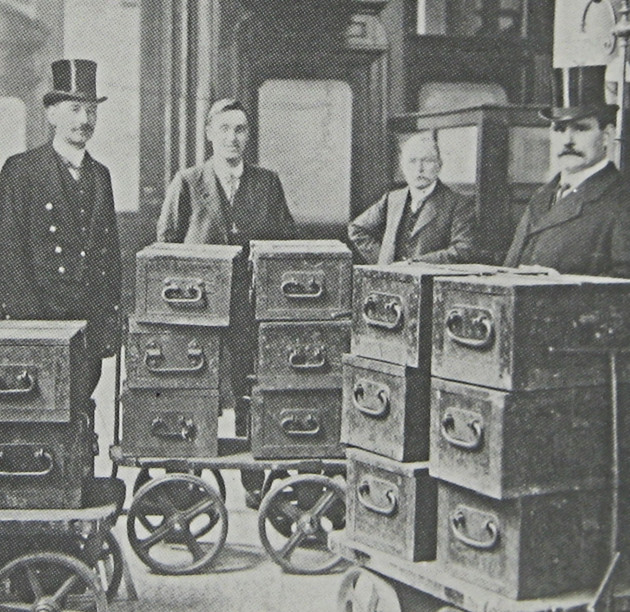
First, the gold was packed into heavy-duty wooden boxes, custom-built for the task. Then, these boxes were bound with thick iron bars, strapped down tight. Finally, they were sealed with wax, stamped with the company’s official insignia. To tamper with the seal was to leave an undeniable calling card.
But that was just the beginning. These iron-bound boxes were then locked inside massive, cast-iron safes in the guard’s van of the train. And these weren’t just any safes with any old locks.
Deep Dive: The “Unpickable” Chubb Lock
The safes were secured with the legendary Chubb lock. In the mid-19th century, the name Chubb was synonymous with security. It was the Apple or Google of its day for protection. Patented by Jeremiah Chubb in 1818, the lock featured a special security mechanism called a “detector.” If a thief tried to pick the lock and lifted any of the internal tumblers too high, a tiny lever would catch and jam the bolt. The lock would freeze. The only way to open it then was with the correct key, which would also reset the detector, silently informing the owner that an attempt on their lock had been made.
It was considered unpickable. The pinnacle of mechanical security. The company had a standing offer of a huge reward to anyone who could defeat it. No one ever had.
To top it all off, there wasn’t just one key. A set of duplicate keys existed, but they were kept under the tightest control. One set in London with a high-ranking railway official. Another in Folkestone, the train’s destination on the English coast. The boat captains who would ferry the cargo across the Channel had keys. The guard on the train itself did not. He was just a guardian, not a keyholder.
Sealed boxes. Iron bars. Chubb locks. Limited keys. A guard in the van. What could possibly go wrong?
The Men Who Dared
A system is only as strong as the people who run it. And within the South Eastern Railway, a seed of criminal genius was taking root. This wasn’t a spur-of-the-moment crime. It was the result of over a year of patient, meticulous, and insider planning. The crew was small, but each member was essential.
The Brains: Edward Agar
Edward Agar was not your typical Victorian crook. He was a career criminal, yes, but a sophisticated one. He had spent time in both America and Australia, learning his trade, honing his skills. He was a planner, a strategist. He understood systems, mechanics, and most importantly, human weakness. Agar was the driving force, the man who saw the impossible and figured out the how.
The Inside Man: William Pierce
Every great heist needs an inside man. William Pierce was a 39-year-old former employee of the railway. He was a ticket printer, a seemingly minor cog in the giant machine. But he was disgruntled. He felt he was underpaid and undervalued. He knew the schedules, the procedures, and the people. He had access. Crucially, he had the burning resentment that made him willing to betray his former employer for a shot at a new life. He was Agar’s way in.
The Muscle & The Key: James Burgess
James Burgess was the guard. He was the man who would literally be riding with the gold on the night of the heist. He had worked for the railway for 14 years, a trusted veteran. But he had a weakness for the good life and was deep in debt. He was the corruptible piece of the puzzle, the one who could be turned. His participation was non-negotiable.
The Fourth Man: William Tester
The crew needed one more piece. William Tester was a railway clerk at London Bridge station. A quiet, unassuming man. His job? He oversaw the weighing and loading of the bullion. He was the one who could manipulate the ledgers, the one who could ensure the tampered boxes began their journey without immediate suspicion. He was also in love with a woman he couldn’t afford to marry. Money was a powerful motivator.
The Anatomy of the Perfect Crime
The plan Agar devised was a masterclass in audacity.
It started with the keys. How do you get a copy of a key that’s kept under lock and key itself? Bribery and patience. Pierce, using his old connections, befriended the officials who held the keys. Through a series of social encounters, likely involving a few too many pints at the local pub, they managed to get a wax impression of the safe keys. Just for a second. That’s all they needed. From that soft wax, a skilled locksmith could forge a perfect duplicate.
Next, the weight. Gold is incredibly dense. Stealing it and leaving an empty box would be noticed instantly. It had to be replaced with something of almost equal weight. The answer was lead. Specifically, lead shot. Hundreds of pounds of it. They spent months secretly acquiring it and sewing it into discreet leather bags, each one pre-weighed to match the gold they planned to steal.
They even did a dry run. Weeks before the actual robbery, the crew boarded the same train. They carried a valise with some of the tools, just to see if they could get it into the guard’s van without suspicion. They timed the journey. They noted the bumps in the track, the moments of darkness, the routines of the other staff. It was a dress rehearsal for the greatest performance of their lives.
The Night of May 15, 1855
The night was thick with London’s coal-smoke haze. At London Bridge station, the train for Folkestone was being prepared. Tester, the clerk, oversaw the loading. The three boxes—one large, two small—were weighed and placed into the iron safes in James Burgess’s guard van. Everything looked normal.
As the train chugged out of the station, the final players boarded. Agar and Pierce, dressed as gentlemen travelers, slipped into their compartments. At a pre-arranged point, Burgess simply unlocked the door to the guard’s van and let them in. The mobile vault was now compromised.
In the swaying, lamp-lit darkness of the van, they went to work. The sound of the train on the tracks masked their noise.
First, the keys. The forged copies slid into the Chubb locks. A turn. A satisfying clunk. The “unbreakable” safes were open. They hauled out the heavy boxes. Using a set of specially designed tools, they pried open the iron bars and broke the wax seals. Then, the lids came off.
Imagine the sight. In the flickering light, bars of pure gold. A king’s ransom.
There was no time for awe. They worked frantically. They lifted out the gold, placing it into their own bags. Then they packed the empty space with the pre-weighed bags of lead shot. It was a direct swap. They had to get the weight almost perfect. When they were done, they nailed the lids back down, bent the iron bars back into place, and then, the most ingenious part—they used a blowpipe and their own wax to create new, forged seals, using a counterfeit stamp they had created. To a casual observer, the boxes would look untouched.
They put the doctored boxes back into the safes, locked the Chubb locks, and stashed their bags of gold. Before the train pulled into Folkestone, Agar and Pierce slipped back out of the van and returned to their passenger compartments, melting back into the crowd of travelers. They got off the train with their heavy luggage, filled with a fortune, and simply vanished into the night.
A Baffling Discovery
The train reached Folkestone. The safes were opened, the boxes inspected. They looked fine. They were loaded onto the cross-Channel steamer. They landed in Boulogne, France. It was here that the first hint of trouble emerged.
A French railway clerk, a man of meticulous habit, weighed the boxes. He frowned. The weights were… off. The largest box was nearly 40 pounds lighter than the manifest said it should be. The two smaller boxes were a few pounds heavier. It was a strange discrepancy, but with the seals intact, no one raised a full-blown alarm. The boxes were sent on to Paris.
When the train arrived in Paris, the bullion was taken to its final destination. Officials gathered to open the boxes. The seals were broken, the lids pried off. And they stared in disbelief.
Not at gold. But at lead.
Panic. Confusion. Outrage. The news flashed across the telegraph wires. The Great Gold Robbery became an international sensation. Scotland Yard and the French Sûreté were immediately on the case, but they were stumped. The French insisted the crime must have happened in England, pointing to the weight discrepancy recorded in Boulogne. The British police were adamant the security on their side was perfect, suggesting the theft occurred on French soil. For months, the investigation went nowhere. Hundreds were questioned. Railway staff were grilled. The reward money went unclaimed. The perfect crime remained perfect.
The Unraveling of the Perfect Crime
A crime may be perfect, but criminals are not. They are human. They are greedy, they are careless, and they make mistakes. Edward Agar’s mistake wasn’t the robbery itself. It was a woman.
Agar had a girlfriend, Fanny Kay. He had promised her a share of the loot. But after the heist, he cut her loose with a pittance and ran off with another woman. Before that, however, he had been arrested on a completely unrelated charge involving a forged check. While he was in prison, he needed money for his legal defense. He sent a friend to ask Pierce to pawn some of the stolen gold. Pierce, now living a life of luxury, refused.
This was the beginning of the end. Fanny Kay, scorned and broke, heard about Pierce’s betrayal of her former lover. She went to the authorities. She told them everything she knew. She pointed the finger directly at Agar and Pierce.
The police moved in. They arrested Pierce, who, under pressure, confessed to the entire plot. He laid out the whole incredible story, from the wax impressions of the keys to the lead shot in the guard’s van. He implicated Burgess and Tester. The dominoes fell, one by one.
At the trial, the public was captivated. The sheer nerve of the plan was astonishing. Agar, Pierce, and Tester were sentenced to transportation—exile to the colonies in Australia—for life. Burgess, the guard who enabled it all, got the same sentence. Justice, it seemed, had been served.
Unanswered Questions and Modern Echoes
But is the story really over? Not quite.
Internet forums and alternative history buffs still pick at the threads of the case. Most of the gold, that $322 million in today’s value, was never recovered. It was quickly melted down, laundered, and spent. Did the four men really get it all? Or were there other, silent partners who helped fence the gold and were never caught?
And what about the South Eastern Railway? The official story is one of a brilliant criminal plot. But some researchers wonder if the company’s initial reaction wasn’t a cover-up. Did they downplay their own security failings to avoid panic among their wealthy clients? The finger-pointing between the British and French police certainly served to muddy the waters for a long time.
The Great Gold Robbery of 1855 serves as a chilling reminder that no system is truly secure. It was an analog hack of a physical system, using the same principles modern hackers use today: exploiting human weakness, finding the insider threat, and having a deep understanding of the system you want to break.
In the end, it wasn’t a Chubb lock that failed. It wasn’t the iron bars or the wax seals. It was a handful of men—a disgruntled employee, a greedy guard, a desperate clerk, and a criminal mastermind—who saw a crack in the gilded armor of the Victorian age and dared to split it wide open. They proved that the greatest prize is always protected by the weakest link: people.