Tuesday, August 11, 2026
HomeAncient & Lost CivilizationsHistorical MysteriesThe Strange Legend of The Devil’s Column

The Strange Legend of The Devil’s Column

The Devil’s Column of Milan: Hell’s Gateway in a Holy Place?

Milan. A city of fashion, of finance, of art. A gleaming modern metropolis. But beneath the polished surface, under the shadows of its ancient cathedrals, older stories fester. Secrets are etched into the very stones of the city, and some of them have claws.

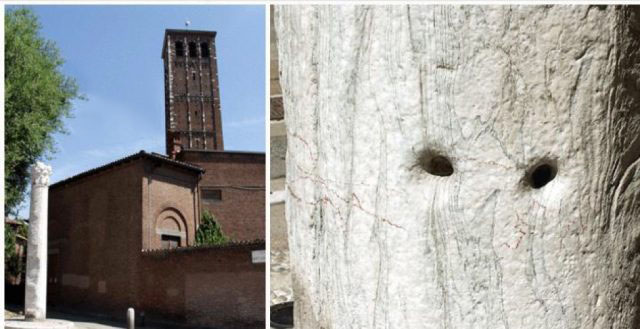
Forget the runways. Forget the stock exchange. Walk with me to a quiet square, the Piazza Sant’Ambrogio. It’s a peaceful place, dominated by one of the oldest and most important churches in Milan. But your eyes aren’t drawn to the basilica. Not at first. They’re drawn to something that feels… out of place. A single, solitary column standing alone. It’s ancient. Weathered. And it has a story to tell. A story of a saint, a demonic confrontation, and two strange holes that might just be a direct line to Hell itself.

This is the story of the Colonna del Diavolo. The Devil’s Column.

And you’re about to find out why, for centuries, people have pressed their ears against its cold marble, hoping—or dreading—to hear the screams of the damned.

Deep Dive: Who Was Saint Ambrose, Milan’s Iron Bishop?

To get why this story has such a grip on the city, you have to understand the man at its center. This isn’t just some forgotten friar. This is Aurelius Ambrosius. Saint Ambrose. A titan of the 4th century.

He wasn’t even a priest to begin with. Ambrose was a politician. A lawyer. The Roman governor of the region, stationed in Mediolanum, as Milan was then called. He was a powerhouse, a born leader, known for his sharp mind and his ability to command a room. Then, in the year 374, the city’s bishop died. The church was in chaos, split between two warring factions. Tensions were explosive. Riots were imminent.

Ambrose, in his role as governor, went to the church to calm the crowds. He gave a speech, pleading for peace and a civil process. And then, something impossible happened. A child’s voice—or so the legend says—cried out from the mob: “Ambrose for bishop!”

The chant was taken up. It became a roar. The people had chosen. There was just one tiny problem. Ambrose wasn’t even baptized yet. He was still just a student of the faith. But the public demand was overwhelming. In the space of a single week, he was baptized, ordained, and consecrated as the Bishop of Milan. Talk about a career change.

He wasn’t a soft bishop. He was a fighter. He took on heretics, challenged emperors, and shaped the very foundations of the Western Church. He was a force of nature. A man so formidable, so utterly unshakeable in his faith, that it makes perfect sense that the Devil himself would see him as the ultimate prize.

A Relic from a Lost Empire

Before it was a demonic landmark, what was the column? It doesn’t match the basilica. It’s stylistically a world away. That’s because it’s much, much older. This is a Roman ruin, a lonely survivor from the 2nd century AD, when Milan was a major capital of the Roman Empire.

No one knows for sure what it was for. Most historians believe it was part of the imperial palace that once stood here, a grand complex belonging to the Emperor Maximian. A symbol of immense earthly power. Perhaps it was a single column from a grand portico, the only piece left standing after centuries of war, fire, and rebuilding. A ghost of Rome, haunting a Christian piazza.

Or was it something else? Something from a pagan temple, a place of old gods and old rituals, left standing as a reminder of what the new faith had conquered? The truth is lost to time. But its powerful, pagan past makes the perfect stage for the legend that would define it forever.

The Clash: A Saint versus the Prince of Darkness

The story goes like this.

One morning, Bishop Ambrose was walking in the gardens of his new basilica. The air was calm. But not for long. The Devil appeared before him. This wasn’t their first meeting. For months, Satan had been working on Ambrose, whispering temptations, trying to corrupt this shining pillar of the church. Getting a man like Ambrose to fall would be a monumental victory for the forces of darkness. But Ambrose was unbending. Annoyed, even.

The Devil, full of arrogance, launched into another tirade, another series of promises and threats designed to break the bishop’s will. He got close. Too close. He sneered, his voice a venomous hiss, right in Ambrose’s face.

And Ambrose had simply had enough.

He was a practical man. A problem solver. Not one for lengthy exorcisms when a simpler solution was available. With a shout of righteous fury, he reared back and delivered a powerful kick, sending the Prince of Darkness flying backward. Satan slammed into the cold, hard marble of the Roman column with bone-jarring force. The impact was so violent that his horns—the very symbols of his infernal power—punched deep into the stone, trapping him.

He was stuck. The Devil himself, pinned to a column like an insect. He thrashed and roared. He pulled and twisted. For an entire night and day, they say, he struggled to break free, the stone groaning under the strain. Finally, with a sickening crack, he wrenched his horns loose and, utterly humiliated and terrified by the raw power of the bishop’s faith, he vanished. He didn’t just walk away. He tore open a hole into his own dimension and fled back to the sulfurous pits from whence he came.

He left two things behind. A story that would never die. And two strange holes in a marble column.

The Scars of Hell: What’s Really Inside the Holes?

This is where the story gets really weird. The two holes are still there. You can go see them today. They are smooth, oddly shaped, and spaced just far enough apart to be… well, horn-shaped.

For centuries, a dark tradition has surrounded these holes. Popular belief insists that if you press your nose close, you can still catch a faint whiff of sulfur, the Devil’s signature scent. And if you are very quiet, and press your ear to the cold stone? You can hear the sounds of Hell. The wailing of the damned, the roar of infernal rivers. An echo of the gateway the Devil tore open in his panicked escape.

Skeptics, of course, have other ideas. The smell? Probably centuries of pollution from city air, or maybe a quirky mineral deposit in the marble itself. The sounds? Just the wind whistling through the holes, or the ambient noise of a bustling city creating an auditory illusion. Simple physics.

But the locals know what they know. They’ve passed the story down for nearly 1,700 years. And the tradition is potent. Even now, you will see tourists and believers alike tentatively placing a hand over the holes, or leaning in close, just to see. Just in case.

Is it mass hysteria? Or is it a folk memory of something real? A place where the veil between worlds was stretched thin, and the damage it left behind still resonates today?

A Magnet for the Macabre: Modern Rituals and Internet Theories

A legend this dark is bound to attract a certain kind of attention. The story doesn’t end with Saint Ambrose. It has a strange and twisted afterlife.

A secondary legend claims that the Devil didn’t entirely give up. On the night of Easter’s eve, if you stand in the piazza, you might see him. A ghostly carriage, pulled by black horses with eyes of fire, will race past the basilica, dragging the souls of the newly damned down to their eternal punishment.

This notoriety has made the Devil’s Column a point of interest for more than just history buffs. It’s known to attract small groups of Satanists and occult practitioners, especially around holidays like Halloween or Walpurgis Night. What do they do here? Mostly, it seems, they come to soak in the atmosphere of a place literally marked by their patron. It’s a site of pilgrimage. A touchstone. Some whisper of small, secret rituals being performed here in the dead of night, attempts to re-open the gate that their master once used.

The internet, naturally, has taken things even further. Online forums and conspiracy blogs buzz with theories. Is the column a focal point for ley lines, those invisible channels of energy that supposedly crisscross the globe? Was the original Roman structure an energy conductor of some kind? Did Ambrose not just kick the Devil, but seal a naturally occurring weak spot between dimensions?

The most compelling “what if” scenario is this: What if the Devil’s escape didn’t close the gate? What if it just left it a tiny bit ajar? The holes, in this theory, aren’t just scars. They’re vents. A permanent, microscopic crack in reality, leaking out the sounds and smells of another place. It’s a chilling thought.

Deep Dive: A Throne for Emperors, A Prison for the Devil?

Here is the single most baffling part of the entire story. This column, this monument to a demonic beatdown, was not shunned by the church or the state. It was embraced. In fact, it became a central piece of one of the most important political ceremonies in Europe: the coronation of the Holy Roman Emperors.

The 14th-century chronicler Galvano Fiamma laid out the process. When a German king came to Milan to be crowned with the legendary Iron Crown of Lombardy (a crown said to contain a nail from the True Cross), the ceremony began *right here*, at this very column.

Fiamma writes: “When the King of the Romans want to receive the crown of the Kingdom of Italy… the Emperor must go first to the marble column… and swear that he will be obedient to the Pope and the Roman Church…”

Think about that. To be crowned with a holy Christian relic, the most powerful men in the world first had to go to the Devil’s Column. They would lay their hands on it, embrace it, and swear their most sacred oath. Why? Why on earth would they do that?

The symbolism is staggering. Was it an act of domination? By starting the holy coronation at the site of Satan’s defeat, were they showing that the power of Christ and his Empire triumphed over all evil? It was a political statement, declaring that their reign was built upon the very spot where the Devil was humiliated.

Or was it something deeper, and far stranger? Was it an acknowledgement of the dual nature of power, both sacred and profane? A quiet nod to the ancient, pre-Christian power of the location, a way of appeasing the old forces even while celebrating the new? It’s a paradox that historians still debate. A holy ceremony, beginning at an unholy monument. It’s one of the strangest twists in a story already full of them.

The Whisper in the Stone

Today, the Devil’s Column stands just as it has for nearly two millennia. Pigeons land on it. Tourists take selfies with it. The city of Milan buzzes around it, a constant hum of modern life.

But the column remains. A silent witness. It saw the Roman Empire in its glory. It saw the arrival of a faith that would conquer the world. It saw the fury of a saint and the humiliation of the Devil. It saw the crowns placed on the heads of emperors who ruled a continent.

It is more than just a piece of rock. It’s a story. A warning. A mystery. It represents a clash of worlds—pagan and Christian, imperial and holy, divine and demonic—all focused on one spot.

So, if you ever find yourself in Milan, wander over to the Piazza Sant’Ambrogio. Find the lonely column. Run your hands over its surface, feel the smooth, unnatural edges of the two holes. And then, when no one is looking, lean in close. Listen. What will you hear? The wind? The traffic?

Or something else entirely?

Arindam Mukherjee
Arindam Mukherjee
Arindam loves aliens, mysteries and pursing his interest in the area of hacking as a technical writer at 'Planet wank'. You can catch him at his social profiles anytime.
RELATED ARTICLES
- Advertisment -

Most Popular

Recent Comments

Warren Pan Abbott on The legend of the Devil Monkey !
chris davies on The McPherson Tape Mystery
Reed Reedly on ET has Internet!
Bea Houseoffashion on Proof Of Time Travellers – Gallery
Marcus2012 on ET has Internet!
Reed Reedly on ET has Internet!
LaughsAtConspiracyNuts on The 9/11 Conspiracy – Myths and Facts
Alex Sliverman on Did the ancients fly?
Doctor Wholigan on Time Traveler in 1938 film
chris davies on The McPherson Tape Mystery
Archie1954 on 10 secret UFO hideouts
chris davies on Ghosts of flight 401
Marcus2012 on ET has Internet!
jason Macdonald on Proof of Time Travel? – China
chris davies on Long-Lost Pyramids Found?
Reed Reedly on ET has Internet!
Milkman on Connected Universe
Tenmiles on Baigong Pipes Mystery
Simon Foster on Sirius – The Documentary
From the 1st April on 2013 – Alien Contact date ?
SkyWatcher on Is ET ignoring us?
I Come From The Future on Obama to make UFO Alien disclouser soon ?
Just another person on 2013 – Alien Contact date ?
Malcolm Windowcleaner on The strange case of Rudolph Fentz
Mason Servio on Strange Things on Mars
Marke Wisdom Seeker on What will we find as arctic melts?
Andrea A Elisabeth Levyne on Aliens Captured in Varginha, Brazil
Mitch Grouyeki on Amazing Space Shuttle pictures