Wednesday, September 9, 2026
HomeWeird WorldStrange PlacesThylacine sighted in Australian coastal town

Thylacine sighted in Australian coastal town

They Say It’s Gone. But What If They’re Lying? The Tasmanian Tiger That Refuses to Die.

They put a date on it. September 7, 1936. That was the day the last known thylacine, a lonely male named Benjamin, died from neglect and exposure on the cold concrete floor of his cage at the Beaumaris Zoo in Hobart, Tasmania.

The end. A full stop on a tragic story. A species wiped from the face of the Earth by fear, ignorance, and a government bounty.

A ghost. A memory.

But ghosts don’t leave footprints. Ghosts don’t scream in the dead of night. And ghosts don’t cross lonely roads in front of shell-shocked drivers, their striped flanks illuminated for one heart-stopping moment in the high beams.

The official story is neat. It’s tidy. It fits in a textbook. But out in the wild, rugged corners of Australia, a different story is being told. It’s a story whispered around campfires, shared in hushed tones in rural pubs, and increasingly, posted in grainy videos online. It’s the story of an animal that simply refuses to be extinct.

One Night in Inverloch: A Modern Encounter

The story often starts on a dark road, just like it did for Barrie Murphy. Inverloch, a coastal town in Victoria, Australia. Not Tasmania. That’s the first detail that should make the hair on your neck stand up. The mainland.

It was late. Around 10:30 PM. The kind of quiet that settles over a small town when most are asleep. Murphy was driving along Ullathorne Road, a ribbon of asphalt cutting through the dark. Then, movement.

“At about 10.30pm, I was driving along Ullathorne Road when it crossed the road in front of me,” he reported, his words carrying the weight of genuine shock. “First of all, I thought it was a fox or a cat, but as it moved off the bitumen on to the green verge, I realised it was dog sized, about the same as an Alsatian.”

This is where most misidentifications fall apart. A fox is a fox. A dog is a dog. But what Murphy saw next defied easy explanation. It had two features that are burned into the collective memory of what a thylacine looked like.

“It was the long, straight tail, which could have been a metre long. It was straight out, white and strong looking,” he said. Not a fluffy, curved tail of a fox. Not the wagging tail of a dog. A stiff, heavy, almost kangaroo-like tail, held rigidly straight. Then came the clincher. The detail that turns a strange sighting into a potential bombshell.

“The thing that really made me twig was, as I drove past it, I saw the stripes down its side and onto its flank.”

Stripes. The unmistakable trademark of the Tasmanian Tiger.

Barrie Murphy’s encounter wasn’t an isolated blip. It was a pattern. Locals confirmed at least two other similar sightings in the Inverloch area around the same time, including one at a caravan park. People were seeing *something*. Murphy’s goal wasn’t fame. It was a public service. “I thought I would report it so other people can keep a lookout,” he said. A lookout for what? A ghost? Or a living, breathing survivor?

Deep Dive: What Exactly Was the Thylacine?

Before we dive down the rabbit hole of sightings and conspiracy, we need to understand what we’re even looking for. What was this creature that haunts the Australian psyche?

First, get the name “Tasmanian Tiger” out of your head. It wasn’t a cat. At all. It also wasn’t a dog or a wolf, though it looked uncannily like one due to an incredible quirk of evolution called “convergent evolution,” where two unrelated species develop similar traits to fit a similar ecological niche. The thylacine was something uniquely Australian. It was the world’s largest modern carnivorous marsupial.

Think about that. A predator, the size of a medium dog, with a pouch like a kangaroo.

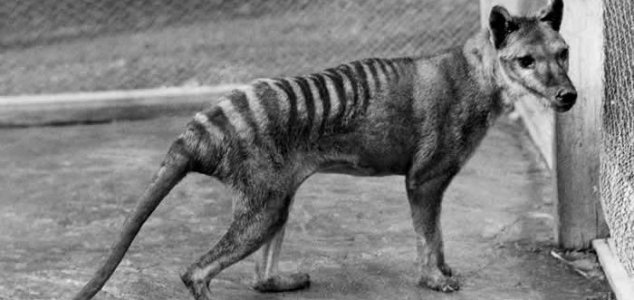
Its scientific name, Thylacinus cynocephalus, means “dog-headed pouched one.” A perfect description. It had a sandy, yellowish-brown coat that gave it perfect camouflage in the Australian bush. Across its back, from the shoulders to the base of its thick, stiff tail, were 13 to 21 dark, transverse stripes. Its most terrifying and awe-inspiring feature? Its jaw. The thylacine could open its mouth to an almost unbelievable 80 degrees. Not quite the 120 degrees of legend, but still a truly intimidating sight.

It wasn’t a pack hunter like a wolf. It was a persistent, solitary predator. It would stalk its prey—wallabies, birds, small kangaroos—at a steady trot, waiting for the perfect moment to strike. Its gait was said to be slightly awkward, stiff, different from any other animal. A key detail many modern eyewitnesses report.

A Man-Made Extinction: A Story of Blood and Bounties

So if this animal was so perfectly adapted, so successful, where did it go? The answer is simple and brutal. We killed them.

When European settlers arrived in Tasmania in the early 19th century, they brought sheep. Lots of them. To the thylacine, a slow-moving, defenseless sheep looked like an easy meal. To the settlers, the thylacine became Public Enemy Number One. A sheep-killing demon of the night.

The propaganda machine went into overdrive. The thylacine was painted as a bloodthirsty monster. A threat to livelihoods. In 1888, the Tasmanian government put an official bounty on its head: £1 for every adult and 10 shillings for every pup. Private companies had already been paying bounties for decades. It was a declaration of war.

Hunters, trappers, and farmers went after the thylacine with a vengeance. They were shot. They were snared. They were poisoned. Between 1888 and 1909 alone, over 2,184 bounties were paid out. The real number of kills was certainly much, much higher. The population, which had already been hit hard by habitat loss and disease, collapsed.

The last one shot in the wild was in 1930. The last one captured was in 1933. That was Benjamin.

The story of Benjamin is a tragedy in itself. For years, he was believed to be a female. He lived his last days in a depressing concrete enclosure. The heartbreaking footage we have of him pacing his cage is the last we will ever see of his kind in motion. On that cold September night in 1936, the story goes that he was accidentally locked out of his sheltered sleeping quarters. He died of exposure. A cold, lonely, pointless end for the last of a species.

The ultimate irony? The ultimate gut-punch? Just 59 days before Benjamin died, the Tasmanian government officially granted the species full protection. Too little. Tragically, unforgivably too late.

The Sightings Begin: A Flood of Evidence?

But the story didn’t end in 1936. In fact, that’s when the *real* mystery began. Almost immediately after it was declared extinct, the sightings started. At first, it was a trickle. A farmer here, a hiker there. But then the trickle became a stream, and the stream became a flood. To date, there have been literally thousands of reported sightings.

Are thousands of people all delusional? Are they all lying? Or are they seeing something real?

The Eyewitnesses Speak

The sheer number and consistency of eyewitness reports are staggering. These aren’t just fleeting glimpses. Many are detailed, emotional accounts from credible people with nothing to gain. Park rangers, police officers, seasoned hunters who know the bush like the back of their hand. They consistently describe the same key features: the medium-dog size, the weirdly stiff gait, the long, rigid tail held straight out, and, of course, the stripes.

One of the most famous cases was Hans Naarding in 1982. He wasn’t some amateur. He was a wildlife officer with the Tasmania Parks and Wildlife Service. He was sleeping in his vehicle at a remote logging road when he was woken by a noise. He switched on his spotlight. There, frozen in the beam for several minutes, was an adult male thylacine. He knew exactly what he was looking at. His report triggered a year-long, government-funded search that, officially, found nothing. But Naarding never wavered in his story.

The Murky World of Photos and Videos

In the age of the smartphone, where is the definitive proof? The lack of a crystal-clear photo is the biggest weapon skeptics use. But that doesn’t mean there’s a lack of alleged photographic evidence. It’s just… messy.

The internet is littered with blurry photos and shaky videos. The 1973 “Sinn” footage, showing a creature running across a road. The 2008 “Doyle” footage, which many experts believe is the most compelling video evidence yet. More recently, trail cam footage from groups like the Thylacine Awareness Group of Australia (TAGOA) shows animals that have thylacine-like features but always remain tantalizingly obscured.

The problem is always the same. The footage is too grainy. The distance is too great. The animal is gone too quickly. Skeptics are quick to cry “mangy fox!” or “wallaby!” And in many cases, they might be right. But are they right in *all* cases? For a creature that was hunted to the brink of extinction, being camera-shy seems like a pretty good survival trait to have.

What If? The Logic of Survival

Could it have survived? Let’s get practical. Is it even possible?

The island of Tasmania covers 68,401 square kilometers (about 26,410 square miles). A huge portion of this is the Tasmanian Wilderness World Heritage Area—one of the last great expanses of temperate rainforest in the world. It is dense, rugged, and in many places, completely inaccessible to humans. It’s the perfect hiding place.

If a small, isolated population managed to retreat into these deep forests, away from the hunters and their traps, it is entirely plausible they could have survived undetected. They were masters of stealth. Their numbers would be small, their range limited. They would be, for all intents and purposes, living ghosts.

And what about mainland Australia, where Barrie Murphy had his sighting? For decades, the accepted science was that the thylacine died out on the mainland around 2,000 years ago, outcompeted by the dingo. But new research and re-examined rock art suggest they may have survived there far more recently, perhaps even into the 20th century. If that’s true, it blows the whole mystery wide open. It means the search isn’t just confined to the island of Tasmania.

The Modern Hunt: Science Enters the Fray

The search for the thylacine has gone high-tech. Armies of amateur and professional researchers are using sophisticated tools. Fleets of motion-activated trail cameras are deployed in remote areas. Drones with thermal imaging cameras scan the forests from above. Environmental DNA (eDNA) is being collected from water sources, hoping to find a genetic trace of the elusive animal.

And then there’s the wildest idea of all: de-extinction.

Scientists are actively working on a project to bring the thylacine back from the dead. Using DNA extracted from a preserved pup specimen, geneticists believe they can sequence the entire thylacine genome. From there, using marsupial relatives like the numbat or dunnart as a surrogate, they could theoretically “edit” an embryo to create a living, breathing thylacine and reintroduce it to the wild.

It sounds like science fiction. But it raises a mind-bending question. What if they succeed in cloning a thylacine, only to discover a small, natural population had been hiding out all along?

The truth is still out there. In the deep woods. Down a dark road. Perhaps in a blurry photo on your computer screen. The official story says the thylacine is gone forever, a closed chapter. But thousands of eyewitnesses and a growing mountain of tantalizing clues suggest that chapter never really ended.

So the next time you’re in the Australian bush and you see something strange in the shadows… a dog-like creature with a stiff tail and stripes on its back… don’t just dismiss it. You might have just seen a ghost. Or you might have just become the one to finally prove that the Tasmanian Tiger is still with us.

Arindam Mukherjee
Arindam Mukherjee
Arindam loves aliens, mysteries and pursing his interest in the area of hacking as a technical writer at 'Planet wank'. You can catch him at his social profiles anytime.
RELATED ARTICLES
- Advertisment -

Most Popular

Recent Comments

Warren Pan Abbott on The legend of the Devil Monkey !
chris davies on The McPherson Tape Mystery
Reed Reedly on ET has Internet!
Bea Houseoffashion on Proof Of Time Travellers – Gallery
Marcus2012 on ET has Internet!
Reed Reedly on ET has Internet!
LaughsAtConspiracyNuts on The 9/11 Conspiracy – Myths and Facts
Alex Sliverman on Did the ancients fly?
Doctor Wholigan on Time Traveler in 1938 film
chris davies on The McPherson Tape Mystery
Archie1954 on 10 secret UFO hideouts
chris davies on Ghosts of flight 401
Marcus2012 on ET has Internet!
jason Macdonald on Proof of Time Travel? – China
chris davies on Long-Lost Pyramids Found?
Reed Reedly on ET has Internet!
Milkman on Connected Universe
Tenmiles on Baigong Pipes Mystery
Simon Foster on Sirius – The Documentary
From the 1st April on 2013 – Alien Contact date ?
SkyWatcher on Is ET ignoring us?
I Come From The Future on Obama to make UFO Alien disclouser soon ?
Just another person on 2013 – Alien Contact date ?
Malcolm Windowcleaner on The strange case of Rudolph Fentz
Mason Servio on Strange Things on Mars
Marke Wisdom Seeker on What will we find as arctic melts?
Andrea A Elisabeth Levyne on Aliens Captured in Varginha, Brazil
Mitch Grouyeki on Amazing Space Shuttle pictures