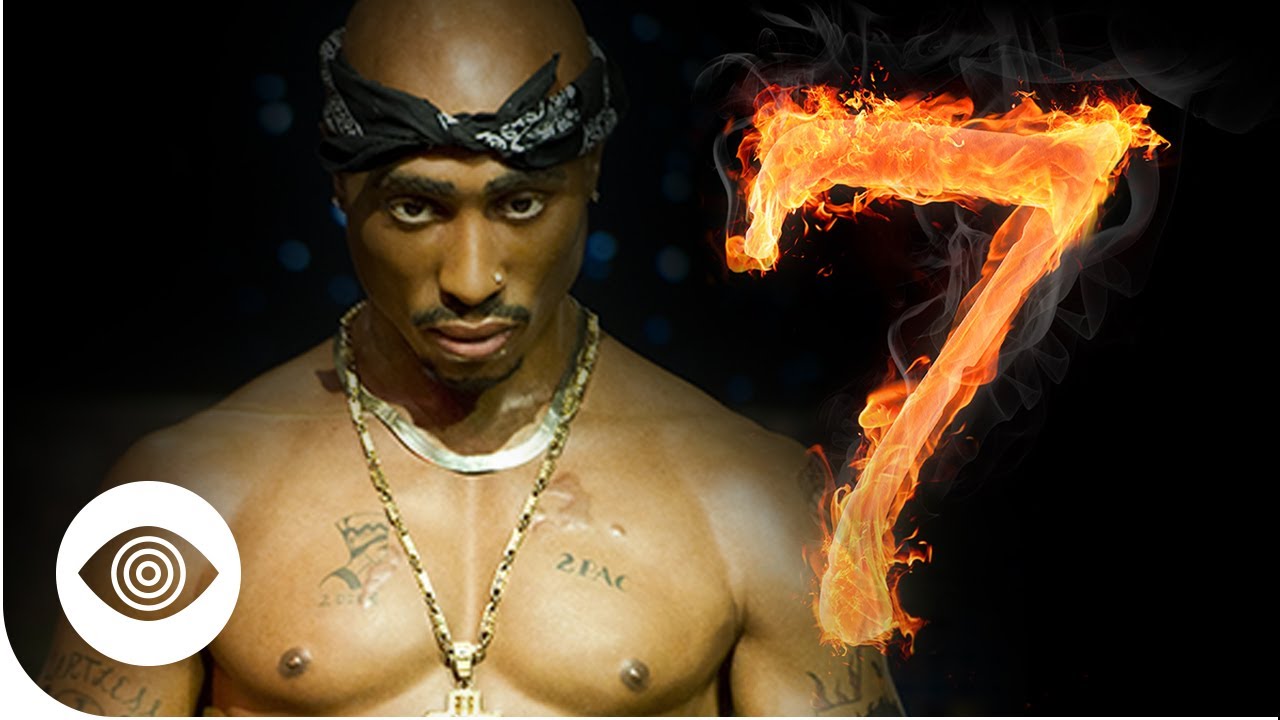
They Told You He Was Gone. What If They Lied?
September 13, 1996. The world lost a voice. A poet. A revolutionary. Tupac Amaru Shakur, the undisputed king of West Coast hip-hop, was pronounced dead in a Las Vegas hospital.
The story is etched into pop culture history. A hail of bullets on the glittering Vegas strip. A week-long fight for his life. And then… silence.
But what if the silence was the point?
What if the most-watched celebrity death of the 90s wasn’t an end, but a calculated, brilliant escape? Forget what you’ve been told. Forget the official reports and the somber news clips. Today, we’re not just scratching the surface; we’re digging a tunnel straight into the heart of one of the most persistent and detailed conspiracy theories of all time: The 7 Day Theory.
The idea that Tupac faked his own death isn’t just a wild fan fantasy. It’s a complex puzzle built on lyrical prophecies, strange coincidences, and a powerful, recurring number. The number 7.
Prepare yourself. The rabbit hole is real. And it’s a lot deeper than you ever imagined.
The Official Story: A Narrative Full of Holes
Before we jump into the theory, let’s look at the “official” version of events. The one they want you to accept without question. On the night of September 7, 1996, Tupac and Suge Knight, the head of Death Row Records, attended the Mike Tyson fight at the MGM Grand. After the fight, a brawl broke out in the hotel lobby, with Tupac and his entourage allegedly attacking a man named Orlando “Baby Lane” Anderson, a member of the rival Southside Compton Crips gang.
Later that night, the black BMW 750iL driven by Suge, with Tupac in the passenger seat, was stopped at a red light. A white Cadillac pulled up alongside them. Gunfire erupted.
Four bullets hit Tupac. One hit Suge. They were rushed to the University Medical Center of Southern Nevada.
For six days, the world held its breath. Reports were conflicting. He was getting better. He was getting worse. Then, on the seventh day, Friday the 13th, at 4:03 PM, Tupac Shakur was declared dead. The cause? Respiratory failure and cardiopulmonary arrest.
Case closed, right?
Wrong. So very wrong.
The Glaring Problems They Don’t Talk About
The official story falls apart under the slightest pressure. It’s a house of cards in a hurricane.
- The Witnesses: The Las Vegas strip on a fight night is one of the busiest places on Earth. Yet, somehow, nobody got a clear look at the shooter? The Outlawz, Tupac’s group, were in the car directly behind him. Their stories have been inconsistent, with key members later claiming they were told to not cooperate. Why?
- The Cremation: Tupac was supposedly cremated the very next day, on September 14th. This is suspiciously fast. There was no open-casket funeral for one of the most famous men in the world. The man who was paid to do the cremation, a C. David Moss, conveniently retired and disappeared from public life. His story of the cremation has changed over the years, and the official paperwork he filed contained physical discrepancies about Tupac, listing him as 6’2″ and 215 lbs when he was famously much leaner, around 5’10” and 168 lbs.
- The Money: Tupac had a life insurance policy worth millions. It was never claimed. Think about that. Why would his family, particularly his mother Afeni who fought for his legacy, leave millions of dollars on the table? Unless, of course, you can’t claim a life insurance policy for someone who isn’t actually dead.
The 7 Day Theory: Rise of Makaveli
This is where it gets interesting. Just weeks after his “death,” a new Tupac album dropped. But it wasn’t under his own name. The artist was “Makaveli,” and the album was titled *The Don Killuminati: The 7 Day Theory*.
The cover art alone was a bombshell. It depicted Tupac on a crucifix, like Jesus Christ, under the headline, “In no way is this portrait an expression of disrespect for Jesus Christ.” The reference was obvious: death and resurrection.
But who was Makaveli?
This wasn’t some random name. It was a direct reference to Niccolò Machiavelli, the 16th-century Italian political philosopher. Tupac had reportedly studied Machiavelli’s works intensely while in prison. What was Machiavelli famous for? His political treatise *The Prince*, and another work called *Discourses on Livy*. In these books, Machiavelli openly advocates for the strategic advantage of faking one’s own death to deceive enemies and gain power.
He literally wrote the playbook for disappearing and coming back stronger.
Tupac, feeling the pressures of the East Coast/West Coast beef and threats from all sides, didn’t just adopt a name. He adopted a strategy. The 7 Day Theory posits that the entire album, released after his death, was the first part of his master plan.
The Numbers Don’t Lie: A Cascade of Sevens
If the Machiavelli connection is the foundation, then the number 7 is the steel frame holding the entire theory together. The coincidences are so numerous, so specific, that to dismiss them as mere chance requires an almost willful ignorance. Let’s break it down.
- He was shot on **September 7th**.
- He survived the 7th, 8th, 9th, 10th, 11th, and 12th… dying on the 7th day, September 13th.
- The official time of death was 4:03 PM. 4 + 0 + 3 = **7**.
- He was 25 years old when he died. 2 + 5 = **7**.
- The album *All Eyez on Me* was released on February 13, 1996. He died on September 13, 1996. That is exactly **7** months.
- In the video for “I Ain’t Mad At Cha,” released just days after his death, Tupac is depicted as an angel in heaven. The video was filmed in August 1996. It eerily foretells his own passing.
- In the song “Hail Mary” on the Makaveli album, there’s a line: “Makaveli in this… Killuminati, all through your body. The blows like a twelve-gauge shotty… Feel me!” The beat then changes, and he continues. Many fans believe this is a coded message.
- The title itself: *The **7** Day Theory*. It couldn’t be more direct.
There are more. So many more. Online forums and Reddit threads have found sevens in album track lengths, release dates, and even the number of shots fired in his music videos. It is a deliberate, recurring pattern. A breadcrumb trail left for his most dedicated followers.
Decoding the Posthumous Messages
If Tupac planned his escape, he certainly left a lot of clues behind in his music. His work released after 1996 is riddled with lines that, in hindsight, sound less like art and more like a confession.
Deep Dive: The Lyrical Evidence
Let’s look at some of the most-cited lyrics that fuel this fire.
From the Makaveli album, in the song “Ain’t Hard 2 Find,” he raps:
“I heard a rumor I died, murdered in cold blood, dramatized. Pictures of me in my final stages, you know mama cried. But that was fiction, some coward got the story twisted.”
This was recorded *before* his death. How much more direct can you get? He’s literally addressing a rumor of his own murder and calling it fiction.
In “Blasphemy,” he says:
“Brothers getting shot, coming back resurrected.”
Again, a direct reference to resurrection. The album is filled with them. The overarching theme is death, rebirth, and outsmarting your enemies.
On “Life of an Outlaw,” another track from the Makaveli album:
“All for the street fame on how to be managed, to plan shit, six months in advance to what we plotted. Approved to go on swole and now I got it.”
Here he talks about planning things six months in advance. The shooting happened in September. Six months prior to that would be March 1996, right after *All Eyez on Me* was released and he was at the peak of his fame and the center of the coastal feud. Was this when the plan was hatched?
Even the production held secrets. In many of his posthumous songs, you can hear a voice whisper “Suge shot me.” For years, this fueled theories that his own label boss was involved. But what if it was misdirection? A red herring planted by Tupac himself to throw everyone off the real scent – that nobody shot him in a way that truly mattered, because he was already planning his exit.
Modern Sightings and The Cuban Connection
For years, the theory stated that Tupac would return after seven years had passed. When 2003 came and went without a triumphant return, many lost faith. But the most hardcore believers simply adapted. The plan, they say, changed. He couldn’t come back; it was too dangerous. He had found peace.
But where did he go?
The most popular theory is Cuba.
Why Cuba? It makes perfect sense. Tupac’s aunt, Assata Shakur, a former member of the Black Liberation Army, was granted political asylum in Cuba in 1984 after escaping a U.S. prison. She still lives there today. It would be the perfect sanctuary, a place with no extradition treaty with the United States, where he could live quietly under the protection of family.
Over the years, “sightings” have become an internet subculture. Grainy photos from Cuba, blurry videos from Malaysia, a man who looks just like him at a Celtics game in 2014. Most are easily debunked. But they keep the hope alive.
In 2018, Suge Knight’s own son, Suge J. Knight, fanned the flames with a series of bizarre Instagram posts claiming Tupac was alive and well, living in Malaysia. He posted doctored photos of Tupac with modern-day celebrities like 50 Cent and Beyoncé. While largely seen as a publicity stunt, it brought the theory roaring back into the mainstream. It proved one thing: two decades later, the world is still desperate to believe.
So, How Could He Have Pulled It Off?
This is the ultimate question. Faking your own death when you’re one of the most recognizable people on the planet seems impossible. But was it?
Let’s imagine the “What If” scenario. The plan is in motion. Tupac knows he needs to disappear.
- The Body Double: The easiest solution. Was there a terminally ill man who looked enough like Tupac to be his stand-in at the hospital? With enough money, anything is possible.
- The Hospital Staff: Las Vegas is a city built on secrets and cash. Bribing a few key doctors and nurses to play along, to manage the flow of information, wouldn’t be out of the question for a man with Death Row’s resources.
- The Escape: While the world’s media was focused on the front door of the hospital, Tupac could have been quietly slipped out the back, onto a private jet, and flown to a non-extradition country like Cuba.
- Suge Knight’s Role: Suge was the only other person in the car. He was grazed by a bullet. Or was he? A shallow wound is an easy price to pay for being part of the greatest disappearing act in history. His cryptic, evasive answers over the decades make perfect sense if he’s protecting the secret. He’s never definitively said Tupac is dead. He always talks around it. In a 2017 interview, he even suggested Tupac could still be alive.
The pieces are all there. It’s a wild, audacious theory. But it’s no more wild than the idea that in a city covered in cameras, on a street packed with people, a car full of assassins could murder a global icon and simply vanish into thin air, never to be found.
Which story is really harder to believe?
The official narrative is a dead end. A mystery with no resolution. The 7 Day Theory, however, provides an answer. It gives purpose to his final album, context to his most cryptic lyrics, and a legacy that transcends death itself.
Is Tupac Shakur gone? Or did he just play the game better than anyone else? Did he check out of the violent world he chronicled, leaving behind a ghost to carry his legend? The official story is written in ink. But the real story, the one whispered in the shadows and pieced together by fans, is written in code. And all the clues point to the number 7.
Originally posted 2014-03-09 18:02:57. Republished by Blog Post Promoter