Home Films & Documentaries Painful Deceptions 9/11 Documentary

Painful Deceptions 9/11 Documentary

0
83

The 9/11 Film That Shouldn’t Exist: A Miracle of Chance, or Something More?

Some stories are written by history. Others are written by sheer, dumb luck. And a few… a very few… seem to be written by something else entirely.

Something that defies the odds. Something that makes you question the very nature of coincidence.

This is one of those stories. It’s the story of two French brothers, a rookie firefighter, and a routine gas leak call that placed them at ground zero of history’s most infamous day. It’s the story of the Naudet brothers’ documentary, simply titled “9/11,” and the footage they captured—footage so clear, so perfectly timed, so astronomically improbable that it has become a sacred text for historians and a Rosetta Stone for conspiracy theorists.

Most people have seen snippets of it. The grainy news reports, the shaky tourist videos. But the Naudet footage is different. It’s clean. It’s close. It’s the only professional, unobstructed view of the first plane striking the North Tower of the World Trade Center.

A one-in-a-billion shot. A filmmaking miracle. Right?

But what if it wasn’t a miracle? What if it was something else? The internet has been asking that question for over two decades. And the answers it comes up with are far more disturbing than you can imagine.

The Probie Project: A Simple Film About a Rookie Fireman

Let’s rewind. Back to a simpler time. Before the world changed forever.

Jules and Gédéon Naudet were French filmmakers with a fascination for America’s heroes. They wanted to capture the essence of bravery, the trial by fire. And what better place to find it than inside a New York City firehouse? They gained remarkable access to the Engine 7/Ladder 1/Battalion 1 firehouse on Duane Street in Lower Manhattan. The heart of the FDNY.

Their plan was simple, almost charmingly so. They would follow a “probie”—a probationary firefighter—through his first months on the job. His name was Tony Benetatos. The film was meant to be a coming-of-age story. The story of a boy becoming a man, learning the ropes, facing his fears, and earning his place in the brotherhood of the FDNY. It was a human story.

For months, they filmed the mundane. The firehouse chores. The shared meals. The false alarms and the small kitchen fires. They were capturing the rhythm of a life dedicated to service. Gédéon typically stayed with Tony, the star of their film, at the firehouse. Jules, on the other hand, often rode along with the battalion chiefs to get a different perspective. It was a division of labor that, on any other day, would have been completely insignificant.

But not on this day.

The Gas Leak That Changed The World

The morning of September 11, 2001, dawned impossibly clear. A perfect, deep blue sky stretched over Manhattan. Inside the Duane Street firehouse, it was business as usual. Until a call came in.

An odor of gas. Church and Lispenard Streets. Routine. Boring, even.

Battalion Chief Joseph Pfeifer saddled up to respond. Jules Naudet, camera in hand, went with him. It was just another scene for their little movie. Gédéon stayed behind at the firehouse with the probie, Tony. The crew was split.

At the intersection, the firefighters started their investigation. Sniffing the air. Checking the manholes. It was nothing. A nothing call on a nothing morning. Jules filmed Pfeifer directing his men. He panned his camera around the street, capturing the quiet, early-morning hum of Lower Manhattan.

And then he heard it.

A sound that didn’t belong. A low, guttural roar that grew louder. Fast. Too fast. A sound that ripped through the city’s calm like a razor blade. Everyone on the street looked up. Jules, instinctively a filmmaker, did too. He tilted his camera skyward, searching for the source of the noise.

And there it was.

9/11 Documentary

An American Airlines passenger jet, flying impossibly low, impossibly fast, screaming over the rooftops of Manhattan. It wasn’t landing. It wasn’t in trouble. It was on a line. A straight, deadly line.

Jules held the shot. He didn’t waver. He kept filming as the plane disappeared behind a building for a split second, then reappeared, and then…impact. A silent, sickening fireball erupted from the North Tower of the World Trade Center. A moment later, the soundwave hit them—a percussive, world-ending boom.

Jules Naudet had just captured history’s darkest moment. He had filmed the unthinkable. And he was the only one.

Deep Dive: The Other Recordings

For years, it was believed Jules’s footage was the *only* recording of the first impact. We now know that’s not entirely true, but it remains the only *clear* video. Pavel Hlava, a Czech immigrant, was filming the Manhattan skyline from his car on the Brooklyn-Queens Expressway. He caught the plane’s final seconds and the impact, but the footage is shaky and from a great distance. Separately, artist Wolfgang Staehle had a webcam project capturing still images of the skyline every four seconds. His camera took a sequence of low-resolution stills showing the approach and the fireball. But neither of these has the terrifying clarity, the ground-level sound, or the immediate human reaction of the Naudet film. His camera was the eye of the storm.

Into the Inferno: The North Tower Lobby

The gas leak was forgotten. Chief Pfeifer, realizing the magnitude of what just happened, immediately radioed it in and raced his battalion towards the burning tower. They were the first responders on the scene. And Jules Naudet, his camera still rolling, went with them.

He followed Pfeifer into the lobby of the North Tower. What his camera captured next is the stuff of nightmares. It was a scene of organized chaos. Firefighters, police, and Port Authority officers streamed in, their faces a mixture of adrenaline and disbelief. Debris rained down from above. The air was thick with the smell of jet fuel. The sounds were horrifying. The roar of the fire high above. The constant pinging of alarms. And a series of sickening, rhythmic thuds on the plaza outside.

The jumpers. People choosing to fall a thousand feet rather than burn. Jules’s camera doesn’t show them, but the firefighters hear them. Their faces tell the story.

Chief Pfeifer set up a command post in the lobby, a futile attempt to orchestrate a rescue in a situation no one had ever trained for. Jules’s lens becomes our eyes, witnessing the bravery of these men firsthand. They knew what they were running into. They knew the elevators were out. They knew they had to climb, loaded with gear, into a raging inferno 90 stories up. And they went anyway.

Then, the second plane hit the South Tower. The building shuddered. A new wave of panic and confusion swept through the lobby. It was no longer an accident. This was an attack.

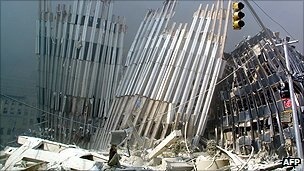
Jules kept filming. He filmed the quiet heroism. He filmed the raw fear. He filmed as the South Tower collapsed, a monstrous roar that sounded like the planet cracking in half. The lobby was plunged into total darkness, a thick cloud of pulverized concrete and death blasting through the entrance. The only light was the one on Jules’s camera. For a terrifying minute, that single beam of light, cutting through the choking dust, was the only thing that existed in a world that had ceased to make sense.

9/11 Documentary

The Footage That Fuels a Thousand Theories

This is where the story takes a turn. Where a documentary about heroes becomes a key piece of evidence in the biggest conspiracy theory of the modern age. Because for some, the Naudet footage is just *too* perfect.

Go to any corner of the internet where 9/11 is still debated—the old forums, the Reddit threads, the dark corners of YouTube—and you will find the Naudet film being dissected frame by painful frame.

What If: The Impossible Pan Shot

The first and most enduring question revolves around the moment of impact. The “money shot.” Critics and theorists ask: How did Jules Naudet, a filmmaker focused on a gas leak, manage to pan his camera up and perfectly capture a plane that was, at that point, just a sound?

The official story is simple: he heard a loud plane and looked up, just like everyone else on the street. It was instinct. But online sleuths argue it’s not that simple. They analyze the camera movement. They claim it’s too smooth. Too prescient. They argue that he begins to pan *before* the plane would have been clearly visible or audibly distinct from any other New York City noise. The question they pose is chilling: Was he just lucky, or was he tipped off? Did he know something was coming?

It’s a rabbit hole with no bottom. The idea that a French film crew was somehow part of a massive conspiracy seems absurd. Yet, the footage remains. The perfect shot. The impossible coincidence.

What If: The “Lucky” Gas Leak

Then there’s the gas leak itself. The very reason they were there. It was a nothing call. A false alarm. What are the odds? What are the mathematical probabilities of a random, pointless call pulling the *only* film crew in the area to a location with a perfect, unobstructed view of the North Tower’s north face, just minutes before impact?

Think about it. Had the call been five blocks east, their view would be blocked. Five minutes later, and they would have missed it. Five minutes earlier, and they might have already packed up and left. It was a perfect storm of coincidence. For theorists, the word “coincidence” isn’t enough. They see it as orchestration. A deliberate move to place the camera exactly where it needed to be to capture the “first shot” of a new war.

Was the gas leak call a decoy? A calculated piece of stage management in a global deception? It’s a terrifying thought. And for millions, it’s a question that has never been satisfactorily answered.

A Tale of Two Brothers: Gédéon’s Story

While Jules was trapped in the dust-choked hell of the North Tower lobby, his brother Gédéon was living a different kind of nightmare back at the firehouse. He filmed the other firefighters—the ones who had just come on shift—as their faces turned from confusion to disbelief to horror while they watched the events unfold on TV.

He captured the moment the second plane hit. The collective gasp. The dawning, sickening realization. When the South Tower collapsed, a firefighter simply whispers, “All those guys are gone.”

Gédéon, armed with his own camera, eventually ran out into the apocalyptic streets. His footage is a different kind of terrifying. It’s the aftermath. The towering clouds of dust rolling through the canyons of Lower Manhattan like a gray tsunami. The dazed, ash-covered survivors—the “dust people”—stumbling through the debris field like ghosts. His journey is one of searching. Searching for his brother. Searching for the men of Ladder 1. Searching for any sense in the madness.

The emotional core of the entire film is when the surviving firefighters, including Jules and Chief Pfeifer, finally make their way back to the firehouse hours later. Covered in dust, eyes hollowed out with trauma, they stumble back to a home that has been forever changed. Many of their brothers would never return. The probie, Tony Benetatos, survived. Chief Pfeifer survived. But his own brother, Lieutenant Kevin Pfeifer of Engine 33, was lost.

Why This 20-Year-Old Film Still Haunts Us

The documentary “9/11” is more than a film. It’s a time capsule. A primary source document of a day that fractured our timeline into “before” and “after.” It stands as one of the most powerful and raw testaments to human bravery and loss ever recorded.

But it’s also something more. It’s a ghost on the celluloid. A piece of the puzzle that, for some, doesn’t quite fit. In the age of AI-video enhancement and obsessive online analysis, the Naudet footage is scrutinized more than ever. Every shadow, every pixel, every sound is debated and argued over. It is used as proof by those who accept the official narrative and as proof by those who believe in a darker truth.

The film is a paradox. It is the clearest picture we have of what happened that morning. And yet, for a growing number of people, it raises more questions than it answers.

Was it a filmmaking miracle, born from a one-in-a-billion chance? Or was it something else? A piece of a carefully constructed narrative, captured by a camera that just happened to be in the right place, at the right time, for the wrong reasons?

Watch it for yourself. Look at the footage. Listen to the sounds. And then you decide.

Originally posted 2016-02-07 13:57:23. Republished by Blog Post Promoter