The Rabbit-Birthing Woman of Godalming: Unraveling England’s Most Bizarre Hoax
Picture it. The year is 1726. The air in Surrey, England, is thick with the smell of woodsmoke, damp earth, and superstition. Science is a flickering candle in a vast, dark room of folklore and fear. Doctors bleed their patients to cure a fever. The line between miracle and medicine is hopelessly blurred. And in the small market town of Godalming, a 25-year-old illiterate servant named Mary Toft is about to become the most talked-about woman in the entire country.
Why? Simple.
She was giving birth to rabbits.
No, you did not misread that. Not metaphorical rabbits. Not rabbit-like tumors. We’re talking actual, furry, floppy-eared lagomorphs. It’s a story so utterly strange, so profoundly baffling, that it short-circuited the minds of the nation’s greatest medical experts and captivated the Royal Court itself. It’s a tale of audacious deception, shocking gullibility, and the desperate lengths one poor woman would go to for a sliver of attention in a world designed to ignore her. Buckle up. This gets weird.
A Frantic Summons in the Night
Our story begins, as so many strange tales do, with a local doctor getting a call he’ll never forget. John Howard was a respected man-midwife in Godalming, a thirty-year veteran of his trade. He’d seen it all. Or so he thought. In September of 1726, he was summoned to the humble cottage of Joshua and Mary Toft. The situation was urgent. Mary was in labor.
But this was no normal delivery. When Howard arrived, he wasn’t greeted with a human baby. Instead, over the course of about a month, he claimed to have personally delivered several animal parts from Mary. We’re talking the legs of a cat. The liver of a rabbit. And then, impossibly, an entire, albeit dead, rabbit. Then another. And another.
In total, nine dead baby rabbits were supposedly born. Howard was stupefied. He was a man of science, but what was this? He documented his findings meticulously, his mind reeling. He sent letters to some of the most prominent figures in England, alerting them to the medical marvel—or monster—he had on his hands. The news spread like a virus. The story was just too sensational to contain.
Deep Dive: The Strange Science of ‘Maternal Impressions’
Before you dismiss everyone involved as a complete fool, you have to understand the world they lived in. A leading medical theory of the time was the concept of “maternal impression.” It was the widely accepted belief that a pregnant woman’s thoughts, dreams, or startling experiences could directly and physically alter the fetus growing inside her.
Did a pregnant woman get frightened by a dog? Her child might be born with a dog-like face or covered in fur. Did she crave strawberries? The baby might have a strawberry-shaped birthmark. It sounds absurd to us now, but this was cutting-edge thinking in the 18th century. It was the only explanation they had for birth defects and other congenital anomalies.
And Mary Toft had the perfect backstory. She claimed that earlier in her pregnancy, while working in a field, she had been startled by a rabbit. She developed a sudden, intense craving—a “longing”—for rabbit meat. This, she and her neighbors insisted, was the cause. The image of the rabbit had so powerfully imprinted upon her mind that it had transformed her pregnancy. To the people of 1726, this wasn’t just possible. It was plausible.
The King’s Men Arrive
Word of the Godalming wonder reached the very top. King George I was fascinated. He dispatched two of his most trusted men to investigate: Nathanael St. André, the Swiss-born surgeon-anatomist to the Royal Household, and Samuel Molyneux, the Prince of Wales’ secretary. This was the big leagues. St. André was an ambitious, slightly arrogant man with a massive reputation to uphold. A genuine medical miracle could make his career legendary.
He arrived in Godalming, brimming with professional skepticism. He examined Mary. He interviewed John Howard. He inspected the preserved rabbit parts. And then, right before his very eyes, Mary went into labor again. St. André personally “delivered” the torso of another rabbit. He was hooked.
He was so convinced, in fact, that he rushed back to London and published a 40-page pamphlet titled, *A Short Narrative of an Extraordinary Delivery of Rabbets*. He declared the phenomenon absolutely real. He was staking his entire professional reputation on Mary Toft. He believed. And because he believed, the whole country started to believe with him.
London’s Unlikeliest Celebrity
With the King’s surgeon backing her story, Mary Toft was whisked away to London to be studied further. She was no longer a poor country girl; she was a national sensation, a living, breathing medical anomaly. She was put up in Lacy’s Bagnio, a type of public bathhouse and inn, under constant observation. The greatest medical minds in England paraded through her room, eager to witness the miracle for themselves.
For a moment, Mary had everything she ever wanted. She was famous. Important people were listening to her. The press wrote about her daily. But the intense scrutiny was a double-edged sword. She was being watched. Every second. Every minute.
And under that unblinking gaze, the “miracle” suddenly stopped. Days went by. Mary writhed and moaned, complaining of labor pains, but she produced nothing. The doctors grew suspicious. The whispers began.
The Hoax Begins to Crumble
The first major crack in the story came not from a doctor, but from a lowly porter. He was caught trying to sneak a small, dead rabbit into Mary’s room. When questioned, he confessed: Mary’s sister-in-law had paid him to procure the “smallest rabbit he could find.” It was a damning piece of evidence, but the true believers, like St. André, desperately tried to dismiss it as a prank or an attempt to discredit Mary.
But the scientific evidence was piling up, too. A skeptical German surgeon named Cyriacus Ahlers had been one of the first to visit Mary in Godalming. He’d taken some of the rabbit specimens back to London for analysis. What he found was shocking.
CSI: 1726 – The Rabbit Pellet Evidence
In one of the rabbit’s pellets—its droppings—Ahlers discovered corn, hay, and straw. This was the smoking gun. A fetus developing inside a womb does not eat. It doesn’t digest food. The presence of digested vegetation proved, beyond any shadow of a doubt, that this rabbit had lived and eaten outside of Mary’s body. It had been born in a field, not in a woman.
Ahlers quietly published his findings. The tide of public opinion began to turn. The doctors watching Mary became more aggressive in their examinations. Sir Richard Manningham, another prominent physician, grew tired of the charade. He confronted Mary, telling her he intended to perform a painful, dangerous, and experimental surgery to physically inspect her uterus. He was going to find out the truth, one way or another.
The threat was too much. The game was up.
A Desperate Confession
Faced with the prospect of being cut open, Mary Toft broke down. On December 7, 1726, she confessed everything.
It was an elaborate and frankly gruesome fraud. After a genuine miscarriage early in her pregnancy, she and her mother-in-law had conspired to fake the monstrous births. The method was horrifyingly simple: an accomplice would supply them with young, dead rabbits. Mary would then… manually insert the dismembered animal parts into herself, holding them in place until it was time for a “delivery.”
Why? The reason was as old as time: desperation. She was impoverished, with children to feed. The family saw a path to fame and fortune. They believed a medical marvel might attract donations, perhaps even a pension from the King himself. It was a lottery ticket, played with bits of dead animal and a spectacular lie.
The Aftermath: A National Joke and Ruined Lives
The confession sent shockwaves through the country. The medical experts who had championed her were utterly humiliated. England erupted not in anger, but in laughter. It was the joke of the century.
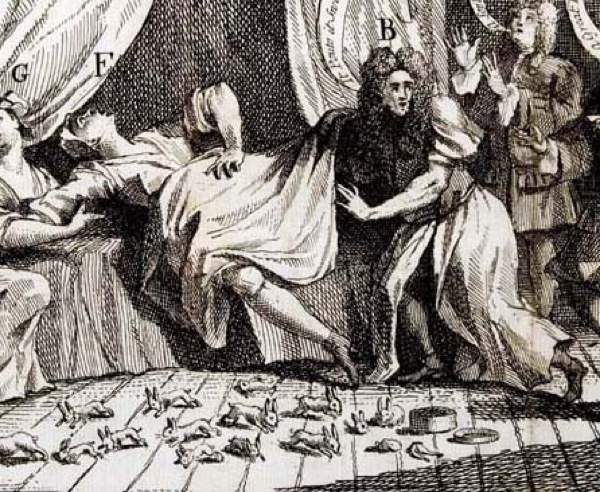
Satirists and cartoonists had a field day. The famous artist William Hogarth published a widely circulated print called *Cunicularii, or The Wise Men of Godliman in Consultation*, viciously mocking the doctors who had been fooled. The image shows a crowd of surgeons, scientists, and midwives, all looking pompous and idiotic, gathered around Mary as she gives birth to yet another rabbit. It perfectly captured the public mood.
For the key players, the consequences were devastating. Nathanael St. André, the King’s surgeon, saw his glittering career destroyed overnight. He became a laughingstock, his reputation in tatters. He lost his position at court and his high-society patients abandoned him. John Howard, the local doctor who started it all, suffered a similar fate, his practice ruined by ridicule.
And what of Mary Toft? She was charged with being a “Notorious and Vile Cheat.” After her confession, she was briefly imprisoned at Tothill Fields Bridewell, where she became a tourist attraction. People paid to come and gawk at the infamous Rabbit-Breeder. But public interest soon faded. She was quietly released a few months later and returned to Godalming, where she lived the rest of her life in total obscurity, dying in 1763.
The Lingering Mystery: Why We Can’t Forget the Rabbit Woman
The story of Mary Toft should have been a forgotten footnote in a strange century. So why are we still talking about it 300 years later? Because it’s more than just a story about a bizarre lie. It’s a perfect storm of human nature.
It’s a story about desperation and the extreme things poverty can drive people to do. It’s about ambition, and how the desire for fame and recognition can blind even the smartest people. It’s a story about the power of belief, and how easily a crowd—or even an entire nation—can be swept up in a narrative that they *want* to be true.
It reveals the terrifying fragility of expertise. The most learned men of the age, the top of their profession, were duped by an uneducated woman and her family because the lie was dressed up in the language of a scientific theory they already believed in. It’s a chilling reminder that seeing isn’t always believing. Sometimes, believing is seeing.
So the next time you hear a story that sounds too wild, too incredible to be real, remember Mary Toft. Remember the doctors who staked their names on her. And remember the dead rabbits of Godalming—a grotesque, absurd, and unforgettable monument to one of the greatest hoaxes in history.