Thursday, July 9, 2026
HomeUnexplained MysteriesModern MysteriesMystery of the Polish 'vampires' solved

Mystery of the Polish ‘vampires’ solved

The Sickle at the Throat: Unearthing Poland’s Terrifying Vampire Graves

They weren’t supposed to get out. Ever.

That was the message, written in bone and cold iron, buried deep in the soil of Poland. A message from a time when the line between life and death was terrifyingly thin, and the greatest fear wasn’t death itself, but what came *after*. When the dead didn’t stay dead.

For centuries, whispered tales and panicked chronicles spoke of the *upiór*, the *strzyga*… the vampire. A creature that clawed its way out of the grave, fueled by an unnatural hunger, to prey upon the living. To us, it’s a story. A horror movie trope. But to the people of 17th and 18th-century Europe, it was a terrifying reality. And they took measures. Extreme measures.

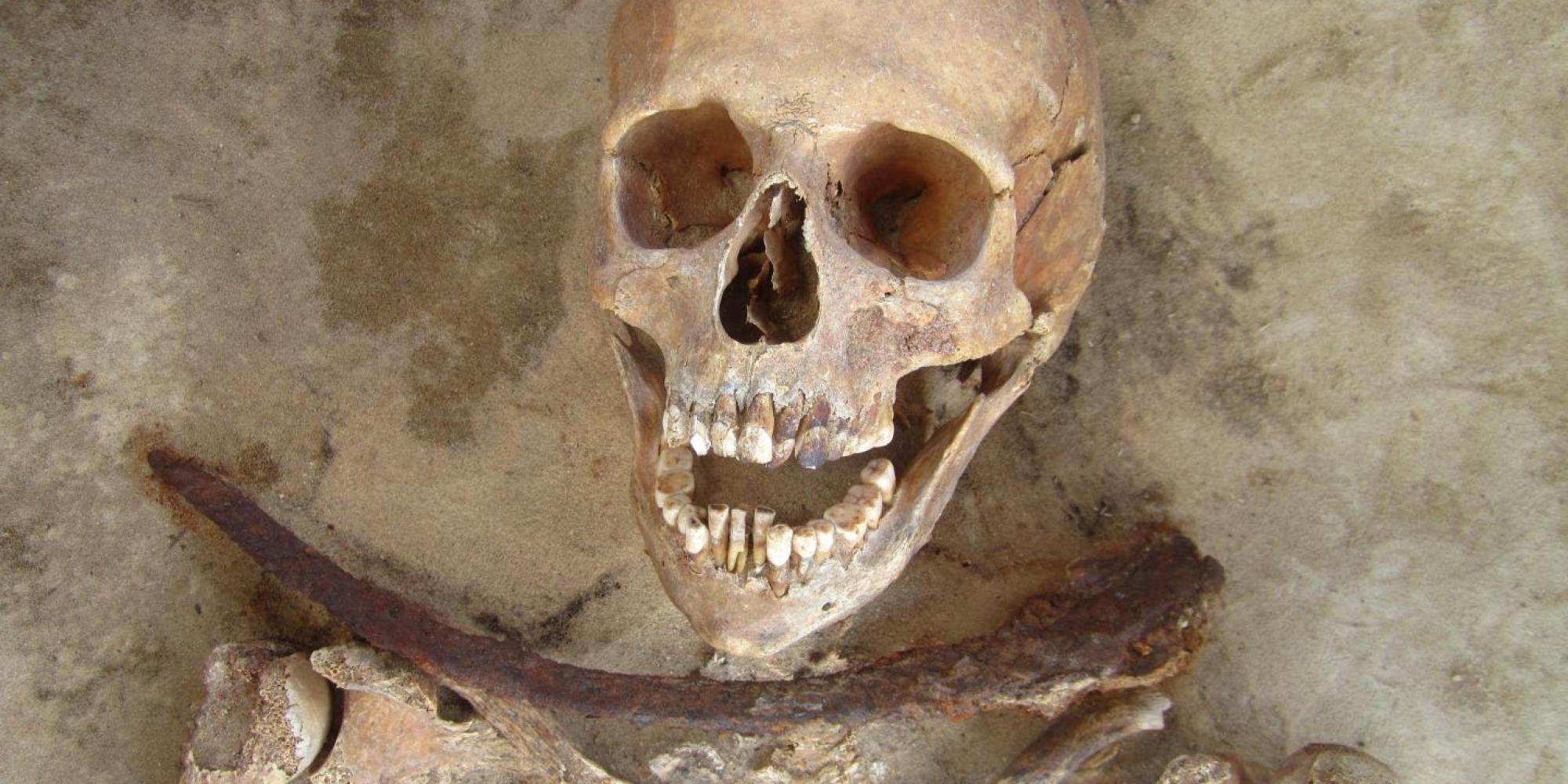
Recently, in a quiet, unassuming corner of Poland, archaeologists unearthed a chilling reminder of this primal terror. Six skeletons, buried not with prayers and gentle repose, but with a grim and very specific purpose. Each one had a razor-sharp sickle placed snugly against its throat. Heavy stones pinned them down. The implication was as clear as a scream in the night: If you try to rise, you will sever your own head.

The official story, the one the academics will tell you, is a neat and tidy explanation involving a misunderstood disease. But is that all there is to it? As we peel back the layers of dirt and dogma, we find a mystery that sinks its teeth in and refuses to let go. Were these people just victims of a plague? Or were they fighting a war against something we’ve long since forgotten how to see?

Forget what you think you know. The truth is far stranger, and far more frightening, than any legend.

The Arsenal of Fear: Tools of the Vampire Hunter

The sickle wasn’t a random choice. In a rural, agrarian society, it was a tool every villager knew. It was used to reap the harvest, to cut down the wheat that gave them life. By placing it at the throat of a suspected vampire, they were symbolically inverting its purpose. The tool of life became the instrument of final death. It was a powerful piece of folk magic, a warning etched in steel.

But it was just one weapon in a terrifying arsenal designed to combat the undead. Across Europe, the methods varied, but the goal was the same: keep the dead in the ground. Wooden stakes, often made from ash or hawthorn wood, were the most famous, driven through the heart to pin the corpse to the earth. Beheading was common, the head often buried between the legs or far away from the body to prevent it from “finding its way back.” Sometimes, the suspected vampire was buried face down, so if it tried to dig its way out, it would only dig deeper into the earth.

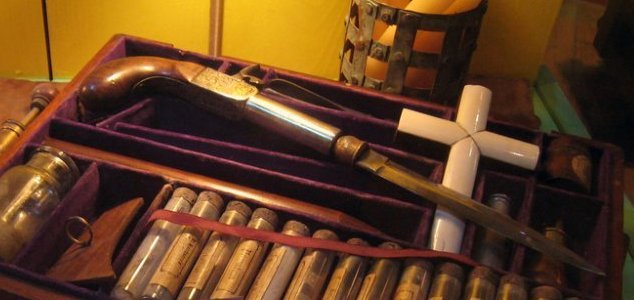
And for those who had the means, there were specialized kits. Tools for a very specific, and very gruesome, kind of work.

vampires

These kits, like the one pictured, often contained a crucifix, holy water, a pistol with silver bullets, a wooden stake, and a mallet. They were the practical, hands-on tools for a job no one wanted. They show us that this wasn’t just a fairytale. People believed this. They prepared for it. They fought it.

A Scientific Explanation… Or a Convenient Cover Story?

So, what happened to the six souls buried in Poland? What made their neighbors so certain they were a supernatural threat?

Modern science has an answer. And that answer is cholera.

Let’s be clear: cholera is a monster of a disease. It’s not a gentle fading away. It’s violent, rapid, and horrifying. Caused by a bacterium, it attacks the intestines, triggering extreme diarrhea and vomiting. A healthy person can become a shriveled husk in a matter of hours. The body loses fluids so fast that the skin becomes blueish-grey and wrinkled, the eyes sink deep into their sockets, and the facial muscles pull back, creating a ghastly, snarling expression. A rictus grin.

Now, put yourself in the shoes of a 17th-century Polish villager. You have no concept of germ theory. You don’t know what a bacterium is. All you know is your neighbor, who was healthy yesterday, is now a contorted, blue-skinned corpse with a terrifying expression locked on their face. You bury them. A few days later, your wife gets sick. Then your son. They die the same horrifying way.

What would you conclude? It’s not a leap to think that the first person who died—the “patient zero”—is somehow responsible. That they are reaching out from the grave, draining the life from your family. They became the first suspect in a supernatural plague. The first victim was often labeled the vampire, the source of the evil that had befallen the village.

This theory suggests that the “vampire burials” were a desperate, fear-driven response to a biological crisis they couldn’t possibly understand. The sickles, the stones… they were a frantic attempt to stop the contagion at its perceived source. They weren’t just burying a body; they were trying to quarantine an evil.

Unmasking the Monster: Signs Our Ancestors Misread

The cholera explanation is compelling. It connects the dots. But the fear of vampires predates major cholera outbreaks. It was an ancient terror, and our ancestors had a whole list of “evidence” they used to identify the undead, much of which was simply a profound misunderstanding of the natural process of decomposition.

Imagine the scene. A few weeks after a burial, another wave of sickness or misfortune hits the village. Panic sets in. The elders decide they must check the grave of the suspected vampire. They dig up the coffin, pry open the lid, and what they see confirms their worst fears.

  • The Corpse Looks “Well-Fed.” After death, blood settles in the lowest parts of the body, a process called livor mortis. This can give the skin a ruddy, reddish complexion, making the corpse appear healthy, as if it had recently been out and about, feeding.
  • Blood at the Mouth. As internal organs break down, decomposition gases build up inside the torso. This pressure can force bloody fluids up the esophagus and out of the mouth and nose. To a terrified villager, it was proof positive the creature had been drinking blood.
  • “Growing” Hair and Nails. This is a classic. The hair and nails don’t actually grow. What happens is that the skin dehydrates and retracts, exposing more of the hair follicles and nail beds, creating the powerful illusion of post-mortem growth.
  • A Groaning Sound. The same internal gases that force fluid out of the body can also escape when the corpse is disturbed. If someone were to, say, drive a stake into the chest, the sudden release of gas past the vocal cords could produce a horrifying groan or sigh. Imagine their terror. The monster was still alive.

Every single one of these “signs” is a normal, natural part of death. But without that knowledge, they painted a picture of a monster that refused to die. A monster that had to be stopped.

What If The Official Story Is Wrong?

The cholera theory is neat. It’s scientific. It fits. But is it too neat?

History is never that simple. The “vampire” label was a powerful one, and it wasn’t always applied because of disease. It was also a weapon. A way to deal with people who didn’t fit in. The social outcast. The woman who practiced folk medicine. The foreigner who arrived right before the crops failed. Anyone who was different could be branded a threat.

Think about it. A “vampire burial” was the ultimate act of post-mortem condemnation. It didn’t just kill you; it erased your identity and marked you as an eternal monster. It was a way for a community to enforce its norms, to punish those who transgressed, even in death. Could some of these Polish graves belong to social outcasts rather than plague victims?

And there are other possibilities, whispering from the fringes of history.

The Suicide Stigma

In many Christian societies of the era, suicide was considered a mortal sin. Those who took their own lives were denied a proper Christian burial in consecrated ground. They were often interred at crossroads or in unmarked graves, outside the community. It was believed that their troubled souls would not rest, making them prime candidates to return and haunt the living. A sickle at the throat might have been seen as an extra layer of insurance against a restless, damned spirit.

Paganism’s Last Stand

Poland’s conversion to Christianity wasn’t an overnight switch. For centuries, older Slavic pagan beliefs and traditions coexisted uneasily with the new religion. Many of these old beliefs centered on the importance of appeasing spirits and the very real danger posed by the improperly buried dead. Could these “vampire” burials actually be the last vestiges of a dying pagan tradition, misinterpreted by later Christian chroniclers? Perhaps the sickle wasn’t a punishment, but part of an older, forgotten ritual meant to guide or pacify the spirit, a ritual that looked barbaric to outsiders.

The Mystery Deepens: Modern Discoveries and Lingering Questions

The graves in Poland are not an isolated case. Far from it. All across Eastern and Central Europe, archaeologists keep finding more of these “deviant burials.”

In Bulgaria, a skeleton from the 13th century was found with an iron rod hammered through its chest. In Venice, the skull of a 16th-century woman was discovered with a brick forced into her mouth—a common method used against “shroud-eaters,” vampires believed to chew on their burial shrouds to fuel plagues.

Every new discovery adds another piece to the puzzle, but the picture isn’t getting clearer. It’s getting more complex. More mysterious.

Internet forums and alternative history communities buzz with theories. Some suggest a link to a rare blood disorder, porphyria, which can cause severe photosensitivity, facial disfigurement, and reddish teeth—symptoms that sound eerily vampiric. Others wonder if our ancestors knew about something else entirely, a form of energy or a non-physical entity that they interpreted as a “vampire.” Were they trying to sever a psychic link, not just a physical neck?

This is where the story leaps from the history books and into the shadows of our own modern world. The vampire myth is more than just a myth; it’s a deeply embedded part of our collective psyche. It changes its face—from the monstrous *Nosferatu* to the sparkling heartthrobs of today—but it never truly goes away. Why? What primal fear or fascination does it tap into?

Perhaps it’s the fear of contagion, of a sickness that spreads invisibly from person to person. Or maybe it’s the fear of the predator who looks just like us. The ultimate insider threat.

The six bodies in Poland may have been cholera victims. That is the most likely, rational explanation. But it doesn’t feel like the whole story, does it?

It doesn’t explain the cold dread you feel when you think about that sickle resting against a skeleton’s neck for 300 years. It doesn’t silence the part of your brain that wonders, “But what if they were right?”

History tells us our ancestors were superstitious and ignorant. But they were also survivors. They lived in a world where death was a constant, intimate companion. They saw things we have sanitized away. Perhaps they weren’t wrong, but were simply using the language they had—the language of myth and monsters—to describe a threat that was all too real. Whether that threat was a bacterium or something else… well, that’s a secret the dead are still keeping.

Arindam Mukherjee
Arindam Mukherjee
Arindam loves aliens, mysteries and pursing his interest in the area of hacking as a technical writer at 'Planet wank'. You can catch him at his social profiles anytime.
RELATED ARTICLES
- Advertisment -

Most Popular

Recent Comments

Warren Pan Abbott on The legend of the Devil Monkey !
chris davies on The McPherson Tape Mystery
Reed Reedly on ET has Internet!
Bea Houseoffashion on Proof Of Time Travellers – Gallery
Marcus2012 on ET has Internet!
Reed Reedly on ET has Internet!
LaughsAtConspiracyNuts on The 9/11 Conspiracy – Myths and Facts
Alex Sliverman on Did the ancients fly?
Doctor Wholigan on Time Traveler in 1938 film
chris davies on The McPherson Tape Mystery
Archie1954 on 10 secret UFO hideouts
chris davies on Ghosts of flight 401
Marcus2012 on ET has Internet!
jason Macdonald on Proof of Time Travel? – China
chris davies on Long-Lost Pyramids Found?
Reed Reedly on ET has Internet!
Milkman on Connected Universe
Tenmiles on Baigong Pipes Mystery
Simon Foster on Sirius – The Documentary
From the 1st April on 2013 – Alien Contact date ?
SkyWatcher on Is ET ignoring us?
I Come From The Future on Obama to make UFO Alien disclouser soon ?
ÛñK?øWn on 2013 – Alien Contact date ?
Just another person on 2013 – Alien Contact date ?
Malcolm Windowcleaner on The strange case of Rudolph Fentz
Mason Servio on Strange Things on Mars
Marke Wisdom Seeker on What will we find as arctic melts?
Andrea A Elisabeth Levyne on Aliens Captured in Varginha, Brazil
Mitch Grouyeki on Amazing Space Shuttle pictures