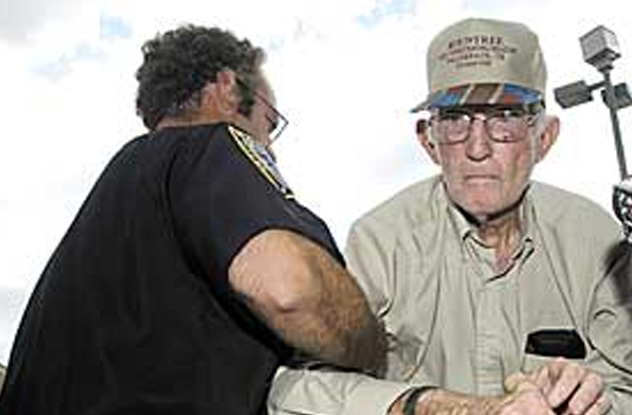
Crime – A true story: The 91-Year-Old Bandit Who Hated Banks
You have a picture in your head. Admit it. When you think of a bank robber, what do you see? A guy in a ski mask? Maybe a crew of young, athletic pros jumping over counters with assault rifles? That’s what Hollywood sells us. That’s the movie version.
Real life? It’s stranger. Much stranger.
Forget the young guns. Forget the adrenaline-fueled twenty-somethings sprinting from the cops. The most fascinating criminal in modern American history wasn’t fast. He wasn’t strong. He didn’t even wear a mask. He walked with a cane, drove a sedate sedan, and could have been your grandfather.
Meet J.L. Hunter “Red” Rountree. The man who proved that breaking bad isn’t just for the young.
The American Dream… Until It Wasn’t
To understand the crime, you have to understand the man. And Red Rountree wasn’t a career criminal. Far from it. This is where the story gets twisted.
Born in 1911—let that sink in, 1911—Rountree was a relic of a different time. He grew up before the internet. Before television. He came from the era of the Texas oil boom. And he made it. He really made it. Rountree was a legitimate, high-rolling businessman in Houston.
He founded Rountree Machinery Company. He sold winches and heavy equipment to oil rigs. We are talking about serious money here. Millions. He had the house, the reputation, and the comfortable life. He was the classic American success story.
So, what happened? How does a millionaire end up passing notes to terrified bank tellers?
The pivot point. The moment the switch flipped.
It was 1965. Rountree decided to expand. He took out a massive loan to invest in a shipyard in Florida. It was a gamble, sure, but he had the track record. But then, the bank did something unexpected. According to Rountree, the bank “called the note” early. They demanded full repayment before the agreed-upon time.
He couldn’t pay. The bank seized everything. The shipyard. The business. The assets.
Rountree was forced into bankruptcy. He watched his empire crumble to dust overnight.
The Seed of Hatred
Most people would just give up. They would retire, live on social security, and complain to their neighbors. Not Red. That moment planted a seed of pure, black hatred in his heart. He didn’t just dislike banks. He loathed them. He viewed them as predators. Monsters in suits.
For decades, this anger simmered. It bubbled under the surface while he tried to live a normal life. But the universe wasn’t done with him yet.
The Downward Spiral
If you think the bankruptcy was the breaking point, wait until you hear about the 1980s. This is when the tragedy really hits. Rountree was an old man by now, well past retirement age. He should have been bouncing grandkids on his knee.
Instead, death came knocking.
In 1986, his stepson was killed in a tragic accident. It devastated him. But he had his wife, right? They had been together for 50 years. Half a century of partnership. A year later? She died too.
Rountree was alone. The house was empty. The silence was deafening.
What does a lonely, angry, grieving 80-year-old man do? He went off the rails. Completely.
We aren’t talking about bingo nights. We are talking about booze. We are talking about drugs. Yes, you read that correctly. At an age where most people are worried about their hip replacement, Rountree was reportedly dabbling in cocaine. He was looking for anything to numb the pain. Anything to make him feel alive again.
Then came the woman. He met a 31-year-old. He was in his 80s. You can do the math. They married. It was a disaster. It ended in a messy divorce and court-ordered anger management classes. He was spiraling. Fast.
He was frustrated. He was broke. He hated the system. And he decided, at the ripe old age of 86, to get some payback.
Heist #1: The Biloxi Job
Imagine the scene. It’s 1998. SouthTrust Bank in Biloxi, Mississippi. The doors open. The air conditioning hums.
In walks an old man. Gray hair. Maybe a little shaky. The security guard probably held the door for him.
Rountree walked up to the teller. He didn’t pull a shotgun. He didn’t scream. he just demanded the money. The teller, likely confused and terrified by the sheer absurdity of it, handed over the cash.
Success? Not quite.
Rountree was 86. He wasn’t exactly Usain Bolt. He shuffled out of the bank. A witness simply followed him to his car and wrote down his license plate. It was over before it began. The police picked him up almost immediately.
The judge was baffled. What do you do with an 86-year-old first-time offender? They gave him a slap on the wrist. Three years probation. A $260 fine. They told him to go home and stay out of trouble. They treated him like a confused grandpa who wandered away from the nursing home.
Big mistake.
The “Karate Kick” Incident
Probation didn’t stop him. If anything, the taste of the crime, the rush of adrenaline, it fueled him. He realized something crucial: Nobody looks at an old man. He was invisible. He was a ghost in the machine.
Less than a year later, he was in Pensacola, Florida. He walked into a NationsBank. This time, he was more aggressive. He told the teller he had a bomb. (He didn’t). He walked out with $8,000 in cash.
This could have been the perfect getaway. He made it to the parking lot. He was almost to his car.
But he didn’t count on the “hero.”
A bank customer—younger, stronger—had followed him out. But he didn’t just watch. This guy decided to play action hero. He ran up to the 87-year-old Rountree and—I am not making this up—took him down with a flying karate kick.
Boom. Down goes the elderly bandit.
The police arrived. The money was recovered. This time, the courts weren’t as lenient. Rountree was sentenced to three years in prison.
Prison Legend
Here is where the story gets even weirder. You’d think prison would break an 87-year-old man. You’d think the inmates would eat him alive.
Wrong.
Rountree became a celebrity on the inside. The other inmates? They loved him. They called him “Red.” They respected him. Why? Because he robbed banks. In the criminal hierarchy, bank robbers are at the top of the food chain. And here was this ancient guy who had the guts to do it.
He thrived. He gave advice. He told stories about the oil fields in the 1930s. He did his time standing up.
The Final Score: 91 Years Old and Gunning for Glory
2002. Rountree is released. He is 91 years old. Ninety-one. Most people at that age are bedridden. Rountree?
He was bored.
He headed back to Texas. But retirement wasn’t in the cards. He had one more score to settle. He still hated banks. He still craved the rush. He famously told a reporter later, “You want to know why I rob banks? It’s fun. I feel good, awful good.”
It wasn’t about the cash anymore. It was the thrill. It was the only time he felt relevant.
August 12, 2003. Abilene, Texas.
The First American Bank. It was a hot Texas morning. Rountree pulled his car up nearby. He walked in. He was wearing a blue button-down shirt. He looked like he was there to deposit a social security check.
He walked to the counter and slid a literal envelope across the polished granite. On the envelope, scrawled in shaky handwriting, was one word:
“ROBBERY”
He told the teller, “Give me the money, quick.”
She handed him two bundles of cash. $1,999 total. Rountree grabbed it, turned around, and walked out.
The bank’s vice president saw him leaving. He ran to the window. He saw the license plate. He called 911.
The “High-Speed” Chase
Police spotted Rountree’s car on the highway shortly after. The lights flared. The sirens wailed. Did Rountree pull over? No way.
He gunned it. Now, when I say “gunned it,” we have to be realistic. It was a 1996 Buick sedan. He was 91. The chase reportedly hit speeds of… well, they weren’t exactly NASCAR speeds, but he refused to stop for miles. He led the cops on a pursuit through the Texas heat.
Finally, he was boxed in. He pulled over.
A young police officer approached the car. He had his service weapon drawn, adrenaline pumping, expecting a dangerous felon. He screamed for the driver to show his hands.
Rountree rolled down the window. He looked at the young cop, looked at the gun barrel, and sneered.
“Take that damn thing out of my face.”
Ice cold. The cop, realizing he was pointing a Glock at a man born before World War I, lowered the weapon. They cuffed him. It was over.
The Aftermath: A Sad End or a Victory Lap?
The trial was a media circus. People couldn’t believe it. America’s Oldest Bank Robber.
Rountree was defiant. He didn’t apologize. He complained that the prison food had too much salt. He complained that the bank was the real criminal.
The judge had no choice this time. Rountree was sentenced to 12 years in federal prison. It was effectively a death sentence, and everyone in the courtroom knew it.
Rountree was sent to the Federal Medical Center in Springfield, Missouri. He spent his final days surrounded by other sick and elderly inmates. But he was different. He was the guy who went out fighting. He was the guy who didn’t go gentle into that good night.
He died in October 2004, at the age of 92. He was buried near his family in Texas.
The Deep Dive: Why Do We Love This Story?
Why does Red Rountree fascinate us? Is it just the age? I don’t think so.
It’s the rebellion. We live in a society that tells old people to be quiet. To sit in the corner. To be invisible. Rountree refused. He took that invisibility and weaponized it. He forced the world to look at him one last time.
Was he a hero? Absolutely not. He terrified tellers. He stole money. He broke the law. But there is a tiny, dark part of the human brain that cheers for him. The part of us that hates the banks. The part of us that fears getting old and irrelevant.
Rountree proved that you can still make headlines at 91. You can still be dangerous. You can still be the bad guy.
So, the next time you walk into a bank and see a sweet old man fumbling with his wallet, take a closer look. Check the eyes. Because you never really know who is standing next to you.
The legacy of J.L. Hunter Rountree remains: You are never too old to make a really, really bad decision.