Friday, September 11, 2026
HomeAncient & Lost CivilizationsHistorical MysteriesThe strange mysteries of the Longyou Grotto Caves

The strange mysteries of the Longyou Grotto Caves

The Longyou Caves: China’s Impossible Underground Secret That History Erased

Some mysteries are whispers. Faint clues in a forgotten text. A strange artifact dug from the dust. But the Longyou Caves are not a whisper. They are a scream. A deafening, echoing roar from the ancient past, carved into millions of tons of solid rock, and yet… history heard nothing.

Imagine this.

You’re standing in a quiet, rural corner of China’s Zhejiang province. Rolling green hills, peaceful rivers, the hum of daily life. Nothing seems out of place. But beneath your feet, hidden for over two millennia, lies an underground city. A network of immense, man-made caverns so vast, so precise, and so utterly baffling that modern engineers can only scratch their heads. So grand in scale they are called ‘the ninth wonder of the ancient world’.

And the most chilling part? There is not a single, solitary word about their creation in any historical text. Not one. It’s a project that should have been the talk of an empire, meticulously recorded by scribes. Instead, there’s only silence. A 2,000-year-old blank page where a masterpiece of engineering should be.

This isn’t just an archaeological puzzle. This is a wound in the historical record. A ghost of an achievement so huge it defies belief. What really happened in the darkness beneath Longyou?

The Day the Ponds Gave Up Their Secret

The story doesn’t begin with a team of archaeologists or an ancient map. It begins with a single, curious farmer. His name was Wu Anai. For generations, the people of his village, Shiyan Beicun, had known of the deep, rectangular ponds scattered nearby. The locals called them “bottomless ponds.” They were unnaturally deep, teeming with fish, and regarded as a simple, if slightly strange, feature of the landscape.

But Wu Anai was possessed by an idea in the summer of 1992. An idea that seemed crazy to his neighbors. What if the ponds weren’t natural at all? What if they were hiding something?

On June 9th, he gathered a few other villagers and purchased a powerful water pump. He chose one of the smaller ponds and switched the machine on. The pump chugged away, spitting out water day and night. For hours. Then days. The water level seemed to barely drop. His neighbors laughed. But Wu Anai persisted. For 17 straight days, the pump ran, pulling out thousands upon thousands of gallons of water.

And then, something impossible happened.

The water receded below a certain point, and the earth opened up. A gaping maw appeared where the pond had been. Sloping stone stairs, covered in slime, descended into the blackness. The villagers stared in stunned silence. This wasn’t a pond. It was a doorway. A flooded entrance to a lost world.

What they found inside changed everything. It wasn’t a simple cave. It was a colossal, hand-carved hall supported by massive stone pillars. And it wasn’t just one. Wu Anai’s discovery was just the first domino. Further investigation revealed a sprawling complex of at least 36 similar grottoes, covering an astonishing area of over 30,000 square meters. A subterranean complex that history had completely, and impossibly, forgotten.

Inside an Impossible Underground World

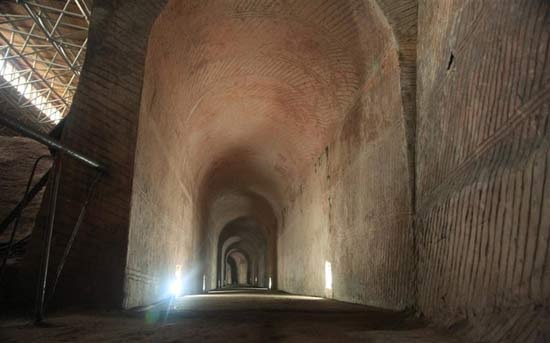
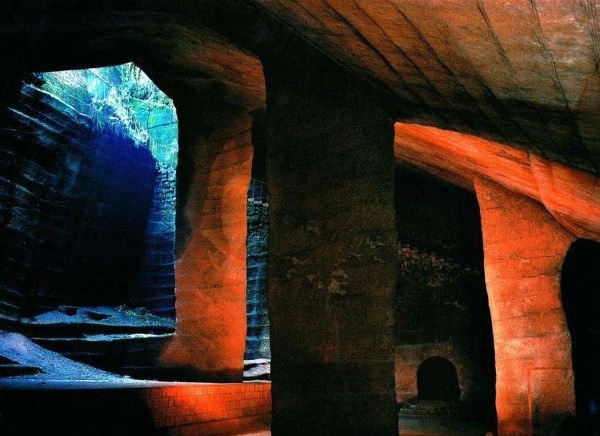
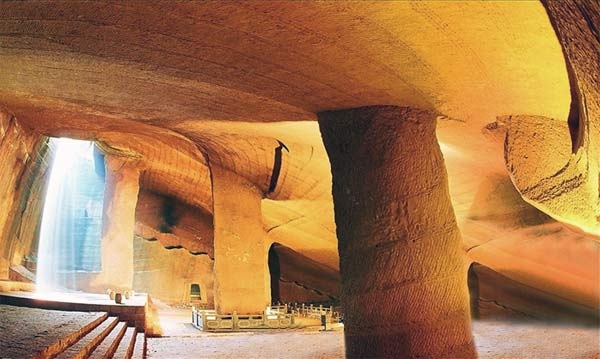
To call the Longyou Grottoes “caves” is an understatement. These are underground cathedrals. Each one is a massive hall carved directly from the native siltstone. The average floor space of each grotto is over 1,000 square meters, with ceilings soaring to heights of 30 meters. That’s like a 10-story building, but underground.

The design is shockingly uniform. The walls are straight, the corners and edges are perfectly defined. In each grotto, massive, room-sized pillars of rock were left in place to support the ceiling. Some grottoes have a few pillars; others have dozens. They stand like silent, stone sentinels in the dark, guarding a secret they will not speak.

And they are ancient. Geologists estimate they were carved well before the Qin Dynasty was founded in 212 BCE. We are talking about an engineering feat that predates the Great Wall of China as we know it. A project undertaken with Bronze Age tools, yet exhibiting a precision that would challenge modern builders.

image

As you walk through these silent chambers, the sheer scale is overwhelming. It feels alien. The air is still and cool. Sound doesn’t travel far, swallowed by the immense space. You are standing inside a mountain, in a space that should not exist, built by people who left no name.

The Riddle of the Tool Marks: A Precision Paradox

Now, let’s zoom in. Look closer at the walls. The ceilings. The pillars. They aren’t smooth. Every single surface, from the floor to the highest point of the ceiling, is covered in a uniform, repeating pattern of tool marks.

Think about that. Not just some walls. *Everything.*

These marks are a series of parallel lines, chiseled at a perfect 60-degree angle. They are so uniform, so consistent across thousands upon thousands of square meters, that they look almost like a modern machine did the work. A gigantic subterranean rock-milling machine from 2,200 years ago.

image

This raises two mind-bending questions.

First, why?

Why would anyone go to the incredible extra effort to texture every surface? If you just want to hollow out a space, you just remove the rock. The decorative pattern would have added an immense amount of time and labor to an already colossal project. Was it for acoustics? Was it purely for aesthetics, a kind of subterranean wallpaper? Or did the marks have a symbolic meaning we can no longer comprehend?

Second, and more importantly, how?

The precision is staggering. The lines are parallel, the spacing is consistent. To achieve this on this scale, deep underground, in what must have been near-total darkness, is a paradox. Which brings us to the next impossible fact: there is no evidence of lighting.

No soot. Nothing.

Ancient builders working in darkness would have used torches or fire pits. These would have left tell-tale black soot marks on the ceilings and upper walls. The Longyou Caves are clean. There is not a trace of soot to be found anywhere. How did thousands of workers toil for years in pitch-black conditions while carving decorations with millimeter precision?

It’s an equation with too many variables missing. An unknown people, using an unknown method, for an unknown purpose, lit by an unknown light source. It just doesn’t add up.

The Deafening Silence of History

This is where the mystery tips over into genuine conspiracy. The ancient Chinese were arguably the most meticulous record-keepers of the ancient world. They recorded everything. Dynastic histories, imperial decrees, tax collections, major construction projects, military campaigns, even celestial events.

The Great Wall? Documented. The Terracotta Army? Documented. Grand canals and palaces? All there in the records.

The Longyou Caves project involved the removal of nearly one million cubic meters of rock. Let’s put that in perspective. That’s enough rock to fill 400 Olympic-sized swimming pools. Scientists have calculated that for this project to be completed in a reasonable time, it would have required 1,000 people working non-stop, day and night, for at least six years.

This wasn’t a weekend project. This was a state-level undertaking. An army of laborers, engineers, and overseers. It would have required massive organization, food supplies, and tools. And yet, there is not one single mention of it. Anywhere. It’s as if it never happened.

How do you hide a project of this magnitude? How does it escape every historian, every poet, every bureaucrat for two millennia? Was it a forbidden project, whose records were systematically sought out and destroyed? Was it the work of a rogue kingdom or a powerful cult operating completely outside the knowledge of the imperial court? The silence is not an absence of evidence; it feels like evidence of an absence. A deliberate, chilling erasure.

Cracking the Code: The Wild Theories on What They Were FOR

With no historical records, we are left adrift in a sea of speculation. The mainstream explanations feel thin and unsatisfying, which has opened the door for far more provocative ideas. Let’s explore the possibilities.

Theory 1: An Imperial Palace or Tomb?

The grandeur certainly fits. The scale is fit for an emperor. Perhaps it was a subterranean palace to escape the summer heat, or the final resting place for a forgotten king.

The Problem: It’s completely empty. Ancient Chinese tombs, especially for royalty, were filled with treasures, artifacts, chariots, and servants (like the Terracotta Army). The walls would have been covered in murals depicting the life of the deceased. The Longyou Caves are bare. No graves, no gold, no art. Just empty, decorated stone.

Theory 2: A Secret Military Base?

A hidden place to garrison thousands of troops, hide supplies, or launch a surprise attack. It makes a certain kind of sense.

The Problem: Why the beautiful, intricate carvings? Military bunkers are built for function, not form. The effort spent on the decorative tool marks makes no strategic sense. Furthermore, the supposed purpose of a secret base is secrecy, yet the sheer manpower required to build it would have been impossible to hide.

Theory 3: An Ancient Quarry?

This is the most “official” and perhaps laziest explanation. The theory suggests the goal wasn’t to create the caves, but to quarry the high-quality siltstone for use in building projects elsewhere.

The Problem: This theory falls apart under the slightest scrutiny. Miners do not carve majestic, uniform halls with perfectly spaced support pillars and decorative patterns. They follow the most efficient path to extract the material, leaving behind a chaotic mess. Also, where did the million cubic meters of quarried stone go? There is no evidence of it being used in any nearby construction.

Theory 4: A Place of Ritual or Extraterrestrial Contact?

Now we venture into the fringe, where the official explanations fail. The cathedral-like acoustics and strange, almost alien aesthetic have led some to propose the caves were a religious site for a forgotten faith. A place for mass ceremony or initiation.

The “What If?” Scenario: What if the builders weren’t just carving stone? What if they were building a receiver? Or a power plant? The strange tool marks, some theorists whisper, are not decorative. They are functional. Part of a lost technology designed to resonate with certain frequencies. The lack of soot isn’t because they used magic lights; it’s because the technology they used produced no smoke. This theory posits that the Longyou Caves are evidence of lost high technology, or perhaps even contact with a non-human intelligence that provided the means and the motive for this impossible construction.

Modern Mysteries and Internet Rabbit Holes

The questions didn’t stop in 1992. The more we study the caves, the stranger they get.

For one, their preservation is a miracle. They were perfectly preserved for 2,000 years *because* they were flooded. How did they flood so quickly and completely, sealing them off from the elements? Was it deliberate?

Then there’s the fish. When the first cave was drained, villagers found fish that, according to local fishermen, were not a species found in the nearby river. These were “thin-backed fish” that had apparently lived and bred for centuries in the pitch-black, isolated water of the cave. How did they get there?

Today, the Longyou Caves are a hotbed of discussion in online forums and alternative history communities. New theories emerge constantly. Were they built to survive a global cataclysm? Are they connected to other unexplained ancient sites around the world? Every photo of the strange tool marks, every diagram of the grotto layouts, fuels a new round of debate.

The Longyou Caves are more than just an ancient wonder. They are a challenge. They challenge our understanding of our own past. They stand as a monument to a ghost story, a colossal achievement with no author. They are proof that there are still immense, fundamental gaps in our knowledge of human history. There are still monsters in the blank spaces on the map.

We are left with one, haunting certainty: someone, two millennia ago, undertook one of the most ambitious engineering projects in human history. And then, they, their purpose, and their incredible creation, simply vanished.

The question is not just who built them, or why. The real question is, what else have we forgotten?

Arindam Mukherjee
Arindam Mukherjee
Arindam loves aliens, mysteries and pursing his interest in the area of hacking as a technical writer at 'Planet wank'. You can catch him at his social profiles anytime.
RELATED ARTICLES
- Advertisment -

Most Popular

Recent Comments

Warren Pan Abbott on The legend of the Devil Monkey !
chris davies on The McPherson Tape Mystery
Reed Reedly on ET has Internet!
Bea Houseoffashion on Proof Of Time Travellers – Gallery
Marcus2012 on ET has Internet!
Reed Reedly on ET has Internet!
LaughsAtConspiracyNuts on The 9/11 Conspiracy – Myths and Facts
Alex Sliverman on Did the ancients fly?
Doctor Wholigan on Time Traveler in 1938 film
chris davies on The McPherson Tape Mystery
Archie1954 on 10 secret UFO hideouts
chris davies on Ghosts of flight 401
Marcus2012 on ET has Internet!
jason Macdonald on Proof of Time Travel? – China
chris davies on Long-Lost Pyramids Found?
Reed Reedly on ET has Internet!
Milkman on Connected Universe
Tenmiles on Baigong Pipes Mystery
Simon Foster on Sirius – The Documentary
From the 1st April on 2013 – Alien Contact date ?
SkyWatcher on Is ET ignoring us?
I Come From The Future on Obama to make UFO Alien disclouser soon ?
Just another person on 2013 – Alien Contact date ?
Malcolm Windowcleaner on The strange case of Rudolph Fentz
Mason Servio on Strange Things on Mars
Marke Wisdom Seeker on What will we find as arctic melts?
Andrea A Elisabeth Levyne on Aliens Captured in Varginha, Brazil
Mitch Grouyeki on Amazing Space Shuttle pictures