The Silent Skitter: Are We Building Nature’s Perfect Mechanical Spies?
Look closer at the surface of a still pond. See that tiny ripple? That almost imperceptible dimple in the water? It’s probably just a water strider. An ordinary insect, darting across the liquid skin of the pond, hunting for even smaller prey. It’s been doing that for millions of years. A perfect, natural machine.
But what if it isn’t?
What if that little creature, the one you just dismissed without a second thought, isn’t a creature at all? What if it’s a machine? A pair of tiny, artificial eyes staring back at you from the shimmering surface. A listening device, carried on legs that defy physics. Sounds like science fiction, doesn’t it? A paranoid fantasy.
It’s not. It’s happening right now.
The official story, the one fed to us by the mainstream, began with a deceptively simple announcement. Researchers, a brilliant team from South Korea’s Seoul National University and Harvard’s Wyss Institute, had done the impossible. They had built a robot that could not only walk on water, but could leap from it. A mechanical water strider.
A marvel. A breakthrough. A new tool for science.
Or is it a blueprint for the most insidious surveillance network ever conceived?
The Official Story: Cracking the Code of a Pond Skater
Let’s start with what they *tell* us. The science is, admittedly, genius. The entire project is a masterclass in what engineers call biomimicry—copying nature’s best designs. And nature, it turns out, is the ultimate engineer.
The team didn’t just guess how a water strider works. They went to a local pond, collected the real insects, and brought them back to the lab. There, under the unforgiving gaze of high-speed cameras, the bugs gave up their secrets. Every twitch of their spindly legs, every powerful push-off that sent them airborne, was recorded, slowed down, and analyzed with obsessive detail.
What did they find? A miracle of physics. Water striders don’t just float. They manipulate the very surface of the water. Think of water’s surface tension as a thin, invisible, stretchy film, like the top of a trampoline. The insect’s legs are covered in microscopic, waxy hairs that repel water, allowing them to stand in the tiny “dents” they make without ever breaking through. It’s a delicate, beautiful dance with physics.
But the jump? That was the real magic. The researchers discovered the striders don’t just push down hard. That would break the surface. Instead, they apply force gradually, smoothly rotating their legs to generate maximum power without ever exceeding that critical surface tension limit. They “squeeze” the water’s surface to launch themselves.
Building the Mechanical Mimic
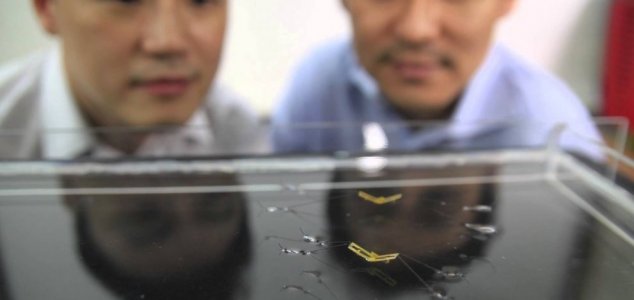
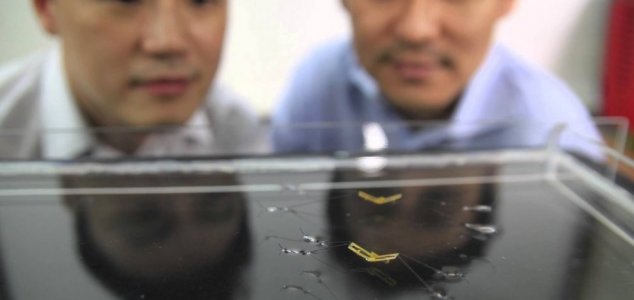
Armed with this secret knowledge, the team got to work building their own. The result was a tiny robot, barely 2 centimeters long. A fragile-looking thing, built from thin layers of material folded into a ‘v’ shape. It has long, wire-like legs designed to perfectly replicate the pressure distribution of its living counterpart. They even built in a spring-loaded catapult mechanism, a torque-reversal system that mimics the insect’s powerful leg stroke.
When triggered, this tiny spring releases, allowing the robot to launch itself into the air with the same explosive grace as a real water strider. It lands softly, the surface tension catches it, and it waits for its next command. An incredible achievement.
The stated purpose for these mechanical marvels? Environmental monitoring. They tell us these robotic insects could one day be deployed in swarms to monitor pollution along streams and rivers, reaching places where conventional equipment is too clumsy or difficult to set up. A noble goal. A clean, publicly-funded, easily-digestible explanation.
It’s also, almost certainly, not the whole story.

The official demonstration. A team of water-walking robots in a lab tank. What happens when they leave the tank?
But Is Pollution the REAL Reason?
You have to ask the question. Who benefits from a tiny, jumping, water-walking robot? Pollution agencies? Maybe. A little.
But who *really* benefits?
Think about it. We live in an age of pervasive surveillance. We’re tracked by our phones, watched by cameras on every street corner, and listened to by our own smart devices. We’ve been trained to look for the camera in the smoke detector, the microphone in the lamp. We scan for the blinking red light. We look for the van parked across the street.
But who looks at the bugs?
Who would ever suspect the fly on the wall is anything more than a fly? Who would think twice about the spider in the corner of the ceiling? Or the water strider, skittering across the pond behind a billionaire’s lakeside estate where a secret deal is being made? Nobody.
Nature is the perfect camouflage. And we’re now handing the keys to that camouflage over to military and intelligence agencies.
Deep Dive: The DARPA Connection
While this specific project was a university collaboration, it exists within a much larger, and much more shadowy, ecosystem of research. And at the center of that web, you will almost always find a name: DARPA. The Defense Advanced Research Projects Agency. This is the Pentagon’s “mad science” division, the people responsible for creating the internet, stealth bombers, and GPS. Their job is to fund the development of “radical, breakthrough technologies for U.S. national security.”
For decades, DARPA has been obsessed with creating micro-robotics and insect-like drones. Projects with names like “Fast Lightweight Autonomy” and the “Short-Range Independent Microrobotic Platforms” (SHRIMP) program are just the tip of the iceberg. They’ve poured hundreds of millions of dollars into developing things like the “RoboBee,” a mechanical bumblebee that can fly, perch, and even swim.
Why? The answer is always “national security.” But what does that mean?
It means a swarm of mechanical hornets that can access a fortified building through an air vent. It means a robotic cockroach that can scuttle under a door to map a hostile compound. And it means a water strider that can sit silently on a body of water, recording a conversation that was specifically held outdoors to avoid electronic eavesdropping.
These aren’t just tools for monitoring river quality. These are weapons. These are tools of espionage.
The Swarm is Coming
A single robotic insect is a curiosity. A thousand of them, operating in unison, is a force of nature. A million is a nightmare.
The true power of these devices isn’t in a single unit, but in swarm intelligence. Imagine thousands of these water-walking robots being released upstream from a target. They drift silently, spreading out, forming a vast, invisible sensor network. They can monitor chemical signatures, listen for specific keywords, and use their collective vision to track targets across miles of shoreline. They can communicate with each other, coordinate their movements, and even sacrifice themselves to create a distraction while another unit gets closer.
This isn’t a “what if” scenario. Swarm robotics is one of the hottest fields in military tech. The idea is to overwhelm an opponent not with one big, expensive weapon, but with thousands of tiny, cheap, and disposable ones. A swarm of insect drones can’t be stopped by conventional air defenses. You can’t shoot them all down.
And if they look exactly like real insects? You wouldn’t even know you were under attack until it was too late.
What the Internet is Whispering
The original research for this water-walking robot is from a few years back. In the world of technology, that’s an eternity. Since then, battery technology has become microscopic. AI processing can now happen on a chip smaller than your fingernail. High-resolution camera sensors are now so tiny they’re practically dust.
What are the new models like? Chatter on the darker corners of the web, on forums where engineers and whistleblowers speak more freely, paints a chilling picture.
There are whispers of insect drones powered by ambient radio waves, meaning they never need to recharge. Others talk about biomechanical hybrids—real insects with tiny electronic “backpacks” that hijack their nervous systems, turning them into living, controllable drones. Some even speculate about self-replicating nanobots, robotic insects that could harvest materials from their environment to build more of themselves.
Think of the implications. A surveillance device that never runs out of power. A spy that can’t be distinguished from a real bug even under a microscope. A weapon that builds its own army.
A Future Where You Can’t Trust Your Eyes
We are fast approaching a world where the line between the natural and the artificial is not just blurred, but completely erased. The technology is no longer the limiting factor; it’s here. The only question is how it will be used.
Imagine a political protest. The authorities want to identify the ringleaders. Instead of sending in obvious drones that buzz overhead, they release a cloud of “gnats.” These tiny robots land on people’s clothing, taking DNA samples, recording conversations, and using facial recognition to tag individuals in the crowd. They are completely unseen and unsuspected.
Imagine a corporate negotiation. A rival company wants your trade secrets. They don’t hack your servers. They simply let a robotic moth into the boardroom. It flutters to the ceiling and hangs there, a silent, unblinking eye recording every word and every document on the table.
This is the ultimate invasion of privacy. Not just the end of private conversations, but the end of private spaces. The concept of “getting away from it all” by going out into nature becomes a lie. You will be more watched, more monitored, out in the open than you ever were in the city.
The humble water strider showed us what was possible. Its elegant, efficient design was the perfect blueprint. A silent hunter, a master of its environment, hiding in plain sight. We saw it, we copied it, and we weaponized it. We’ve taken one of nature’s small wonders and twisted it into a tool of control.
So the next time you’re by a quiet lake or a slow-moving stream, and you see that familiar skittering motion on the surface, take a closer look. Watch how it moves. See if it catches the light in a way that seems just a little too… metallic.
You have to ask yourself. Is it nature?
Or is it them, watching you from the surface of the water?