Home Unexplained Mysteries Crime Mysteries The Cleveland Torso Murders

The Cleveland Torso Murders

0
49

The Mad Butcher of Kingsbury Run: Cleveland’s Unsolved Torso Murders

There are some stories that burrow under your skin. They are tales of shadows and whispers, of monsters who walk among us, hidden in plain sight. This is one of those stories. It’s a story from the desperate, grimy heart of the Great Depression, about a phantom who stalked the forgotten corners of Cleveland, Ohio. A killer so brazen, so methodical, and so utterly terrifying that his crimes still echo through the decades.

He was never caught. He was never named.

They just called him the Mad Butcher.

And his bloody reign of terror may have been the work of the very first serial killer in American history.

20131219-012432.webp

A Grisly Discovery in the Run

September 23rd, 1935. Kingsbury Run, Cleveland. It wasn’t a park. It wasn’t a neighborhood. It was a wound. A long, dirty gash running through the city, a dumping ground for industrial waste and forgotten people. A place of shantytowns, hobo jungles, and hopelessness. The perfect place to hide a secret.

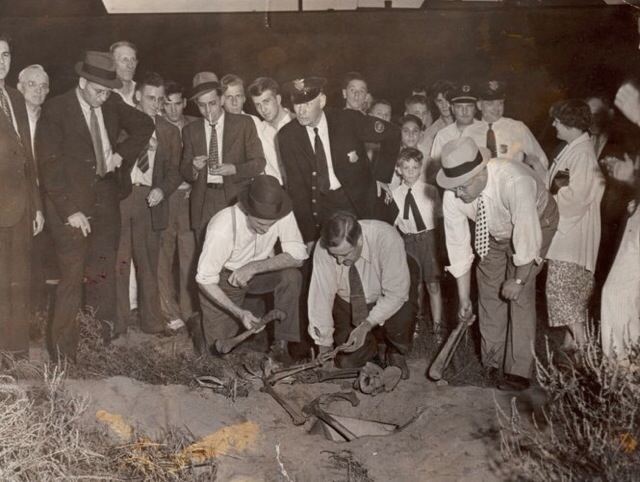
Two teenagers, cutting through the overgrown weeds near Jackass Hill, stumbled upon something that didn’t belong. It was the lower half of a man’s torso. Then the upper half. Nearby, another body, in similar pieces. The scene was bizarre. Horrific. But what was truly unnerving was what *wasn’t* there.

Blood. There was almost no blood.

Police were called, their faces grim under the grey Ohio sky. They quickly confirmed the horror: two male bodies, both beheaded, both emasculated. The killer had drained them of their blood somewhere else, dismembered them with an almost surgical precision, and then arranged their remains like a grotesque art installation. This wasn’t a crime of passion. This was the work of a predator. A butcher.

One victim was eventually identified as Edward Andrassy, a 28-year-old drifter and petty criminal. The other, John Doe I, would never get his name back. The coroner delivered another chilling fact: the unidentified man had been killed weeks, maybe even a month, before Andrassy. The killer had held onto the pieces. Or he had simply come back to his favorite dumping ground.

Eliot Ness: The Untouchable vs. The Uncatchable

As the body count began to rise, the city panicked. This was no ordinary murder. This was a nightmare. The press went wild, plastering the gruesome details across every front page. The pressure mounted. And so, the city turned to its hero. Its celebrity lawman.

Eliot Ness.

Fresh off his legendary takedown of Al Capone in Chicago, Ness was now Cleveland’s Public Safety Director. He was the man who couldn’t be bought, the incorruptible G-man. He was a superstar. But Capone was a gangster, a man of ledgers and bullets. This new enemy was something else entirely. A ghost. A monster who hunted the most vulnerable people in the city—the drifters, the prostitutes, the men and women so far on the fringes that no one would miss them. At first.

Ness threw everything he had at the case. He assembled a massive team of detectives. He brought his “Untouchables” mentality to a case that was, in every sense of the word, untouchable. The killer left no clues. No fingerprints. No witnesses. Just bodies. Or, more accurately, *parts* of bodies.

A Parade of Horrors: The Official Victims

The killer’s rampage was a two-year drumbeat of dread. Each new discovery was a fresh slap in the face to Ness and his investigators.

  • Florence Polillo (January 1936): Her dismembered remains were found stuffed into baskets behind a butcher shop. A woman. This threw investigators for a loop. Serial killers rarely cross gender lines so early. The Butcher didn’t seem to care. Man, woman… it was all just meat to him. Flo was a 42-year-old barmaid and part-time prostitute. Another soul from the margins.
  • The Tattooed Man (June 1936): A young man’s decapitated body was found in a wooded area. He was never identified, which is its own special kind of mystery. Why? Because his body was covered in distinctive tattoos: a bird, the cartoon character “Jiggs,” and the names “Helen and Paul.” The police plastered photos of the tattoos everywhere. They even created a “death mask” of his head and put it on public display. Thousands of people came to stare into the dead man’s face. Nobody knew him. How can a man with so many identifying marks simply vanish from history?
  • More John and Jane Does (1936-1938): The bodies kept coming. A torso here, a limb there. Some were found in the industrial sludge of Cuyahoga River. One washed ashore on the banks of Lake Erie. They were all the same. No heads. No blood. Drained and dissected with terrifying skill. The official count settled at twelve victims, though many investigators believed the real number was much higher.

Deep Dive: The Killer’s Chilling Signature

What kind of person does this? Profilers today would have a field day. Back then, they were just staring into the abyss.

The evidence painted a portrait of a killer who was both a raving lunatic and a cold, calculating genius.

He was strong. Dismembering a human body is hard, physically demanding work. This wasn’t a weak or frail individual.

He had medical knowledge. The cuts were clean, precise. The dissections were made at the joints, expertly separating limbs. The coroner, Dr. Arthur J. Pearce, stated that the killer had to have significant knowledge of human anatomy. He was a surgeon, a butcher, a doctor, or at the very least, a skilled hunter.

He had a “murder lab.” The victims were killed and dissected elsewhere in a private, secure location. A place where a person could be bled out and taken apart without anyone hearing a scream or seeing a drop of blood. A basement? A hidden workshop? Maybe even a medical facility.

He was taunting them. The placement of the bodies felt deliberate. It was a show. He was dumping them in plain sight, daring the police to find him. He knew they couldn’t. He was smarter than them. He was smarter than Eliot Ness.

The Hunt Goes Wrong: Desperate Measures

As the years dragged on and the body parts piled up, Ness grew desperate. The public was losing faith. The press mocked him. The “Untouchable” was failing.

He made a decision that would forever stain his reputation. Convinced the killer was hiding among the poor souls in Kingsbury Run, or at least using the shantytown as his personal hunting ground, Ness decided to burn it all down.

On August 18, 1938, just days after the final two victims were found, Ness led a massive raid. His police force, armed with torches and kerosene, descended on the shantytowns. They rousted over 300 men, interrogated them, and then set their homes on fire. Dozens of shacks and lean-tos were reduced to ash. Ness called it a “drastic measure” to “drive the killer out of his lair.”

Critics called it an act of vigilantism. He destroyed the homes of the very people he was supposed to protect, many of whom were potential victims themselves. It was the act of a man at the end of his rope. And it didn’t work. The killer was gone.

Suspects in the Shadows

The investigation was a revolving door of dead ends. But two names rose above the rest, becoming permanent fixtures in the mythology of the Mad Butcher.

The Bricklayer’s “Confession”

Frank Dolezal was a 52-year-old bricklayer who had lived in the area and had briefly known victim Flo Polillo. He was arrested in August 1938. What happened next is a dark chapter in Cleveland police history.

Dolezal was held for days. He was allegedly beaten relentlessly. His son claimed he saw his father after the interrogation and he was a “mass of bruises.” Then came the news: Dolezal had confessed to Polillo’s murder. But the confession was rambling and inconsistent. Before he could be properly questioned about the other victims, Frank Dolezal was found dead in his cell, hanging from a hook. An autopsy later revealed he had six broken ribs—injuries his family swore he did not have before his arrest.

The official story was suicide. But almost no one believed it. The prevailing theory was that the police, under immense pressure from Ness, beat a confession out of a man and then either killed him or pushed him to suicide to close the case. Dolezal’s confession was thrown out. The hunt was back on.

The Doctor in the Dark

This is where the story takes a turn. It leads us to one man. A man Eliot Ness himself believed, until his dying day, was the Mad Butcher. His name was Dr. Francis E. Sweeney.

Sweeney was, on the surface, an unlikely suspect. He was a brilliant surgeon from a well-respected family. But beneath the surface, there was darkness. During World War I, he had been a medical field surgeon, performing countless amputations on the battlefield. He had the skill. He had the knowledge.

He was also an alcoholic with a history of mental instability. His marriage fell apart, his drinking spiraled, and he lost his privileges at the local hospital. His office was located right on the edge of the “Roaring Third,” the grimy bar district where many of the victims were last seen.

Ness brought Sweeney in for a secret interrogation at a hotel room. He hounded him for days. Sweeney was arrogant, toying with Ness. He failed two separate, very early-model polygraph tests. Ness was convinced he had his man. He felt it in his bones.

But he had no physical evidence. Nothing to link Sweeney to the crimes directly.

Then Sweeney played his trump card. Knowing Ness was closing in, Dr. Sweeney voluntarily committed himself to a state mental institution. Checkmate. In the 1930s, this move made him legally untouchable. Ness couldn’t arrest him, couldn’t formally charge him. Sweeney could spend the rest of his life in the relative comfort of a hospital, safe from the electric chair.

And then, the most chilling part of all. Coincidentally or not, the day Dr. Sweeney was institutionalized, the Cleveland Torso Murders stopped. Forever.

For years after, Eliot Ness would receive taunting postcards and letters, allegedly from Sweeney, mocking him for his failure to capture the Butcher. The letters were sent from various cities across the country where Sweeney was known to be traveling on short leaves from the hospital.

The Echoes of Kingsbury Run

So, was it Sweeney? All the circumstantial evidence points a trembling finger in his direction. The skills, the location, the unstable mind, and the simple, damning fact that the killings stopped the moment he was off the streets. Most crime historians agree he is the most likely culprit.

But we will never know for sure.

The case remains officially unsolved. A dozen people, stripped of their names and their lives, were left in pieces in the dirtiest corners of Cleveland. Their killer, a specter of incredible brutality, performed his ghastly work and then simply vanished.

Eliot Ness’s career never fully recovered. The Mad Butcher was the one that got away, a failure that haunted him far more than the takedown of Capone ever defined him. He left Cleveland a few years later, his shining armor dented and tarnished.

The Mad Butcher of Kingsbury Run dissolved back into the shadows of American history, leaving behind a chilling question that still hangs over the city of Cleveland. Who was the man who hunted the forgotten, and could he, or someone like him, ever appear again?

Originally posted 2013-12-19 00:26:41. Republished by Blog Post Promoter