The above picture is on the giant fish in Bermuda Triangle.
Maybe that’s the part of fishing that doesn’t get talked about enough. Fishing brings people together sometimes after a very long time.
Back in the ’70’s as a young buck I would mostly hunt but fish as well with my Dad’s close friend Bob Polzin. Bobby, as Dad would call him was the youngest of “the group” of the select few that Dad automatically invited to duck and pigeon dinners, playing cards and whatever else those guys did that a 14 – 15 year old shouldn’t know about. Since Bob was the youngest of the crew, and I wanted to get into the field in the worst way, Bob took the time to take me road hunting as much as I could talk him into. We shot a lot of ducks and pigeons together. A Lot.
Between Bob getting married, buying a home, starting to raise a family and me moving on with growing up, we saw less and less of each other. I saw his oldest daughter Vickie the last time when she was around 10 years old I’m guessin’.
Then a few weeks ago I get a call while I was guiding. I don’t like to answer the phone when I’m with a customer but the second time the phone rang I noticed it was a Hutchinson prefix. I excused myself from my customers with the explanation that the call was from Hutch and my Mother lives out there. Well it wasn’t Mom, it was that snot nosed 10 year old that’s all grown up wanting to go fishing! We finished our conversation the next day and dates where scheduled. Long time friend Bobby and his lovely wife Naomi on a Friday and Vickie along with her younger sister that I hadn’t met on Sunday.
I’m not going to take you through the Old Home Days we had, I’m just going to get into the fishing with the exception of Bob didn’t look like the 30 something I remembered him as. I think he looked happier.
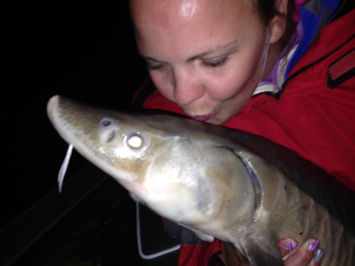
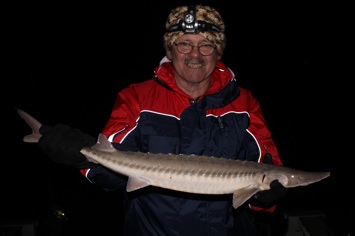 Friday evening was rainy with the wind gusting and changing direction. Not exactly what I would call a perfect night for fishing but we managed some average fish with the exception of Bob’s big Shovelnose Sturgeon. It was close to the MN State record of 6 lbs 7 oz and 33 inches, it was what I would call a very good sized shovel. We boated channel cats, flatheads and lake sturgeon along with a couple more shovels. Like I said, it wasn’t one of my best nights, in fact I listed it as my worst trip since starting to use night crawlers this year.
The Saturday night folks had a much better time for size of fish. Marty and Tom had lot’s of action with channel cats in the 3 to 8 pound range that filled in between the lake sturgeon bites. That’s one thing that I love about the river, I don’t care what your fishing for, we never know what’s going to be on the end of the line the next time a “fish” comes in.
I told the story of my daughter asking about the fish we caught in the river system while we were fishing a few years back. I said “it’s funny, we talked about the American Eel and 15 minutes later by daughter had one next to the boat.” That was the first and only eel I’ve ever had…until after telling the story this night. Thirty minutes later… you guessed it American Eel #2! Now I know most will say “YUCK” but take a moment and read some interesting facts on the American Eel when you have a moment. They are an amazing fish spawning close to the Bermuda Triangle. But back to Marty and Tom.
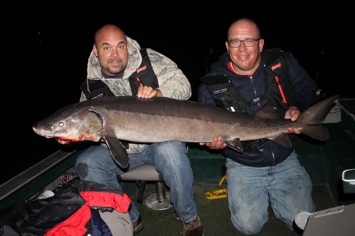 Tom’s first lake sturgeon taped out at 57″. I told him that was going to be the big fish of the evening. Since Mother Nature does not like to be told anything, she proved me wrong as the last fish of the night taped out at 61″ or about 55 pounds. Even with the smallest sturgeon of the night coming in at 50″, all I could hear coming out of their mouths were “my gosh”, “wow” and a few more terms not suitable to type. These two fishermen were truly “man handled” by the Mississippi River’s Lake Sturgeon!
I’ve talked about the rigging before but I’ll touch on the line and the rods we’re using. Now, most this gear is new, so youl’ll be able to find it in The Best Spinning Reels of 2018: The Definitive Guide (In-Depth Reviews) – Outdoor Empire, if you’re interested. The line is an 80 pound no stretch, high visibility braid made for large catfish and the rods are what most would call a very heavy musky rod with a sensitive tip to detect the ultra subtle bite of a sturgeon while in a rod holder. I use a super sensitive carbon fiber I-Cat rod. By holding the rod in your hands we can feel bites that go by undetectable otherwise. With the no stretch line coupled with the carbon fiber I-Cat rod we can feel fish brushing against the line! When a channel cat bites there is no mistake the bait was taken. It’s a solid thump. With lake sturgeon it could be a 5 pounder or a 55 pounder and the bite is as soft as a 5 inch sunfish in a negative bite mood. The two most often talked about pieces to sturgeon fishing is 1st, how much they fight and 2nd, how light of a bite a large fish makes. Truly a person needs to experience this to understand it.
Then came Sunday night with Vickie and her sister Amanda. As mentioned before, the last time I saw 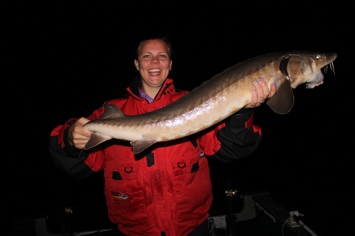 Vickie was when she was 10 and Amanda was very young at that time. Their dad did something right, they both love fishing and like tonight, often head off together on fishing adventures. Next stop on the books with be for walleyes on Lake of the Woods.
These two where an absolute blast to have in the boat! Asking so many “why’s” I would get confused as to which question I was answering! It’s fantastic to see that much interest in the “how to’s” of catching the States largest fish. It wasn’t these girls first rodeo but it was their first three ring circus with sturgeon! (Only people that have dance with a sturgeon before will understand that.)
Vickie wasn’t about to be out done by her sister but when the paddle boat The American Queen was going through the lock her attention was diverted for a moment and her sister took advantage of it and pulled in another sturgeon. I have a sister and even I know what sisters are for! Vickie, you have to watch them closely!
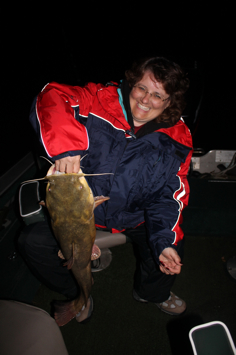 We had a good number of shovelnose, lake sturgeon, flatheads,
 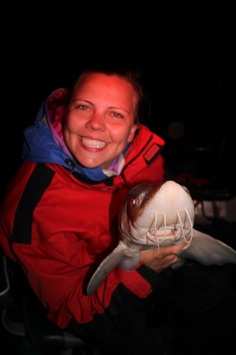 channel cats and even a sheepshead or two in the boat this night. I normally pull the plug around 1 pm, but with these two in the boat, well I don’t know where time went. We didn’t see the sun come up but it wouldn’t have been too much longer!
On each hook up with a sturgeon, I would ask Vickie if she had a deck of cards or if she wanted to play checkers while Amanda was working, lifting the rod up, then reeling down over and over again to get the fish closer to the boat. Of course it looked like she was gaining line and the sturgeon was almost boat side, then down she would go and Amanda would start all over again.
Just a little more about my two new friends. Amanda works as a nurse at Regions Hospital in St Paul and 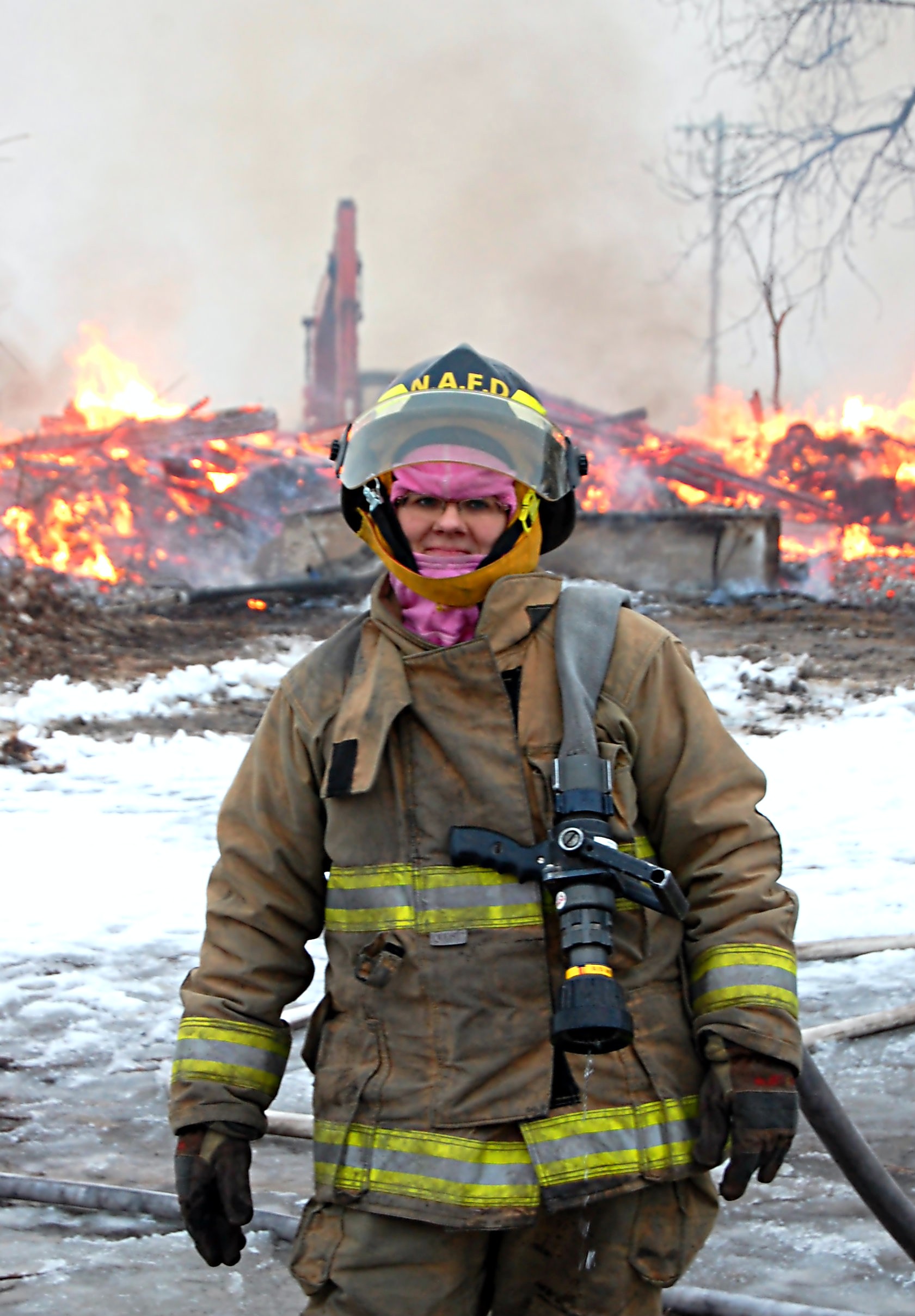 Vickie is a nurse in New Auburn, MN along with being a volunteer Fire Fighter. As an old duffer, I was in good hands in case of a fire or medical emergency!
The catch and keep season on the St. Croix River ends on Sept 30th. The catch and release season on the St Croix for MN and WI ends on Oct. 15th. The catch and release season for Minnesota only will continue on until spring of 2016. Yes, there will be people targeting these fish through the ice on Minnesota waters over the winter. The Wisconsin catch and release season is planned to be coming soon to keep the rules the same on both sides of the border. Keep an eye on the regulations.
The success of the Lake Sturgeon Catch and Release season relies heavily on us anglers. Keeping our fingers out of their gills and gill plates is essential to a good release. We all have a duty to inform anglers of how to hold these creatures that take a very very long time to reproduce. Seldom will we find an angler that wants to hurt these gentle giants but since it’s a new sport fish there are many that are not aware. The tricky part is to inform the angler when spotted holding a fish by the gills while keeping their self esteem intact. If we can take care of these fish now, there’s a good chance that your snot nose granddaughter could hook into the very same fish you caught and carefully released. For more information on Minnesota’s Lake SturgeonClick Here to go to the Department of Natural Resources website.
And lastly..
When someone asks me about guiding, more specifically what I like the best about guiding, the answer is always the same. Most would say it’s putting people on fish and yes, that is part of it but it’s the incredible fact that a person can enter my boat as a stranger and leave as a good friend.
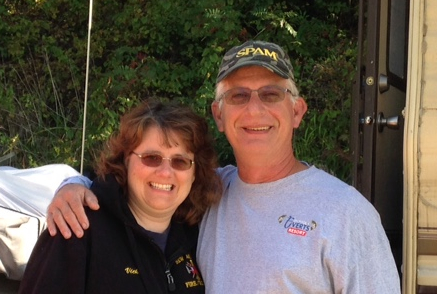
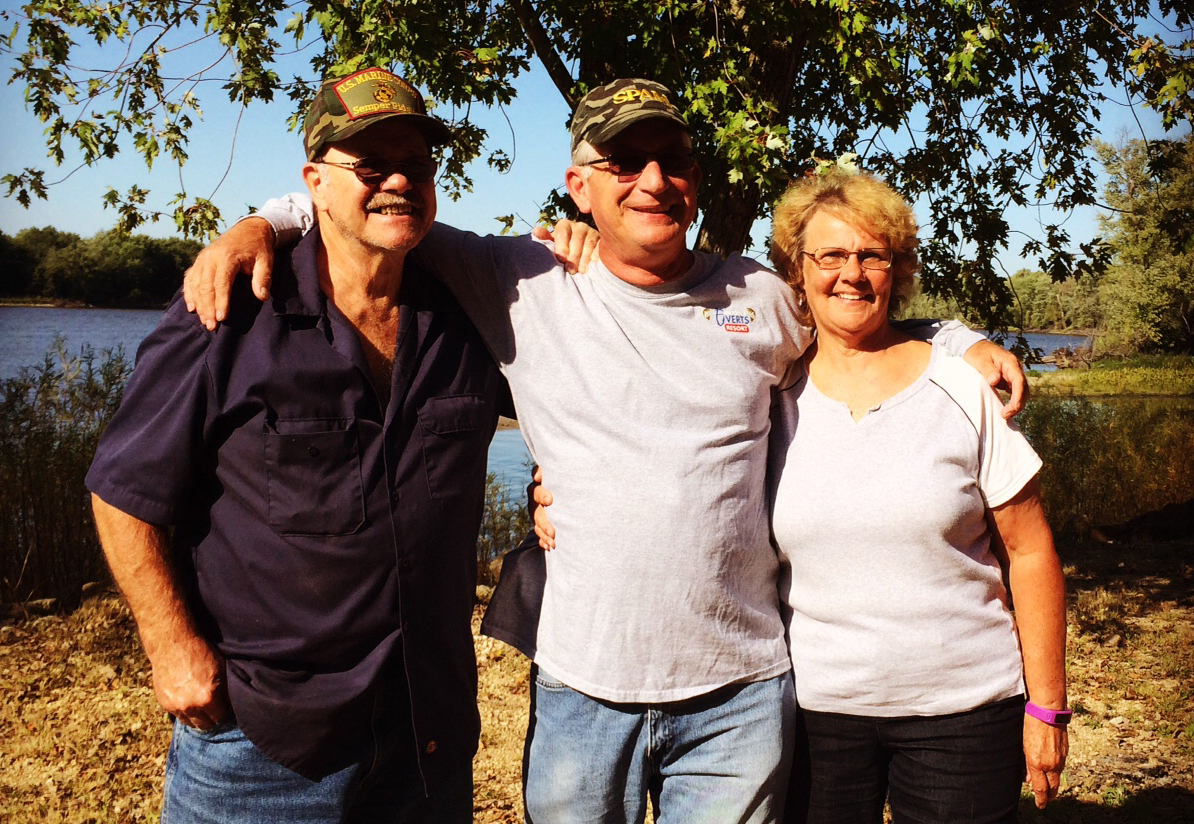
That’s the best part of guiding.
Everyone should have a chance a Lake Sturgeon. My guide service is booked for the year but if you have a boat and would like to go, give me a call or send an email. I’ll do my best to get you on The Memory Making Lake Sturgeon!
By the way, it never hurts to show your love to a Lake Sturgeon.