The Anasazi Mystery

0
55

The Vanished Ones: Did Aliens Abduct America’s Mysterious Anasazi Civilization?

They built cities in the sky. Palaces carved into sheer canyon walls, hundreds of feet above the desert floor. They mapped the sun and the stars with a precision that still baffles engineers today. And then, in the blink of an historical eye, they were gone.

Gone.

We’re talking about the people known as the Anasazi, a civilization that rose and fell in the stark, beautiful, and unforgiving landscape of the American Southwest. For over a thousand years, they thrived. They built architectural marvels. They created a complex society. Then, around the year 1300 AD, they simply… vanished. The cliff cities were abandoned. The ceremonial kivas fell silent. The hearths grew cold, some with pottery and tools left as if their owners had just stepped out for a moment and never came back.

The mainstream story? A drought. Social upheaval. A simple migration. But is that the whole picture? Or is it just the easy answer to a question so profound it chills the bone? Because when you dig deeper, when you look at the clues they left etched in stone and woven into the very fabric of their culture, a far stranger narrative begins to emerge. A story whispered by their neighbors, the Navajo, in a name that translates to “Ancient Strangers.” Or, more chillingly, “Ancient Enemy.”

Who were these strangers? And where did they go? Did they just move down the road? Or did they go… up?

20140109-003958.webp

A Name That Echoes with Mystery

Let’s start with that name. “Anasazi.” It’s not what they called themselves. We don’t actually know their true name; it has been lost to the winds of time. The word comes from the Navajo language, and its meaning is hotly debated. For decades, it was politely translated as “Ancient Ones.” But that’s a softening of the truth. The real meaning, depending on inflection, is closer to “Ancient Strangers” or “Ancient Enemy.”

Now, stop and think about that. Your neighbors, a people who lived in the same region, referred to this powerful civilization not as old friends, but as outsiders. Enemies. Strangers. Replace “stranger” with a more modern word. Alien. The name itself plants a seed of doubt. Were these people not from around here? Were they viewed as something fundamentally different by the other tribes who shared the land?

Legends from other local tribes, like the Hopi who are considered their descendants, speak of an arrival from the west, across a great water, by ship. The official story says the Anasazi culture first flickered into existence around 1200 BC, but the legends hint at a much more dramatic entrance onto the world stage.

Cities on the Edge of Forever

For centuries, the Ancestral Puebloans, as they are more respectfully called today, lived and evolved in the Four Corners region—the unique spot where Arizona, Utah, Colorado, and New Mexico meet. They built incredible structures that seem to defy logic.

Take Chaco Canyon. This wasn’t a village; it was a metropolitan hub. The main building, Pueblo Bonito, was a D-shaped behemoth containing over 600 rooms, standing five stories tall. It was the largest apartment building in North America until the 19th century. How did they construct this with nothing but stone tools and human muscle? The architecture is precise, with walls aligned to cardinal directions and celestial events.

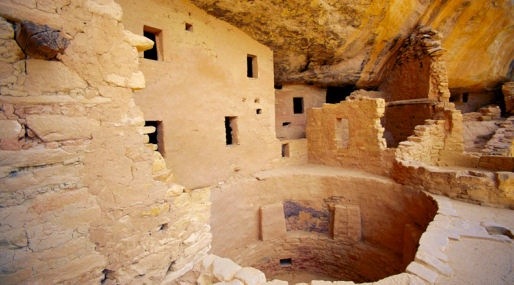
Even more stunning are the cliff dwellings of Mesa Verde. Entire towns built into massive natural alcoves in the rock. To reach their homes, the inhabitants had to scale sheer cliff faces using tiny, carved handholds and footholds. It was a life lived on the edge, a display of engineering and bravery that is hard to comprehend. Why build in such impossibly difficult and dangerous locations? Were they hiding? Or were they watching the skies for something?

Deep Dive: The Roads to Nowhere

One of the most baffling features of the Anasazi world is their road system. This wasn’t a collection of simple footpaths. We’re talking about a massive network of engineered roads, some up to 30 feet wide, radiating out from Chaco Canyon for hundreds of miles. But here’s the kicker. These roads are perfectly straight. They don’t go around obstacles; they go over or through them. They ascend sheer mesas using carved stairways. They stretch out into the desert and then just… stop.

They don’t connect major population centers in a logical way. They don’t follow the easiest path. For what purpose would a pre-industrial society expend such enormous effort to build these vast, dead-straight highways to nowhere? Archaeologists suggest they were for religious pilgrimages, spiritual lines connecting sacred sites. But the sheer scale of the project feels like overkill. Online forums and late-night radio shows have posed another question: if they weren’t for walking, were they for landing?

20140109-004026.webp

Messages from the Star Gods?

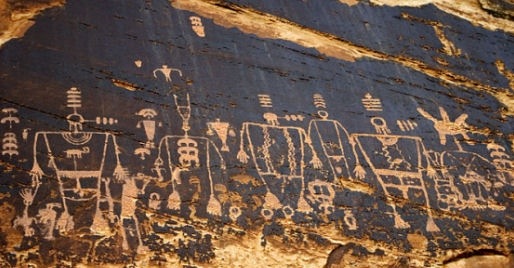
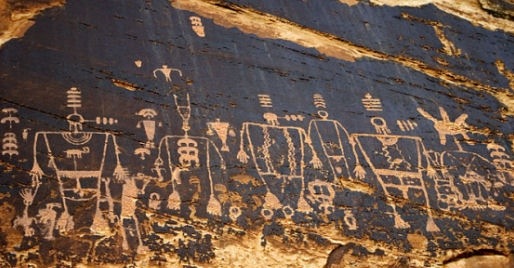
The clues get stranger when you look at what the Anasazi left on the walls. Their petroglyphs and pictographs are a window into their minds, and some of the images are profoundly odd.

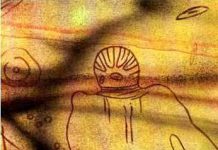
All over the Southwest, you can find depictions of figures that look nothing like humans or animals. Beings with large, strange eyes. Triangular bodies. And, most tellingly, what appear to be antennae or helmets on their heads. Are these just symbolic representations of spirits or gods? Absolutely, that’s the safe explanation.

But what if they weren’t drawing what they believed, but what they *saw*?

The Hopi talk of the Kachinas, powerful spirits who came from the sky to teach and guide humanity. These Kachinas are often depicted as these very same strange, non-human figures. The legends state that in a time of crisis, the Kachinas would return. Could these petroglyphs be a record of contact? A field guide to visitors from another world?

Their entire spiritual life was centered on the cosmos. At Fajada Butte in Chaco Canyon, the famous “Sun Dagger” petroglyph acts as a perfect celestial calendar. Daggers of light pierce the center of a spiral carving only on the solstices and equinoxes. They built astronomical observatories. Their kivas, the round ceremonial chambers, had a central hole in the floor called the “sipapu.” This represented the portal through which their ancestors emerged from a previous world into this one. A world below. Or a world… beyond?

So, Where Did Everybody Go?

And so we come to the great vanishing. Sometime in the late 1200s, the entire civilization collapsed. The great houses of Chaco were abandoned. The cliff cities of Mesa Verde were emptied. For a society of tens of thousands, it was a shockingly rapid exodus.

The “Official Story”

Science gives us a neat, tidy answer. Tree-ring data points to a massive, 23-year-long drought that began in 1276. A “Great Drought” that would have crippled their corn-based agriculture and sent society spiraling. This would have led to warfare, starvation, and eventually, a mass migration where the people broke into smaller groups and moved south and east, eventually becoming the ancestors of the modern Pueblo tribes. There is indeed evidence of violence and even cannibalism at some late-stage sites, painting a grim picture of a society tearing itself apart.

This is the most likely scenario. The most rational one. But it feels incomplete.

The Alternative View: A Final Exit

Why was the departure so sudden? So total? Why leave behind perfectly good pots, tools, and grain stores? It looks less like an organized migration and more like a rapid evacuation. This is where the story takes a sharp turn into the unknown.

Was the Great Drought not the cause of their departure, but merely the backdrop for it? The Hopi legends speak of the “Star People.” What if the Kachinas, the beings who came from the sky, returned? What if they came back to a world in turmoil—a world of drought and war—and offered a way out?

Imagine the scene: a civilization on the brink of collapse, praying for salvation. And then, the gods answer. Not with rain, but with rescue. Is it possible that the disappearance of the Anasazi was not a migration across the land, but a migration to the stars? A mass abduction, not of a few individuals, but of an entire culture, lifted from their cliff-side homes and taken to the home of their “Ancient Strangers.” It sounds like science fiction. But the evidence they left behind—the roads to nowhere, the sky-watching cities, the strange figures on the rocks—paints a picture that is hard to ignore.

A Global Pattern

The mystery of the Anasazi doesn’t exist in a vacuum. It echoes the riddles of other ancient sites around the globe. The astronomical perfection of Stonehenge. The impossible stonework of Puma Punku in Bolivia. The sheer mathematical genius of the Great Pyramid of Giza. All over the ancient world, we see cultures that suddenly display a shocking level of scientific and engineering knowledge, often centered on astronomy.

Were the Anasazi simply another branch of this global, forgotten culture? A civilization that possessed a universal key to understanding the cosmos? Or were they all, in their own time, students of the same, non-human teachers?

The desert keeps its secrets. The canyon walls don’t talk. But as you stand in the eerie silence of Pueblo Bonito, with the desert wind whispering through empty doorways, you can’t help but look up at the vast, star-dusted sky. The archaeologists and historians can have their tidy explanations of drought and migration. They make sense. But they don’t capture the magic, the sheer wonder, and the profound strangeness of it all. The clues are there for those willing to see them. An ancient name that means stranger. Cities built to touch the heavens. And a silence so complete it screams a single, mind-bending question: when the Anasazi vanished, where did they truly go?

Originally posted 2014-01-08 23:41:40. Republished by Blog Post Promoter