Home Unexplained Mysteries Modern Mysteries Strange Unexplained Books – The Codex Seraphinianus

Strange Unexplained Books – The Codex Seraphinianus

0
62

The Codex Seraphinianus: Is This The World’s Most Mysterious and Unreadable Book?

There are books that tell stories. Then there are books that hold secrets. And then, there is the Codex Seraphinianus.

It’s not just a book. It’s an artifact. A puzzle box. A beautifully illustrated enigma that has haunted artists, linguists, and conspiracy theorists for over four decades. When you open its pages, you are not simply reading; you are falling headfirst into a reality that feels both alien and disturbingly familiar.

Forget everything you think you know about books. This one breaks all the rules.

And it might just be the most important unreadable text on the planet.

A Genius or a Madman? The Ghost in the Machine

To understand the book, you must first try to understand the man. His name is Luigi Serafini. An Italian artist, architect, and designer born in Rome in 1949. Between 1976 and 1978, he locked himself away and poured his soul into this singular, obsessive project.

What was he doing? He was creating a world.

Not with bricks and mortar, but with ink and paper. He meticulously crafted an encyclopedia. An exhaustive, 360-page survey of a place that does not exist. Or… a place we haven’t found yet. When asked about the strange, elegant script that fills every page, a language no one on Earth can decipher, Serafini remains a smiling sphinx. He has steadfastly refused to explain its meaning. Is it a real, forgotten language? A complex cipher hiding a world-changing secret? Or is it all just beautiful, meaningless gibberish?

His silence is part of the performance. Part of the mystery. He once hinted that the Codex is meant to recreate the feeling a small child has when looking at an encyclopedia before they can read. The pictures tell a story. The words are pure magic, full of promise but devoid of concrete meaning. A beautiful, simple explanation. Almost too simple.

A Guided Tour Through Another Reality

The Codex is broadly separated into eleven sections, each one a deeper plunge into the rabbit hole. It starts with the familiar—plants, animals—and slowly spirals into the utterly bizarre.

The Impossible Botany

The first section is a catalog of flora. But these are not the plants of our world. You turn a page and see a tree that bleeds, its branches weeping a strange crimson liquid into a bucket. Another page reveals a plant that literally grows into the shape of a chair, waiting to be harvested and sat upon. There are flowers that float away like balloons, and fruits that peel themselves.

20140116-020700.webp

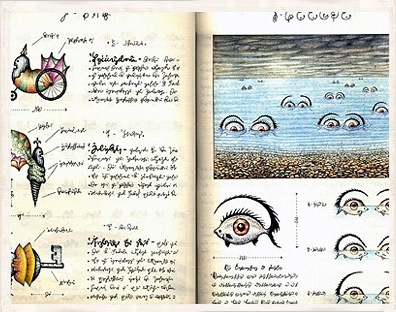
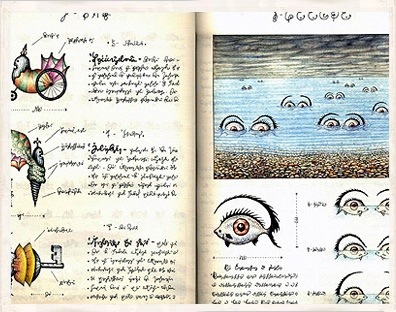
Each illustration is rendered with the clinical precision of a Victorian naturalist. The detail is staggering. The colors are vibrant. The anatomy of these impossible organisms is laid out for you. It feels real. It feels studied. This isn’t just doodling; it’s world-building on a cosmic scale.

Creatures from a Fever Dream

Next comes the fauna. And this is where the world of the Codex truly begins to warp. Imagine a deer with a head made of branching coral. A fish that looks like a human eye, swimming in schools of thousands. There are rhino-like beasts covered in traffic signs and bizarre, multi-limbed creatures that seem to be part-animal, part-machine.

One of the most famous illustrations shows a series of bizarre, horse-like animals. One is little more than a wire frame. Another is wrapped in a rainbow. Another seems to be made entirely of tiny, rolling wheels. Are they different species? Or is it a diagram showing the stages of some strange evolutionary process?

The book doesn’t give you answers. It only gives you more questions.

Meet the Bizarre Inhabitants

And then we meet the people. Or… the things that pass for people. They are bipedal. They have arms and heads. But that’s where the similarities end. They wear baffling outfits, from brightly colored cones that obscure their entire bodies to suits made of what looks like living plants. Their customs are even stranger.

In one of the most talked-about images, we see a couple making love. As they embrace, their bodies begin to melt and morph, their skin fusing together until they have transformed into a single, terrifying alligator. Is this a metaphor? A religious ritual? Or is it their actual method of reproduction?

Another section depicts a leader-like figure, his head completely encased in a green sphere, being followed by citizens with rainbow-colored umbrellas sprouting directly from their shoulders. The scenes are a kaleidoscope of surreal social practices, rituals we can only guess at, and a civilization that operates on a logic completely alien to our own.

Physics, Chemistry, and Things We Cannot Name

The book moves on to science. Physics. Chemistry. But the diagrams are pure madness. They show bizarre contraptions that defy all known laws of nature. We see detailed schematics of a machine that seems to be dissecting a rainbow. Another illustrates a strange, thread-like energy being pulled from the sun and woven into fabric. There are diagrams of atoms that look like spinning tops and chemical reactions that resemble warring sea creatures.

Is this the science of a parallel dimension? Are these the blueprints for technology we can’t possibly comprehend? Or is it a critique of our own science, showing how strange and arbitrary our own diagrams of reality would look to an outsider?

The Great Unbreakable Code

At the heart of the Codex Seraphinianus is the text itself. The writing. The thing that promises to explain it all, yet explains nothing. For decades, the world’s best cryptographers, linguists, and amateur sleuths have thrown themselves at this script, and all of them have failed.

A Language That Pretends

The writing system is a work of genius because it mimics real language perfectly. It’s written left-to-right in neat paragraphs. There are “capital” letters that begin chapters. There are recurring symbols, suggesting a consistent alphabet. The flowing, cursive script has a distinct rhythm and an internal logic that feels right. It has all the hallmarks of a genuine language.

But that’s the trap. Frequency analysis, a classic code-breaking technique that looks for common letters (like E, T, and A in English), yields nothing but gibberish. No patterns emerge. No root words can be found. It’s a ghost that disappears every time you try to grab it.

A Glimmer of Hope: The Numbers

There was one small breakthrough. Just one. In 2009, Bulgarian linguist Ivan Derzhanski studied the page numbers. He noticed a pattern and declared that he had “cracked” their system. He proposed that the numbering system was a variation of base 21.

This sent a shockwave through the community. A crack! A foothold! If the numbers could be solved, surely the rest of the text would eventually fall. But it didn’t. The discovery of the base-21 numbering system proved to be a dead end, a small mathematical puzzle inside a much larger, impenetrable mystery. Some now believe Serafini included it as a red herring, a deliberate clue designed to frustrate and mislead those trying to solve his grand puzzle.

What if AI Tried to Crack It?

In recent years, internet forums have buzzed with a new idea: what if we fed the Codex to a powerful AI? Modern machine learning algorithms can recognize patterns far beyond human capability. Surely an AI could see through the noise and find the hidden structure.

Several attempts have been made. The results? Disappointing. The AIs came to the same conclusion as the humans: the script has the “statistical properties” of a real language, but contains no discernible semantic meaning. It is, according to the machines, a perfect imitation. A forgery of language itself. This has only deepened the mystery. Did Serafini create a code so complex that even our most advanced technology can’t break it? Or did he create the world’s most elegant nonsense?

The Three Big Theories: What Is This Thing?

When facts run out, speculation begins. And the Codex Seraphinianus is a playground for speculation. Broadly, the theories fall into three camps.

Theory 1: The Transcription of a Vision

This is the most romantic and unsettling theory. What if Luigi Serafini isn’t the author, but the scribe? What if the Codex is not a work of imagination, but a work of transcription? Believers in this theory suggest that Serafini somehow, through dreams, visions, or a psychic event, tapped into another reality. He saw this world and, as an artist, felt compelled to document it with the accuracy of a scientist.

In this view, the language isn’t a code to be broken, because it’s not for us. It’s the genuine language of that other place. We can’t read it for the same reason we can’t read a biology textbook written in a language we’ve never seen. It explains the coherence of the world, the internal logic of its bizarre ecosystems and societies. It wasn’t invented; it was observed.

Theory 2: The Ultimate Artistic Statement

This is the more grounded, academic view. The Codex is a masterpiece of surrealist art. It’s a commentary on our information-saturated age, a giant middle finger to the authority of encyclopedias and the scientific establishment. In a world where everything is cataloged, explained, and indexed, the Codex is a sanctuary of pure, unadulterated mystery.

It forces you to stop trying to understand and to simply see. To experience wonder. It’s not a book with a hidden meaning; the hidden meaning is that there is no meaning, and that’s okay. It’s a psychological test. Our desperate need to decipher the text shows more about our own minds—our obsession with order and logic—than it does about the book itself.

Theory 3: Automatic Writing from the Subconscious

This theory splits the difference. It takes Serafini’s own hint about the “childhood feeling” and pushes it further. What if the book is a form of “automatic writing,” an artistic process where the conscious mind is shut off and the hand is allowed to channel the subconscious directly onto the page?

The strange creatures, the bizarre rituals, the alien language—they could be archetypes and symbols bubbling up from the deepest, most primal parts of Serafini’s own mind. The language, in this case, would be a form of “glossolalia,” or speaking in tongues. It has the sound and feel of language, but it’s a pre-linguistic, emotional expression. The book isn’t from another world, but from the inner world we all share but can rarely access.

The Enduring Cult of the Codex

Whatever its origin, the Codex Seraphinianus has become a legend. First editions, published in the early 80s, are now collector’s items that sell for thousands of dollars. It has influenced writers, filmmakers, and game designers. It has a cult following online, where every page is dissected and debated endlessly.

It is a book that resists being consumed. You can’t speed-read it. You can’t summarize its plot. It demands that you slow down, look closer, and let your imagination run wild. In an age of instant answers and searchable information, the Codex is a towering monument to the power of the unknown.

So, is it a prank? A portal? A psychological portrait? Maybe the point is that it can be all of them at once. The book is a mirror. It doesn’t contain a message; it reflects the one you bring to it. It’s a key, but what it opens is not a secret text, but a door in your own mind.

And that is a mystery worth more than any answer.

Originally posted 2014-01-16 01:08:02. Republished by Blog Post Promoter