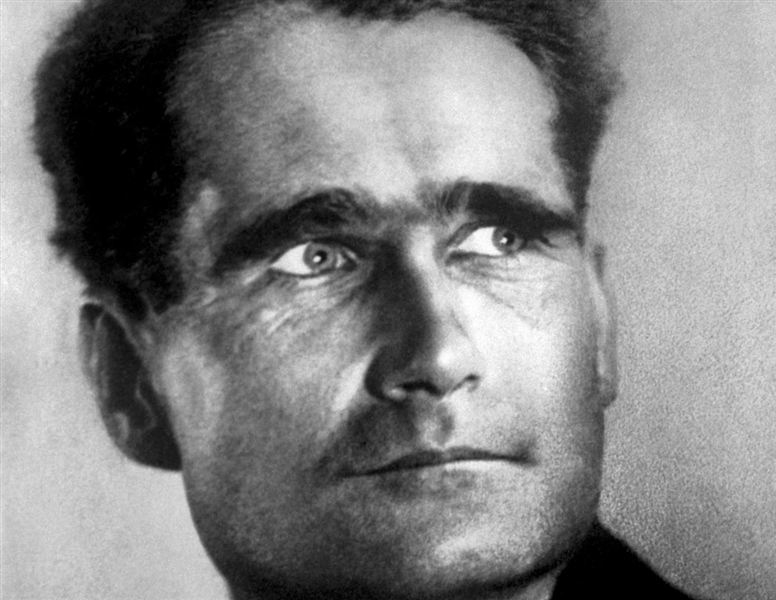
The Unsolvable Mystery of Rudolf Hess: Madman, Peacemaker, or Impostor?
Picture it. The night of May 10, 1941. Europe is a bonfire. The Blitz is raining fire on London. And in the heart of the Third Reich, one of its most powerful men is about to vanish.
He wasn’t just some random officer. This was Rudolf Hess. Deputy to the Fuhrer. The man who sat at Hitler’s right hand, a fanatical devotee from the earliest, darkest days of the Nazi party. He ate a final dinner with his wife, kissed his son goodbye, and then did something absolutely insane.
He climbed into the cockpit of a Messerschmitt Bf 110 fighter plane and pointed it north. Towards enemy territory. Towards Scotland.
This single act tore a hole in the fabric of World War II history. A hole that, to this day, has never been properly stitched up. What followed was a spiral into one of the 20th century’s most bizarre and persistent conspiracy theories. A story of prisons, impostors, and a secret so dangerous, it might have been worth killing for.
Forget what the history books tell you. The official story is just the cover of the book. We’re going to rip it off and read the pages they tried to burn.

Who Was Rudolf Hess, Really?
Before the flight, before the madness, Hess was the ultimate insider. A true believer. Born in Alexandria, Egypt, to German parents, he was an decorated infantry officer in World War I. After the war, like so many disillusioned German soldiers, he was drawn to the furious, charismatic energy of a young Adolf Hitler.
He was there from the start. He marched alongside Hitler in the failed Beer Hall Putsch of 1923 and shared a prison cell with him afterward. It was in that cell that Hess transcribed and helped edit Hitler’s twisted manifesto, *Mein Kampf*. He wasn’t just a follower; he was an architect of the nightmare to come.
When the Nazis seized power, Hess was rewarded for his loyalty. He became Deputy Fuhrer, the third most powerful man in Germany after Hitler and Hermann Göring. He signed the infamous Nuremberg Laws into effect, stripping Jewish people of their rights. His fingerprints are all over the foundations of the regime.
But something was shifting. As the war machine ramped up, Hess found himself increasingly sidelined. More aggressive men like Martin Bormann and Heinrich Himmler were grabbing for power, pushing the “old guard” like Hess out of Hitler’s inner circle. He was a man of immense power, but he was also becoming a relic. A man watching his influence fade.
Did this perceived irrelevance drive him to an act of desperation? Or was something else at play?
The Flight of a Madman: A One-Way Ticket to Mystery
Let’s go back to that night. Hess, an experienced pilot, navigates the dark skies alone. He’s flying a long-range fighter, stripped of its armament and fitted with extra fuel tanks. This wasn’t a spur-of-the-moment decision. This was meticulously planned.
He dodged British night fighters. He flew low over the Scottish coast. His target? The estate of the Duke of Hamilton, a man Hess had never met but believed to be a key player in a British faction that opposed Winston Churchill and might be open to a peace deal.
His fuel ran out. He was forced to bail out. He parachuted down, injuring his ankle, and landed in a field near the village of Eaglesham. The first person to find the Deputy Fuhrer of Nazi Germany was a local farmer named David McLean.
With a pitchfork.
McLean took the strange German pilot back to his cottage. Hess, calling himself “Hauptmann Alfred Horn,” asked to be taken to the Duke of Hamilton. The authorities were called. And the world’s most unbelievable game of telephone began. It didn’t take long for British intelligence to figure out exactly who they had in custody.
The shockwave was immense. In Germany, Hitler was apoplectic. The official Nazi story, blasted across the radio waves, was that Hess was a deluded idealist who had suffered a mental breakdown. A madman acting alone.
In Britain, the government was baffled. Churchill’s war cabinet didn’t know what to make of it. Was this a genuine peace offer? A trap? The bizarre ramblings of a lunatic? Unwilling to take any chances, they simply classified him as a prisoner of war and locked him away, first in the Tower of London.
Hess claimed he had come to prevent the catastrophic two-front war he saw coming with the imminent invasion of the Soviet Union. He wanted to broker a peace between Germany and Britain, two “Aryan” nations, so they could focus their combined might against the communists.
But here’s the first big crack in the official story. The timing. Hess flew on May 10th. Operation Barbarossa, the invasion of the Soviet Union, was launched just a few weeks later on June 22nd. Did he really think he could stop it? Or was his flight a signal? A secret message to powerful people in Britain that something big was about to happen?
Prisoner No. 7: The Long Silence of Spandau
Hess’s story gets even stranger after his capture. His mental state seemed to collapse. At the Nuremberg Trials, he was a ghost of his former self. He claimed profound amnesia, staring blankly when confronted with his own signature on Nazi documents. At times he seemed catatonic, at others paranoid.
Was it real? A convenient act? Or the result of psychological torture or drugs?
The judges didn’t buy the amnesia. They found him guilty of “crimes against peace” and sentenced him to life in prison. He, along with six other high-ranking Nazis, was sent to Spandau Prison in Berlin. A massive, grim fortress run jointly by the four Allied powers: the US, Britain, France, and the Soviet Union.
One by one, the other prisoners were released or died. By 1966, only one remained.
Rudolf Hess. Prisoner No. 7.
For the next 21 years, he was the sole inmate of a prison designed for 600. An army of guards from four nations patrolled the walls. An entire institution existed just for him. The cost was astronomical. The isolation was absolute. The silence was deafening.
And it’s in this bizarre, lonely silence that the biggest conspiracy theory of all took root.
Deep Dive: The Spandau Doppelgänger Theory
What if the man in Spandau wasn’t Rudolf Hess at all?
It sounds like the plot of a pulp thriller, but the theory has surprisingly stubborn legs. For decades, it was championed by a small but dedicated group of people, including Hess’s own son, Wolf Rüdiger Hess, and, most famously, by a British military doctor who worked at Spandau, W. Hugh Thomas.
The “evidence” is a collection of strange anomalies and inconsistencies that, when viewed together, paint a deeply unsettling picture.
- The Family Refusal: For the first 28 years of his imprisonment, Prisoner No. 7 refused to see his wife or son. He would write them letters, but refused face-to-face contact. Why? The official reason given was pride. But the conspiracists ask a different question: Could it be because he knew they would immediately recognize him as an impostor?
- The Missing Scar: As a young soldier in World War I, Rudolf Hess was shot in the lung. The bullet entered his back and exited his chest, leaving significant, undeniable scars and a collapsed lung that would have shown up on any x-ray. Dr. Thomas, who examined Prisoner No. 7 multiple times, claimed the man had no such scars. None. He x-rayed him. He physically examined him. Nothing. This is the cornerstone of the doppelgänger theory. How could a man be missing a massive wound from a rifle bullet that passed clean through his torso?
- The Flight Records: Some researchers claim that flight records and Luftwaffe reports indicate that the Messerschmitt that crashed in Scotland was not the one Hess took off in. They suggest a mid-air switch, or that another plane was involved. Could the real Hess have landed safely somewhere else while a body double crashed the plane?
- The Amnesia: The sudden, convenient, and total amnesia at Nuremberg is another red flag. Was it a way for an impostor to avoid being grilled on details of Hess’s life that he simply wouldn’t know?
So, what’s the scenario here? The theory goes something like this: The real Rudolf Hess did fly to Britain, but he successfully landed and met with powerful figures in the British government, perhaps even a member of the Royal Family. They struck some kind of deal, a secret pact that would be politically explosive if it ever came to light. To keep it secret, the real Hess was hidden away (or eliminated), and a brainwashed or coerced double was put on trial and locked in Spandau for life.
The four Allied powers guarding one man in a giant prison suddenly makes more sense. They weren’t guarding a man. They were guarding a secret. A secret so big it required the cooperation of bitter Cold War enemies to maintain the lie.
Of course, there are official explanations. The British government released files in the 1990s that supposedly contained a 1941 medical report detailing Hess’s chest wound. And in 2019, a DNA test was published in a scientific journal. Researchers compared a blood sample from Prisoner No. 7 with a sample from a living male relative of Hess. The result? A match. Case closed, right?
Not so fast, say the theorists. How do we know the blood sample, preserved for decades, was really from Prisoner No. 7? How do we know it wasn’t switched? For those who believe in the cover-up, a government-sanctioned DNA test is just another piece of the disinformation puzzle.
A Final, Violent End: Suicide or Murder?
The story takes one last dark turn. On August 17, 1987, Prisoner No. 7 was found dead in a summer house in the prison garden. He was 93 years old.
The official cause of death, declared by the British, was suicide by hanging. They said he had looped an electrical extension cord over a window latch and hanged himself. His supposed suicide note was released, a letter to his family that he had apparently written years earlier.
Almost immediately, this story fell apart under scrutiny.
His family, his lawyer, and his final nurse, a man named Abdallah Melaouhi, all screamed murder. Their arguments are compelling.
- Frailty: At 93, Hess was incredibly frail. He suffered from severe arthritis and could barely walk. He couldn’t even raise his arms high enough to dress himself. How could such a man have the strength and dexterity to rig an electrical cord and hang himself?
- Conflicting Reports: The initial reports from the American guards on the scene mentioned signs of a violent struggle. These reports later vanished or were changed. Melaouhi, the nurse, claimed he found Hess on the ground, not hanging, and that the cord was around his neck but not attached to anything.
- The Autopsy: A second, independent autopsy commissioned by Hess’s family found evidence of strangulation. The pathologist noted marks on the neck that were not consistent with hanging, but rather with a garrote-like attack from behind.
But why? Why murder a 93-year-old man who was just a few years from dying of natural causes? The timing, once again, is everything.
In the 1980s, with the Cold War thawing under Mikhail Gorbachev, the political will to keep Spandau open was collapsing. The Soviets, who had for decades vetoed any talk of releasing Hess, were finally about to relent. His release was imminent.
And what would a free Rudolf Hess (or his double) have said? What secrets might he have revealed about the 1941 flight? Would he have exposed the names of the powerful British “peace party” he was trying to contact? Would he have finally blown the lid off the biggest cover-up of World War II?
Someone couldn’t take that chance. The theory is that British intelligence agents, perhaps from the SAS, were sent in to silence him for good.
And what happened after his death is perhaps the most suspicious part of all. The authorities moved with breathtaking speed. Spandau Prison, the historic fortress that had stood for a century, was immediately and completely demolished. Ground into dust. Every brick was pulverized and scattered into the North Sea.
They didn’t just knock it down. They erased it from the face of the earth. Why? To prevent it from becoming a neo-Nazi shrine, they said. Or was it to destroy a 40-year-old crime scene?
The Mystery That Refuses to Die
Today, the story of Rudolf Hess is a playground for internet sleuths and alternative historians. Was he a lone madman on a misguided peace mission? Was he a carefully selected doppelgänger, a pawn in a game so secret we still don’t know the rules? Was he a lonely old man who took his own life, or was he the last victim of the Second World War, silenced to protect the reputations of the powerful?
The official story is tidy. Too tidy. It’s a straight line in a story that is nothing but knots and tangles.
The truth, whatever it was, died with Prisoner No. 7 in that prison garden. It was buried under the rubble of Spandau and scattered to the bottom of the sea. All we are left with are the questions. The inconsistencies. The lingering, chilling feeling that the most important parts of this story were never written down.
Originally posted 2016-02-22 08:28:06. Republished by Blog Post Promoter