Saturday, June 6, 2026
HomeUnexplained MysteriesModern MysteriesDid rare sword belong to Ivan the Terrible ?

Did rare sword belong to Ivan the Terrible ?

The Lost Sword of Ivan the Terrible? A Siberian Mystery Forged in Blood and Steel

Some objects just shouldn’t exist where they’re found. They’re glitches in the historical matrix. A puzzle piece from the wrong box, forced into a picture where it makes no sense. And sometimes, one of these impossible artifacts whispers a story so wild, it threatens to change everything we thought we knew.

This is a story about a sword.

Not just any sword. A European knightly sword. The kind you’d expect to see in a German castle or a Swedish king’s court. But this one wasn’t found in Europe. Not even close. It was found in the absolute middle of nowhere. It was found in Siberia.

And its story might just lead us straight to the blood-soaked throne of Russia’s most terrifying ruler: Ivan the Terrible.

A Relic Beneath the Roots

The year is 1975. The place? The Novosibirsk region of Siberia. A vast, unforgiving landscape of endless forests and frozen earth. A team of workers is clearing land near the village of Barabinsk when they hit something. Something hard. It’s not a rock. Prying it from the tangled roots of an old tree, they pull a long, rusted blade from the soil that has held it for centuries.

It was immediately obvious this was no ordinary find. This wasn’t some local Tatar blade or a Russian pioneer’s axe. This was different. Elegant. Alien.

The discovery sent a shockwave through the local archaeological community. Nothing like it had ever been unearthed in Siberia. Not before, and not since. It was a singular, baffling artifact. A European longsword, thousands of miles from home, sleeping under a Siberian tree. The questions started immediately. Who carried it here? How did they lose it? And why were they in Siberia in the first place?

A Blade Forged in a Different World

When experts finally got their hands on the weapon, the mystery only deepened. This was no crude frontier weapon. It was a masterpiece of European craftsmanship. A high-status weapon. A killer’s tool, yes, but also a symbol of immense power and wealth.

German Steel, Swedish Silver

The blade itself was traced back to Germany, likely forged sometime in the 15th or 16th century. German steel was the gold standard of its day, renowned for its strength and flexibility. This was the technology that armed the knights and mercenaries of Europe’s brutal wars. But the sword’s journey didn’t end there.

Sometime after its forging, the blade traveled north. To Sweden. There, it was given a new handle, a magnificent hilt and pommel crafted from shimmering silver. This wasn’t just decoration. This was a statement. A weapon like this belonged to someone important. A nobleman. A royal guardsman. A commander whose authority was as sharp as the blade he carried.

Think about that. A German blade, fitted with a Swedish silver handle, found buried in the middle of Asian Russia. How does that happen?

Whispers on the Blade: The Runic Prayer

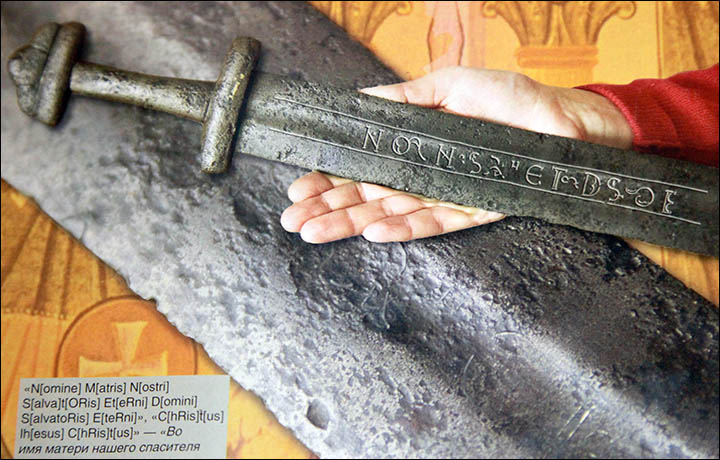
If the sword’s construction was a puzzle, its inscriptions were a direct message from the past. Etched into the steel were runic letters. But they didn’t spell out some pagan curse or a warrior’s name. They spelled out a devout Christian prayer.

The translated text is believed to read: “In the name of the mother of our saviour eternal, eternal Lord and Saviour. Christ Jesus Christ.”

This adds yet another layer of beautiful confusion. It confirms the sword’s Western European, Christian origins. It tells us its owner was not just a warrior, but a man of faith, carrying a blessing into battle. A crusader’s sword, lost on a godless frontier. The weapon was a paradox, a fusion of worlds. It had no business being in Siberia. Yet, there it was.

Enter the Terrible: The Ivan Koltso Connection

For decades, the sword remained a beautiful, unsolvable enigma. Theories were floated. A lost merchant? A lone explorer who met a tragic end? None of it felt right. The sword was too grand, too specific. Then, a new theory emerged. A theory that didn’t just explain the sword’s location, but connected it to one of history’s most infamous tyrants.

The theory points to a specific man and a specific, violent moment in history. The man? A Cossack warlord named Ivan Koltso. The moment? The bloody Russian conquest of Siberia. And the man who set it all in motion? Tsar Ivan IV Vasilyevich. Ivan the Terrible.

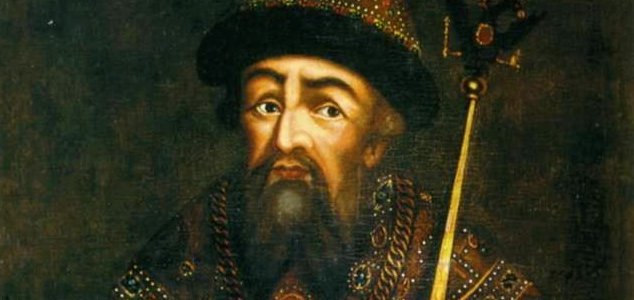
A portrait of Ivan the Terrible.

Deep Dive: Who Was Ivan the Terrible?

You can’t understand the sword without understanding the man. Ivan IV wasn’t just a king. He was a force of nature. A paranoid, brilliant, and deeply cruel ruler who dragged Russia out of the medieval era, kicking and screaming. He was the first to be crowned “Tsar of All the Russias,” and he took the title seriously. He saw enemies everywhere—in the boyar nobles he suspected of poisoning his wife, in the rival kingdoms on his borders, and in his own dark thoughts.

In a fit of rage, he murdered his own son and heir. He created the Oprichnina, a black-clad force of secret police who terrorized the country on his behalf, riding with severed dogs’ heads on their saddles to “sniff out treason.”

But he was also an expander. He was obsessed with pushing Russia’s borders outward. And his gaze fell upon the vast, untamed wilderness to the east. The land of the Tatars. Siberia.

Deep Dive: The Conquest of Siberia, A Bloody Frontier

In the 16th century, Siberia wasn’t the empty space we might imagine. It was the territory of the Khanate of Sibir, a remnant of the once-mighty Mongol Golden Horde. For Russia, it was a lawless frontier and a source of incredible wealth in the form of furs—the “soft gold” that drove European economies.

Ivan wanted it. All of it. But he couldn’t send his regular army. They were busy fighting wars in the west. So he did what powerful rulers have always done. He outsourced.

He turned to the Cossacks. The Cossacks were a semi-nomadic people of the steppes—fierce, independent, and borderline lawless. They were skilled horsemen and brutal fighters, part-pioneer, part-bandit. They were the perfect tool for a dirty job.

Ivan Koltso: The Tsar’s Renegade Ataman

And that brings us to Ivan Koltso. Koltso was a Cossack ataman, or chieftain. And he wasn’t just any ataman; he was a famous outlaw, a river pirate who had once been sentenced to death by the Tsar himself. But Ivan the Terrible was a practical man. He recognized Koltso’s talent for violence and leadership.

In a stunning reversal, the Tsar pardoned Koltso and several other Cossacks. He gave them his blessing to join the legendary Yermak Timofeyevich’s expedition to conquer the Khanate of Sibir. They were no longer outlaws. They were now agents of the Tsar, tasked with breaking an empire in his name.

The Gift of a Tsar: A Sword of Power and Pardon?

Now, imagine you are Ivan the Terrible. You are sending a pardoned pirate to conquer a kingdom for you. You need him to succeed. You also need to remind him who he serves. You don’t just give him a pat on the back. You give him a symbol. A gift of immense value.

Could the Tsar, through his vast trade networks with Western Europe, have acquired this magnificent German and Swedish sword? Could he have presented it to Ivan Koltso as a physical manifestation of his pardon and his authority?

It was more than a weapon. It was a leash. A reminder that Koltso fought not for himself, but for the Tsar in Moscow. Every time he drew that silver-hilted blade, he would be reminded of the power—and the paranoia—of the man who had spared his life and sent him into the wilderness.

The Final Battle: Reconstructing a Lost Moment

This is where the theory becomes a cinematic, brutal reality. Archaeologist Vyacheslav Molodin painted a vivid picture of what might have been the sword’s final moments. Let’s go there.

Picture it. The endless Siberian steppe. A small band of Cossacks, led by Ivan Koltso, is ambushed. They are hopelessly outnumbered by Tatar horsemen. Arrows fill the air. The screams of men and horses echo across the plain.

It’s chaos. Desperation.

Koltso is in the thick of it. He’s not fighting with a standard Cossack shashka. In his hand is the glittering giant sword, the gift from his Tsar. The German steel bites deep, a flash of European death in a sea of Asian warfare. He cuts down one enemy, then another. The silver hilt is slick with blood.

They are trying to break through, to escape the trap. Koltso spurs his horse, fighting his way toward a stand of young birch trees. He’s almost there. His leg is in the stirrup, ready to gallop to safety. But then, it happens. Maybe a Tatar arrow finds its mark, wounding his arm. Maybe his horse stumbles. Maybe in the bloody confusion, his grip simply fails him.

The sword, the priceless gift from a terrible king, falls from his grasp. It tumbles through the air and lands silently in the soft earth at the base of a young tree. There is no time to go back. The fight is for survival now. Koltso escapes, but the sword remains.

Lost. Forgotten.

Slowly, the seasons turn. The tree grows. Its roots creep through the soil, wrapping around the blade, pulling it deeper into the earth’s embrace. A king’s decree, a warrior’s last stand, a moment of violent history—all swallowed by the Siberian silence. Until 1975.

Weighing the Evidence: Fact vs. Fascinating Fiction

Is this story true? It’s impossible to say for certain. There’s no document that reads, “Item #1: One German sword, gifted to Ivan Koltso.” But great historical mysteries are rarely solved with a receipt.

The Arguments For

  • The Timing is Perfect: The sword dates to the 16th century, the exact period of Yermak’s and Koltso’s conquest of Siberia.
  • The Location is Dead On: The Novosibirsk region lies directly on the path of the Cossack advance into the heart of the Khanate of Sibir.
  • The Status is Right: A common Cossack couldn’t afford a weapon like this. But a chief commander, armed by the Tsar? Absolutely. It fits the profile.
  • The Man was Real: Ivan Koltso was a key figure in this specific campaign. He was there. He was fighting. He was leading.

The Lingering Questions

Of course, it’s not a closed case. There is no direct, ironclad proof. It relies on connecting dots. Could the sword have belonged to another high-ranking European mercenary in the Cossack’s service? It’s possible. Could it have been captured from a Tatar who had somehow acquired it himself? Also possible, but less likely given its pristine condition.

The beauty of this theory is that it fits all the known facts in the most compelling way. It provides a motive, a means, and an opportunity. It weaves together the artifact, the place, and the larger-than-life characters of the era into a single, cohesive story.

Modern Echoes and Digital Detectives

In the age of the internet, the mystery of the Siberian sword has found new life. On history forums and Reddit threads, digital detectives pour over the details. Some have pointed out that the Hanseatic League, a powerful Northern European trading confederation, had deep trade links with the Russian state of Muscovy. It would have been entirely possible, even common, for high-end German goods to make their way to the Tsar’s court.

Others have tried to digitally enhance photos of the blade, searching for a minuscule maker’s mark that could link it to a specific smith—perhaps one known to supply arms to royal courts. The search continues, with every new post and comment adding a small piece to the puzzle.

The sword is no longer just a museum piece. It’s a living mystery, actively being debated by a global community fascinated by its impossible journey.

So what are we left with? A single object, now likely resting behind glass in a museum. Its silver handle is tarnished. Its German steel is pitted with the memory of the soil. It is quiet now. But it speaks of an incredible journey across a continent, of the clash of empires on a bloody frontier, and of the terrifying ambition of a paranoid Tsar.

Does the truth of the Siberian sword lie buried with the bones of forgotten Cossack heroes and Tatar warriors? Or is the answer right there in front of us—a direct link, forged in steel and silver, between a lost warlord and Russia’s most feared ruler?

Arindam Mukherjee
Arindam Mukherjee
Arindam loves aliens, mysteries and pursing his interest in the area of hacking as a technical writer at 'Planet wank'. You can catch him at his social profiles anytime.
RELATED ARTICLES
- Advertisment -

Most Popular

Recent Comments

Warren Pan Abbott on The legend of the Devil Monkey !
chris davies on The McPherson Tape Mystery
Reed Reedly on ET has Internet!
Bea Houseoffashion on Proof Of Time Travellers – Gallery
Marcus2012 on ET has Internet!
Reed Reedly on ET has Internet!
LaughsAtConspiracyNuts on The 9/11 Conspiracy – Myths and Facts
Alex Sliverman on Did the ancients fly?
Doctor Wholigan on Time Traveler in 1938 film
chris davies on The McPherson Tape Mystery
Archie1954 on 10 secret UFO hideouts
chris davies on Ghosts of flight 401
Marcus2012 on ET has Internet!
jason Macdonald on Proof of Time Travel? – China
chris davies on Long-Lost Pyramids Found?
Reed Reedly on ET has Internet!
Milkman on Connected Universe
Tenmiles on Baigong Pipes Mystery
Simon Foster on Sirius – The Documentary
From the 1st April on 2013 – Alien Contact date ?
SkyWatcher on Is ET ignoring us?
I Come From The Future on Obama to make UFO Alien disclouser soon ?
Just another person on 2013 – Alien Contact date ?
Malcolm Windowcleaner on The strange case of Rudolph Fentz
Mason Servio on Strange Things on Mars
Marke Wisdom Seeker on What will we find as arctic melts?
Andrea A Elisabeth Levyne on Aliens Captured in Varginha, Brazil
Mitch Grouyeki on Amazing Space Shuttle pictures