Home Weird World Photo Galleries Strange places on Mars! – Gallery

Strange places on Mars! – Gallery

0
63

They Lied About Mars. The Proof Is in the Pictures.

They tell us it’s a dead world. A silent, rust-colored ball of dust and rock, spinning lifelessly through the void. For decades, NASA has beamed back images of this desolate landscape. Stunning, high-definition vistas of craters, canyons, and vast, empty plains.

And we’ve accepted it. We’ve oohed and aahed at the pretty pictures from the rovers. We’ve marveled at the technology.

But have we really been *looking*?

I mean, really looking. Past the official explanations. Past the convenient dismissals of “tricks of light and shadow.” What if, hidden in plain sight within these millions of publicly available photographs, lies evidence of something extraordinary? What if the story of Mars isn’t one of emptiness, but of a catastrophic, forgotten past? What if we’re looking at the graveyard of a civilization?

Forget what you’ve been told. Forget the bland press releases. It’s time to open your eyes. Because the evidence isn’t just compelling. It’s overwhelming.

The Official Story: A Planet of Rocks and Dust?

Let’s get the “official” version out of the way first. NASA, the European Space Agency, and others have sent a fleet of orbiters and rovers to Mars. Machines like the Mars Reconnaissance Orbiter, with its unbelievably powerful HiRISE camera, circle the planet from above, mapping every square inch. Down on the surface, rovers like Spirit, Opportunity, Curiosity, and now Perseverance crawl across the terrain, zapping rocks with lasers and analyzing soil samples.

Their stated mission? To search for signs of past microbial life. Water. The building blocks of biology. They tell us about geology, about ancient riverbeds and dried-up lakes. They talk about the planet’s thin atmosphere and its harsh radiation.

It’s a neat, tidy, and frankly, *boring* story. It’s a story designed to manage expectations. To keep the public placated with sciencey-sounding terms and pretty postcards from another world. But is it the whole story? Not by a long shot.

Pareidolia: The Perfect Cover Story?

Before we go any further, we have to address the killjoy in the room: pareidolia. This is the word the debunkers and government mouthpieces throw around anytime something strange is spotted. It’s the psychological phenomenon of seeing familiar patterns, like faces, in random objects. Seeing a rabbit in the clouds. Seeing the Man in the Moon.

They want you to believe that every anomalous object, every strangely symmetrical structure, every potential artifact found in the NASA photos is just your brain playing tricks on you. It’s a rock. It’s a shadow. It’s a coincidence. Move along, nothing to see here.

And yes, sometimes a rock is just a rock. But when you see dozens, then hundreds, then thousands of objects that look manufactured, symmetrical, and completely out of place in a supposedly natural landscape… does the pareidolia explanation still hold water? Or does it become the most convenient, blanket excuse in history to avoid a truth too terrifying to confront?

The Ghosts of Cydonia: A Face That Launched a Thousand Theories

You can’t talk about Mars conspiracies without talking about the big one. The original. The “Face on Mars.”

The year is 1976. NASA’s Viking 1 orbiter is snapping pictures of a region called Cydonia, scouting for a potential landing site for its sister craft, Viking 2. As the data streams back to Earth, one image—frame 35A72—causes a stir. There, staring up from the Martian surface, is what looks undeniably like a massive, humanoid face. A mile long, with a distinct eye, nose, and mouth, encased in what looks like a helmet or headdress.

NASA quickly dismissed it. A trick of light and shadow. A natural butte, they said, whose features were exaggerated by the low sun angle and the poor resolution of the camera. They released the photo to the public with the caption “head,” almost as a joke.

They weren’t laughing for long.

The “Debunking”: A Higher-Res Photo or a Higher-Level Cover-up?

For over 20 years, the Face on Mars became the poster child for alternative theories about the Red Planet. Researchers like Richard Hoagland argued that the Face was part of a larger complex of artificial structures, including nearby pyramid-like formations they dubbed “The City.” They argued this was clear evidence of a lost Martian civilization.

The calls for new photos grew deafening. Finally, in 1998 and again in 2001, the Mars Global Surveyor and the Mars Odyssey spacecraft took new, higher-resolution images of the feature.

The result? A heavily eroded, lumpy, and decidedly less face-like mesa. Case closed, said NASA. See? We told you it was just a pile of rocks. The debunkers celebrated. The mainstream media reported it as the final word on the matter.

But the anomaly hunters weren’t convinced. They pointed out inconsistencies. Why did the new images seem to be taken from different angles and under different lighting conditions? Some claimed the new data was digitally manipulated, scrubbed of the most obvious artificial features. Was the “clear” photo a deliberate attempt to muddy the waters and kill the controversy? To many, the Cydonia mesa looks *more* like a heavily eroded artificial structure in the new photos than a purely natural formation. The mystery, for those willing to look, was far from over.

Scattered Across the Wasteland: The Curious Case of Martian “Artifacts”

While the Face on Mars may be the most famous anomaly, it’s the smaller discoveries made by internet sleuths combing through the rover archives that are, in many ways, more shocking. These aren’t mile-long monuments. These are small, tangible-looking objects half-buried in the dust, things that have absolutely no business being there.

The Martian “Thigh Bone”

In 2014, the Curiosity rover took a picture that sent shockwaves across the internet. Lying on the ground was an object that looked, for all the world, like a fossilized thigh bone. The shape was unmistakable. The curvature, the ball joint at the top—it was a femur.

NASA’s official explanation came swiftly. It’s a rock. Just a rock that has been sculpted by wind and water erosion into a bone-like shape. A classic case of pareidolia. But is it? The object’s form is so specific, so biologically familiar. How many coincidences are we expected to swallow? What if the rover stumbled upon the last remains of a Martian creature, and the official explanation is just a frantic attempt at damage control?

That Time a “Spoon” Appeared on Mars

It gets weirder. Another image from Curiosity shows a long, delicate structure that looks exactly like a spoon, seemingly hovering or suspended over the ground with a perfect shadow underneath. Again, the official line is wind erosion. But the object has a distinct bowl, a narrow handle… it looks designed. It looks manufactured.

And it’s not alone. People have cataloged hundreds of these anomalies:

  • A “statue” of a Martian queen, resembling an ancient Assyrian sculpture.
  • A “traffic light” with three perfectly circular, stacked objects.
  • A perfect pyramid, small but with uncannily straight edges, spotted by Curiosity.
  • “Metal debris” that looks like a polished, intelligently designed piece of machinery.
  • A “Martian crab” or “spider” that seems to be clinging to the side of a rock face in a cave opening.

One by one, they can be dismissed. But taken together? They paint a picture of a world littered with the refuse of a long-dead civilization. It’s a junkyard. An archaeological site of unimaginable importance, and the rovers are just kicking the dirt, pretending not to see it.

Deep Dive: The Lonely Tracks in the Dust

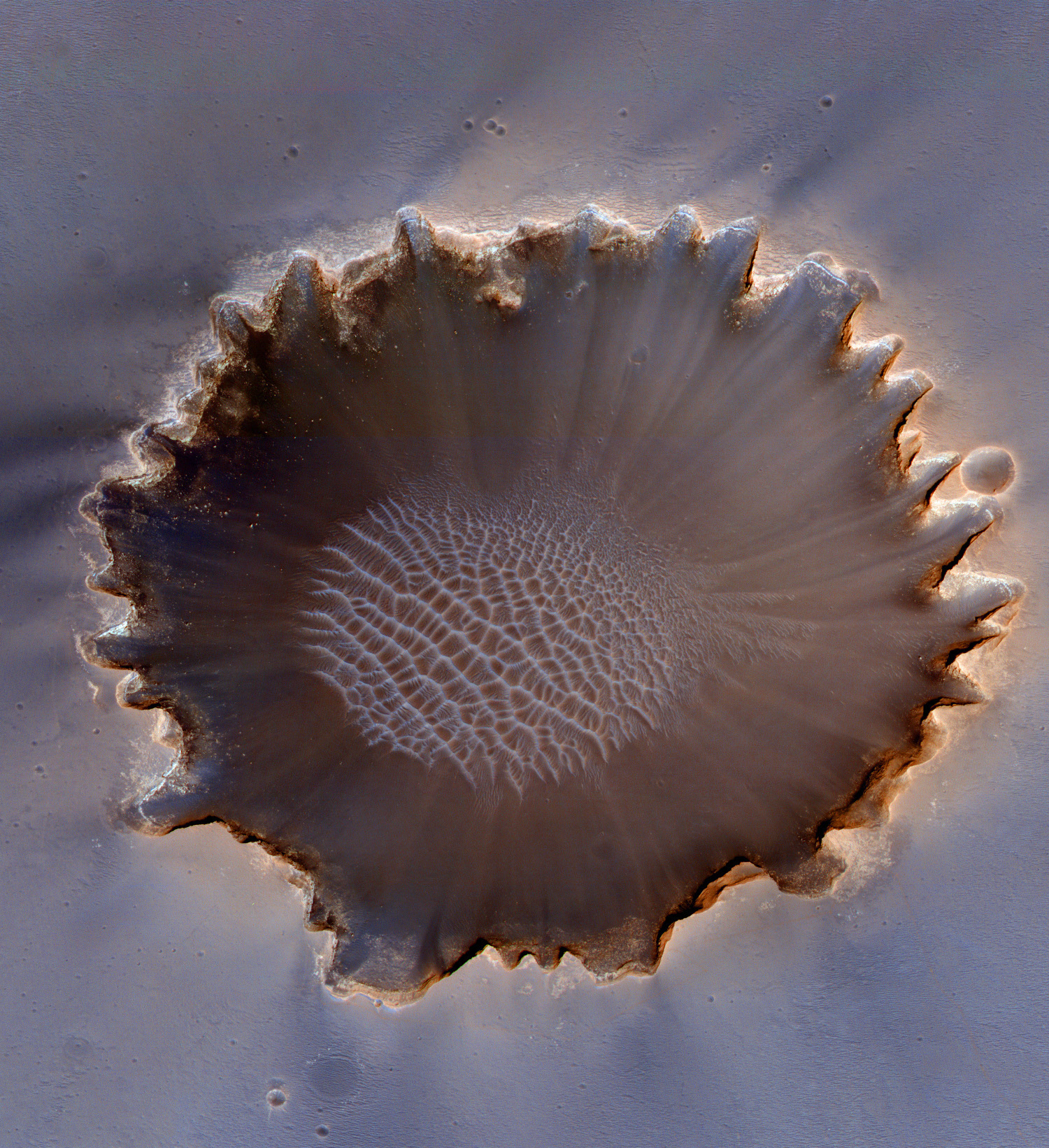
Now, let’s look at the image that started us down this rabbit hole. At first glance, it’s exactly what NASA tells us it is. A beautiful, haunting shot of a crater on Mars. The tracks of the Opportunity rover snake away, a lonely testament to our robotic presence on another world. The scale is immense. The silence is deafening. This is the official story, captured in one perfect photograph.

Tracks from NASA’s Opportunity rover can be seen on the left side of the crater. This image was taken in July 2009 by the High Resolution Imaging Science Experiment (HiRISE) camera on NASA’s Mars Reconnaissance Orbiter.

But now, look at it with new eyes. Forget the rover tracks for a second. Look at the crater itself. Look at the patterns in the rock layers. The official explanation is geology. Eons of wind, water, and impacts. But look at the symmetry. The recurring patterns. Could this be more than a crater? Could we be looking at the eroded remains of a massive, open-pit mine? Or perhaps a collapsed dome of a once-thriving city?

The rover, Opportunity, roamed this area for years. It was designed to last 90 days. It lasted 15 years. What did it really see during that time? We only get to see the sanitized, approved photos. The “interesting” ones. How many pictures of “just rocks” were taken that weren’t released? What might be hidden in the data that we’re not allowed to access? Those lonely tracks might not be a symbol of exploration. They might be a symbol of a crime scene, with the investigator deliberately looking in all the wrong places.

Modern Anomaly Hunters: Are We on the Brink of Discovery?

This isn’t just a game for a few fringe authors anymore. Today, a global army of citizen scientists and anomaly hunters are using powerful software to analyze the images NASA releases. They are sharpening, color-correcting, and zooming in on every single frame.

Communities on Reddit, forums, and YouTube channels are dedicated to this work. They are the ones finding the “spoons” and “bones.” They are cross-referencing old photos with new ones, looking for changes in the landscape that shouldn’t be there. They are using AI-enhancement programs to pull details out of the shadows that were previously invisible.

What this means is that the gatekeepers are losing control of the narrative. NASA can release a photo and call something a rock, but within hours, thousands of people will have analyzed it from every possible angle. The truth, whatever it is, is getting harder and harder to hide. We are on the brink of a citizen-led discovery that could change everything.

The Great Filter: Is Mars a Warning?

Let’s entertain the most chilling possibility for a moment. What if the ruins are real? What if Mars was once like Earth, teeming with life and home to an intelligent, technological civilization?

What happened to them?

This question leads us to the concept of the “Great Filter.” It’s a theory that attempts to explain why we haven’t found evidence of intelligent life in the universe. It suggests that there is some barrier, some filter, that is incredibly difficult for life to overcome. Perhaps that barrier is the leap from single-celled to complex life. Or perhaps… it’s something further down the line. Something that happens after a civilization becomes advanced.

Is Mars a warning? Did the Martians reach a certain level of technology and then destroy themselves through war? Did they exhaust their planet’s resources and choke their own atmosphere? Or did some external, cosmic event—a massive asteroid impact, a solar flare that stripped away the atmosphere—wipe them out in an instant?

Looking at the desolate, ruined landscape of Mars through this lens is terrifying. We’re not just looking at another planet. We could be looking at a vision of our own future.

What Are They Hiding? The Final Question

It all comes down to this: Why would NASA hide it? If they found definitive proof of a past civilization, wouldn’t that be the greatest discovery in human history? Why the cover-up?

The reasons could be complex and terrifying. Perhaps the knowledge is considered too disruptive. How would the world’s religions react to the knowledge that we are not the only, or even the first, children of God in this solar system? How would our economic and political systems handle such a paradigm-shifting revelation? It could cause panic. Chaos. A collapse of the social order.

Or maybe the reason is even darker. Perhaps they know what destroyed the Martian civilization. And perhaps they know that the same threat is still out there, waiting for us.

The answers aren’t going to come from a government press conference. They are buried in the red dust of a silent world, and hidden in the pixels of the very images they so freely give us. They think we’re not looking closely enough. It’s time to prove them wrong.

Originally posted 2016-04-07 00:27:52. Republished by Blog Post Promoter