The Shipton Photo: The Himalayan Footprint That Still Haunts Mainstream Science
Forget what the textbooks and the so-called experts tell you. Forget the neat, tidy explanations they try to sell us. Because high in the thin, frozen air of the Himalayas, something is walking. Something ancient. Something that leaves behind clues so undeniable, so chilling, they’ve defied explanation for over seventy years.
We’re talking about the Yeti. The Abominable Snowman.
And for decades, the skeptics had it easy. They could wave away the stories as local folklore. Hallucinations brought on by altitude sickness. Misidentified bears. Easy. Convenient. But in 1951, one man brought back a photograph that blew all those easy answers to pieces. A single, crystal-clear image of a footprint in the snow. A footprint that belonged to nothing known to science.
That photo should have changed the world. It didn’t. It was filed away under “unexplained.” But the truth has a funny way of refusing to stay buried. Decades later, a quiet, unsuspecting trekker would accidentally stumble upon its perfect twin, a 55-year echo in the mud that proves this mystery is anything but solved.
This isn’t just a story about a monster. This is a story about evidence that won’t die and a cover-up that can’t hold.
Deep Dive: The 1951 Photograph That Ignited a Global Firestorm
To understand the sheer gravity of this mystery, you have to go back. Back to 1951.
The man who took the picture was no crackpot. He wasn’t some wild-eyed sensationalist looking for fame. He was Eric Shipton, one of the most respected and experienced mountaineers of his generation. A legend. When Shipton spoke, people listened. He was leading a reconnaissance expedition on the southwestern face of Mount Everest, charting a new route to the summit.
They were deep in uncharted territory, at about 19,000 feet on the Menlung Glacier. A place where few humans had ever set foot. And that’s when they found them. A line of strange, massive tracks pressed deep into the snow.
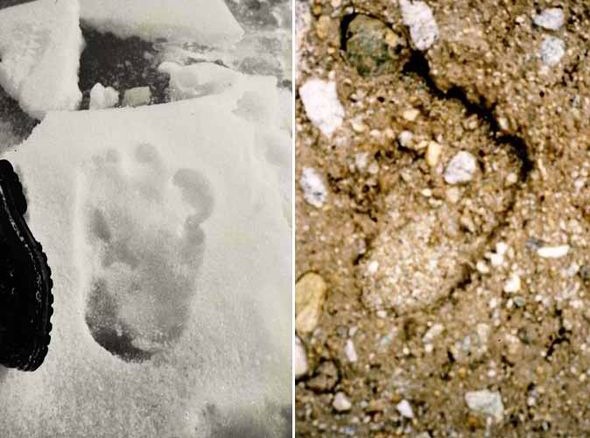
Shipton and his companions, including Dr. Michael Ward, followed the trail for over a mile. The tracks were fresh. They were clearly from a bipedal creature, something walking on two legs. But the size was staggering. The prints were about 13 inches long and nearly 8 inches wide. They showed five distinct toes, with the inner big toe being unusually large and splayed, much like a great ape’s. The heel was broad and flat. It was primate-like. But it was not human.
And it sure as hell wasn’t a bear.
Why It’s Not a Bear (And Why That’s a Problem for Debunkers)
The go-to explanation is always a bear. A Tibetan blue bear or a Himalayan brown bear. They’ll tell you that as the sun melts the snow, a bear’s front and back paw prints can merge, creating a larger, distorted “humanoid” track. It sounds plausible, right? A neat little bow to tie on the mystery.
Except it’s garbage. Here’s why:
- Individual Toes: Shipton’s photo shows distinct, well-defined toes. You can count them. The sun-melting theory would create a blurred, indistinct blob, not a crisp anatomical imprint.
- The Splayed “Thumb” Toe: Look at the print. The big toe is set apart from the others, almost like a thumb. This is a classic feature of non-human primates, used for grasping. No bear has a toe structure like that. Not even close.
- Bipedal Trail: Shipton and his team followed the tracks for a mile. A bear might stand on two legs for a moment, but it doesn’t walk bipedally for a mile through deep snow. It’s a quadruped. The trail they followed was from something that walked on two legs as its primary mode of transportation.
Shipton, an expert outdoorsman who knew the local wildlife inside and out, was baffled. He took several photographs, placing his ice axe next to one of the prints for scale. That photograph would become iconic. It was proof. Tangible evidence of a massive, unknown primate living in the world’s highest peaks.
It lit a fire under the global imagination. The hunt for the Yeti was on.
A 55-Year Echo in the Mud
Now, fast forward. 55 years. The year is 2006.
The world has changed. The internet is booming. The Yeti has become more of a pop-culture joke than a serious subject of inquiry. The “experts” have declared the case closed, a cocktail of folklore and misidentified bears.
Enter Mike Rees. A 73-year-old retired computer engineer from Wales. A practical man. Not a monster hunter. He and his wife, Joyce, were simply enjoying their fourth trekking adventure in Nepal. They weren’t looking for mysteries. They were there for the stunning vistas and the crisp mountain air.
They were on a quiet, little-used route in the Khumbu region, near the village of Machermo—the very same general region where Shipton made his discovery. They were walking near their camp after dinner when Joyce pointed at the ground.
“That’s something interesting,” she said.

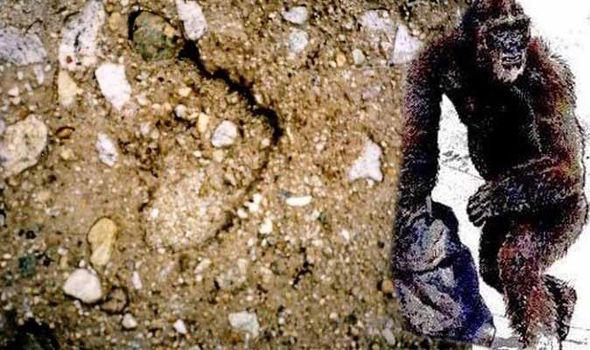
There, pressed into the damp mud, was a footprint. A single, massive, deeply unsettling footprint. It was huge. Humanoid. But distinctly not human. Mike, intrigued but not thinking much of it, snapped a picture. Just a holiday photo. A curious souvenir. “Everyone else laughed at us and joked about it,” he later recalled. Another Yeti tale for the tourists.
They thought nothing more of it. Not until they got home.
The Jaw-Dropping Realization Back Home
It was only when the film was developed that the penny dropped. And it dropped hard.
As Mike began reading books about Everest and the history of Himalayan exploration, a familiar image kept appearing. The 1951 Shipton photograph. He saw it again and again. And a chilling sense of recognition began to creep in.
He pulled out his own photo. The one from the mud near Machermo.
He put them side-by-side.
It was impossible. But there it was.
They were identical. Not just similar. Identical. The same size. The same shape. The same impossibly wide spread of the toes. The same prominent, thumb-like big toe set apart from the others. The same broad heel. It was a perfect match to the legendary print found by Eric Shipton, fifty-five years earlier, in the same remote corner of the world.
“We got books on Everest and they all contained the stories about the Yeti,” Mike said. “The closer we looked we just thought ‘wow’ our photo looks exactly the same as that footprint… It had to be the same, it’s the same size and shape, there’s no doubting it, it looks almost identical.”

What are the odds? Think about that. What are the chances of two men, separated by more than half a century, independently photographing the exact same type of anomalous footprint belonging to an unclassified creature? A footprint that has never been scientifically explained.
This isn’t a coincidence. This is a pattern. This is evidence of a species. A hidden, elusive species that has somehow remained a ghost, a whisper in the mountains. A ghost that occasionally leaves its calling card pressed into the earth.
The “Official” Story That Explains Nothing
Mike Rees kept his photo private for years. But then, around 2013, the mainstream media began running headlines that the Yeti mystery had finally been “solved.” A geneticist from Oxford, Bryan Sykes, had conducted DNA analysis on hair samples purported to be from Yetis.
His conclusion? The samples were a genetic match for an ancient species of polar bear, suggesting that the Yeti was likely just a local species of bear, possibly a hybrid.
The media ate it up. The mystery was over! Pack it up, folks. Nothing to see here. Just a bear.
This “official” explanation is what prompted Mike Rees to come forward. He knew what he had photographed. And he knew it wasn’t a bear.
The “DNA solution” is a classic case of misdirection. A convenient answer that ignores the most compelling evidence. How does DNA from a handful of questionable hair samples—samples that could have come from anywhere or anything—explain away these massive, bipedal, non-bearlike footprints? It doesn’t. It’s a scientific sleight of hand designed to make the uncomfortable questions go away.
They want you to focus on the blurry photos and the questionable hair. They don’t want you to look at the crisp, clear footprints. Because the footprints tell a different story. They point to something far stranger than a misidentified bear.
So, What Is Walking in the Himalayas?
If it’s not a bear, and it’s not human, what is it? The possibilities are mind-bending, and each one takes us deeper down the rabbit hole.
Theory 1: The Relic Hominoid – Gigantopithecus Lives?
This is the leading theory among cryptozoologists. Gigantopithecus blacki was a real-life giant ape, the largest primate that ever lived. Standing up to 10 feet tall and weighing over 1,000 pounds, it roamed the forests of Asia for millions of years. Its fossilized teeth and jawbones have been found in China and Vietnam. Conventional science says it went extinct around 300,000 years ago.
But what if it didn’t?
What if a small population survived? What if they were pushed from their shrinking forest habitats higher and higher into the remote mountain ranges of the Himalayas, adapting to the cold and the altitude? An ape of that size would leave a footprint exactly like the ones Shipton and Rees photographed. It’s a creature that fits the description perfectly: a massive, bipedal ape. The ultimate missing link, hiding in the last truly wild place on Earth.
Theory 2: The Undiscovered Primate
Perhaps it’s not a relic from the past, but something new entirely. The Himalayas are a massive, largely unexplored biological island. We are still discovering new species of mammals, birds, and plants there. Is it really so impossible that a large, intelligent primate could have evolved in isolation, perfectly adapted to its high-altitude environment?
A creature that is smart enough to avoid us. Cautious enough to remain hidden. And strong enough to survive in the harshest conditions on the planet. Its population might be tiny, explaining the rarity of sightings and physical evidence. It would be the zoological discovery of the millennium.
Theory 3: The Paranormal Angle
And then there’s the fringe. The place where high strangeness bleeds into cryptozoology. Some local Sherpa legends don’t describe the Yeti as a simple flesh-and-blood animal. They speak of it as a supernatural entity, a guardian of the mountains. A creature that can appear and disappear at will. Some modern paranormal researchers have even linked Yeti sightings to UFO activity and other strange phenomena in the region, suggesting it may not be an animal at all, but something… else. An interdimensional being? A thought form? It’s a wild idea, but in a mystery this deep, can any possibility truly be dismissed?
The Hunt Goes Digital
Today, the search for the Yeti is no longer confined to daring mountaineers. A new generation of digital sleuths are scouring the Himalayas from their keyboards. Using Google Earth and high-resolution satellite imagery, they pour over every ridge, every valley, every shadow, looking for anomalies.
Online forums buzz with chatter about strange heat signatures picked up by satellites in the Khumbu region, or pixelated shapes moving across inaccessible glaciers. The next great piece of evidence might not be a footprint in the snow, but a single frame of satellite footage or a strange data point that can’t be explained.
The evidence is there. It’s scattered across time, from Shipton’s photograph in 1951 to Mike Rees’s echo in 2006, and into the digital data streams of today. The footprints are too clear, too consistent, and too strange to be a hoax or a mistake.
They are the marks of something real.
The official story—the easy answer of sun-melted bear tracks—is no longer enough. It’s an insult to the evidence and to the men who risked their lives in those mountains and brought back proof of what they saw. Mike Rees’s photograph isn’t just a holiday snap. It’s a vital piece of a 70-year-old puzzle. It’s a corroboration. It’s a message from the past, proving that whatever Eric Shipton saw in 1951 is still out there. Still walking. Still leaving its impossible tracks for those lucky, or unlucky, enough to find them.
The only question left is: What is it?