The City That Should Not Exist: Inside the World’s Largest Modern Ruin
Imagine a metropolis. A gleaming, futuristic titan of steel and glass rising out of the desert. It has everything. Skyscrapers that scrape the clouds. Museums that look like crashed alien spaceships. Massive sports stadiums ready for Olympic crowds. Six-lane highways smooth enough to skate on.
Now, imagine that same city with one thing missing.
People.
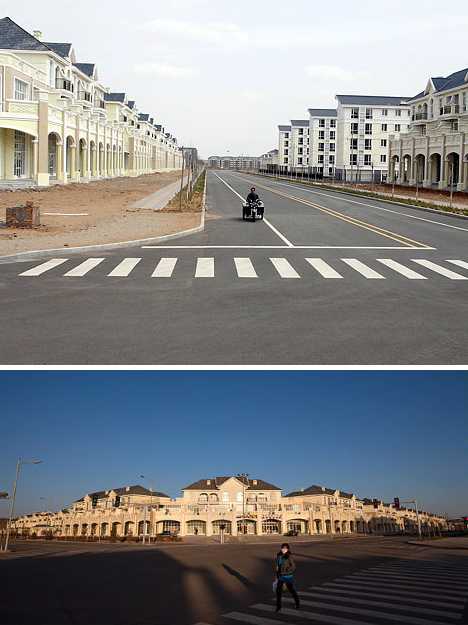
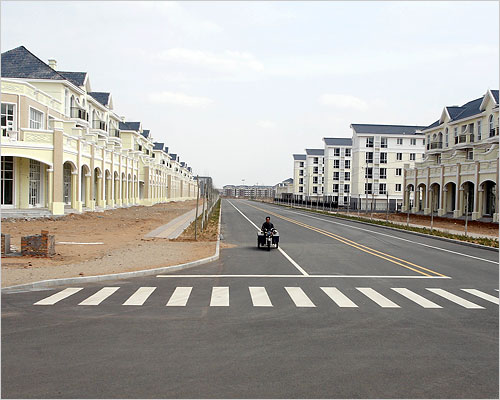
Silence. Absolute, crushing silence. The traffic lights change from red to green, directing cars that aren’t there. The street sweepers clean dust off sidewalks no one walks on. It feels like the set of a post-apocalyptic movie, but nothing has been destroyed. Everything is brand new. It is waiting. But for who?
Welcome to Ordos.

Specifically, this is the Kangbashi district of Ordos, located deep in the Inner Mongolia Autonomous Region of China. For years, this place has baffled economists, frightened tourists, and fueled some of the wildest internet theories you can imagine. It is the ultimate Ghost City. A monument to human ambition, or perhaps, human hubris.
But why is it here? Why did China pour billions of dollars into a sandbox? And is it still empty today?
Buckle up. We are going to dig deep into the mystery of the empty metropolis.
The Black Gold Rush: How It All Started
To understand the ghost town, you have to understand the dirt it sits on. We aren’t talking about sand. We are talking about coal. Vast, endless oceans of coal.
About twenty years ago, this region was nothing but sleepy farming villages and the endless Gobi winds. Then, they found the minerals. Specifically, they found about one-sixth of the entire coal reserves of China sitting right under the grass.
Boom.
Overnight, peasants became millionaires. It was the Beverly Hillbillies story on steroids. Local farmers sold their land rights to mining conglomerates and suddenly found themselves sitting on mountains of cash. We are talking about people who had never owned a car suddenly buying fleets of Land Rovers and Ferraris. At one point, Ordos had more Range Rovers per capita than almost anywhere else on Earth.
The local government was swimming in tax revenue. They had more money than they knew how to spend. So, they decided to do something massive. They wouldn’t just fix up the old city of Dongsheng (which was getting crowded and dirty). No.
They would build a Utopia.
They sketched out a plan for a new city center—Kangbashi—that would rival Dubai. It was designed to house, entertain, and employ over one million people. They broke ground with a fury that only a centralized superpower can muster. Towers went up in weeks. Entire suburbs materialized out of the dust.
But there was a catch. A big one.

The Great Disconnect: A City Without a Soul
Here is where the logic falls apart. You can build a house, but you cannot force a home.
The developers and the government built the hardware: the roads, the water pipes, the power grids, the luxury condos. But they forgot the software: the jobs, the schools, the grocery stores, the community.
The “Build it and they will come” philosophy failed hard. By 2010, the projected population was supposed to be booming. Instead, visitors reported a scene straight out of The Twilight Zone. You could walk down the center of the main boulevard at noon on a Tuesday and not see a single soul. You could scream at the top of your lungs in the central plaza and hear nothing but your own echo bouncing off the empty government buildings.
The Real Estate Casino
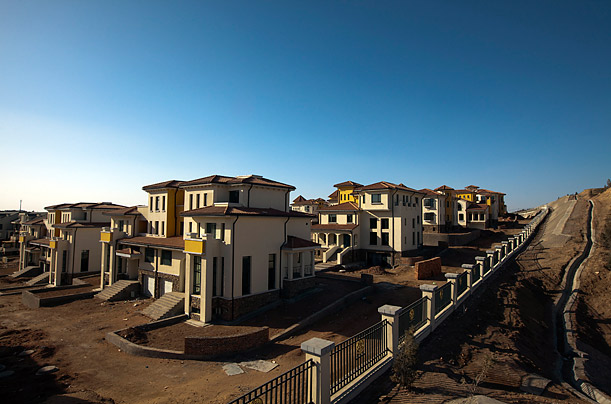
So, who bought these houses? Because, make no mistake, the houses were sold. Almost all of them.
This is the weird economic twist. The properties in Ordos were snapped up by wealthy investors—mostly those coal-rich locals—as a place to park their cash. In China, the stock market can be volatile, and moving money overseas is difficult. Real estate is king.
People bought five, ten, twenty apartments. Not to live in. Not to rent out. But to hold. They were “storage units for wealth.”
The result? A city of owned, but empty, shells. At night, you would look up at a 30-story apartment tower and see maybe two lights on. The rest was a dark monolith blocking out the stars.
Walking on Mars: The Alien Architecture
If you visit Kangbashi, the first thing that hits you is the architecture. It doesn’t look like a normal city. It looks like a sci-fi concept artist’s fever dream.
The government hired prestigious international architects to design the public buildings, and they went wild. They had unlimited budgets and zero constraints.
The Ordos Museum: This is the crown jewel of weirdness. It looks like a giant, amorphous metal blob—some say a bean, others say a crash-landed UFO—plunked down in the middle of the desert. It has no straight lines. It is wrapped in polished metal tiles that reflect the harsh sun. Inside, it is a cavernous maze of white curves. For years, it was filled with dinosaurs and fossils, but no visitors.
The Library: Designed to look like three tilting books on a shelf. It is massive. It holds thousands of volumes. But for a long time, the only sound inside was the hum of the air conditioning keeping the books from rotting.
Genghis Khan Plaza: A sprawling square, larger than Tiananmen Square in Beijing. Enormous statues of horses and Mongolian warriors loom over… nothing. Just vast expanses of stone pavers.
It is beautiful. It is impressive. And it is terrifyingly lonely.

The Conspiracy Files: What Are They Hiding?
Whenever you have a project of this scale that fails this badly, the internet starts asking questions. Dark questions.
Why keep building? Even after it was clear no one was moving in, the cranes kept turning. The trucks kept pouring concrete. Why?
Theory 1: The GDP Hack
This is the most plausible economic theory. In China, local officials are promoted based on GDP growth. How do you juice your GDP numbers? You build stuff. It doesn’t matter if the stuff is useful. If you spend a billion dollars building a bridge to nowhere, that’s a billion dollars added to the GDP.
Ordos might be the ultimate example of “fake growth.” A paper tiger made of concrete. It creates jobs for construction workers and boosts the numbers for the politicians, creating an illusion of prosperity that hides a hollow core.
Theory 2: The Prepper Stronghold
Here is where we get into the “tinfoil hat” territory. Some forum dwellers and conspiracy theorists have suggested that these inland ghost cities aren’t meant for us. Not for the public.
Look at the location. Inner Mongolia is deep inland. Far from the coast. Far from potential naval invasions. High altitude. Stable geology.
Is Ordos a contingency plan? A massive shelter for the elite in case of a coastal catastrophe, war, or rising sea levels? The infrastructure is there. The power is there. The water is there. It’s a turnkey city waiting for a population transfer. If Beijing or Shanghai were to fall, the government could retreat to the impregnable fortress of the Ordos Loop.
Theory 3: The Military Decoy
Satellite imagery enthusiasts have spotted strange grid patterns in the deserts near Ordos. Some claim the empty city layouts are used for military calibration or target practice simulations. While this is likely a confusion with other sites, the emptiness of the region makes it a prime spot for things the government doesn’t want seen.
The Modern Update: Is It Still a Ghost Town?
So, that was the story five, ten years ago. The media loved it. “China’s Empty City!” it screamed from every headline.
But time moves differently in China. The story has shifted.
In recent years, the “Ghost City” has started to wake up. But not naturally. It was forced awake. The local government realized they had a PR disaster on their hands. They couldn’t let the city rot.
So, what did they do? They used the ultimate weapon: Education.
They took the best high schools and middle schools from the old, crowded city of Dongsheng and physically moved them to the empty Kangbashi district. In China, parents will do anything for their child’s education. If the good school moves 20 miles away, the family moves 20 miles away.
It worked. Sort of.
Thousands of “education migrants” flooded in. Apartments filled up with students and grandmothers taking care of them. The lights started turning on. Restaurants opened to feed the students. A pulse began to beat.
Today, Ordos is not the total ghost town it was in 2012. It has a population. It has traffic jams during school pickup hours. But it still feels… off.
The population is maybe 150,000 to 200,000 people. The city was built for a million. That means for every one person you see, there is space for four or five more who aren’t there. You still have entire blocks of empty towers. You still have wide avenues with only a trickle of cars.
It is a city living at 20% capacity. It is a partially animated corpse.
The Warning from the Desert
Ordos stands as a bizarre monument to a specific moment in history. A moment when money was cheap, ambition was limitless, and planning was divorced from reality.
It challenges our idea of what a city is. Is a city just roads and buildings? Or is it the people? Without the chaos, the noise, the trash, and the humanity, Ordos feels less like a city and more like a computer circuit board waiting for electricity.
If you ever get the chance, go there. Walk the Genghis Khan Plaza at sunset. Watch the long shadows stretch across the empty pavement. Listen to the wind howl through the gaps in the high-rises.
It is a feeling you will never forget. The feeling of being small. The feeling of looking at a future that arrived too early, and is still waiting for the rest of us to catch up.
Was it a mistake? A conspiracy? Or just a dream that got too big?
The empty windows aren’t answering. They are just watching.
Originally posted 2016-03-07 04:27:56. Republished by Blog Post Promoter
![ordos-ghost-town[1]](https://coolinterestingnews.com/wp-content/uploads/2012/07/ordos-ghost-town1.webp)