Saturday, June 6, 2026
HomeUnexplained MysteriesAncient MysteriesStrange out of place and time discoveries

Strange out of place and time discoveries

Forbidden History: The Impossible Artifacts That Tear Up The Timeline

The history they teach you in school is a neat, tidy story. It flows in a straight line. Stone tools. The Bronze Age. Iron. Empires rise and fall. Eventually, us. Simple, right?

Wrong.

What if that clean timeline is a lie? What if it’s a carefully curated fairy tale, designed to hide the uncomfortable, the impossible, the things that just don’t fit? All across the globe, buried in ancient rock and hidden in dusty museum archives, are objects that spit in the face of accepted history. They are the glitches in the matrix. The artifacts that scream of forgotten technologies, lost civilizations, and a past far more advanced and bizarre than we were ever taught to believe.

They call them Out-of-Place Artifacts, or OOPArts. And they are the smoking gun.

These aren’t just slightly unusual arrowheads. We’re talking about precision-machined objects found in geological strata millions of years old. We’re talking about evidence of nanotechnology from a time when our ancestors were supposedly chipping away at rocks in caves. Mainstream science either ignores them or scrambles to create flimsy “explanations” that fall apart under the slightest pressure. But the questions remain, nagging at the edges of our reality.

Forget what you know. It’s time to look at the evidence they tried to bury. Let’s dig in.

The 100,000-Year-Old Vase Blasted from Solid Rock

Imagine this. It’s 1851 in Dorchester, Massachusetts. A crew of miners is blasting their way through solid puddingstone rock. It’s hard, back-breaking work. After a particularly powerful explosion clears a massive section of stone, the dust settles. And there, amidst the rubble, are two pieces of a metal vase. Perfectly split in half by the blast.

This wasn’t on the surface. It wasn’t in the dirt. It was inside 15 feet of solid rock. Rock that geologists estimate is over 100,000 years old.

A Dynamite Discovery and an Impossible Object

The story was so incredible it was picked up by Scientific American. They described the object in stunning detail. It was a bell-shaped vase, about four and a half inches high. It was made of a strange alloy, a mix of zinc and silver, with a color reminiscent of pewter. But the most stunning part was the decoration. The sides of the vase featured six exquisite figures of flowers, a bouquet, all beautifully inlaid with pure, shimmering silver.

Think about that. Who, 100,000 years ago, was working with zinc and silver alloys? Who possessed the metallurgical skill and artistic finesse to create such a delicate and beautiful object? According to our history books, humans at that time were primitive hunter-gatherers. They weren’t supposed to be master metalworkers.

The Skeptics’ Corner vs. The Uncomfortable Truth

Of course, the debunkers came out in force. Their best guess? It was a modern candlestick holder or pipe holder from the Victorian era. They claim it must have been on the ground nearby and simply got mixed in with the rubble from the blast. It’s a convenient theory. Too convenient.

The original reports from the workmen were clear: they saw it come out of the solid rock. The rock itself was a solid conglomerate, not loose soil. To believe the official explanation, you have to believe that multiple eyewitnesses all lied or were simultaneously mistaken about the single most incredible moment of their lives. And what happened to this impossible vase? Like so many of these inconvenient truths, it has vanished. Gone from the museum where it was last housed, leaving only the newspaper clippings and the bone-chilling questions behind.

A 21-Million-Year-Old Screw That Shouldn’t Exist

Let’s jump forward a few years, to 1865. We’re in Treasure City, Nevada, at the Abbey Mine. A miner pulls a chunk of feldspar from deep within the earth. As he examines the rock, his blood runs cold. Embedded within the crystalline structure of the stone, he sees something impossible.

A screw.

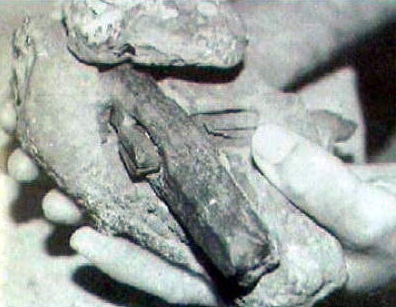
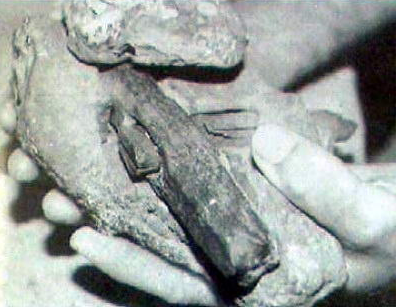
It was about two inches long. The metal itself had long since oxidized, turned to rust, but its perfect form remained imprinted in the feldspar. You could clearly see the tapered point, the head, and most importantly, the fine, precise threads of the screw.

Proof of a Lost Industrial Age?

The problem? The feldspar it was found in was dated to be 21 million years old. Twenty. One. Million.

A screw is not a natural object. It is a symbol of complex manufacturing. To make a screw, you need to understand metallurgy. You need to understand physics. You need precision tools capable of cutting a perfect, continuous helical thread. This single object suggests an industrial society existed on Earth millions of years before the first apes even started walking upright.

Hoax or Hard Evidence?

Skeptics immediately tried to explain this away. Their favorite theory is that the object wasn’t a screw at all, but the fossilized shell of an ancient sea creature, perhaps a Turritella or a crinoid stem, which can have a spiral shape. But this explanation feels lazy. The original report, made by people who saw the object with their own eyes, didn’t describe a “spiral fossil.” They described a “screw.” They saw its form, its threads, its distinct mechanical shape. Did they not know the difference between a seashell and a piece of hardware?

Like the Dorchester Vase, the Treasure City Screw has conveniently disappeared. We are asked to trust the dismissive explanation of a scientist who never saw it, over the eyewitness account of the person who held it in their hand. Are you seeing a pattern here?

300,000-Year-Old Nanospirals: Ancient Aliens or Forgotten Humans?

This next one is a real mind-bender. Between 1991 and 1993, gold prospectors were working the Narada river in the Ural Mountains of Russia. As they sifted through the silt and gravel, they started finding something… odd. Tiny, perfectly formed, spiral-shaped objects.

And when I say tiny, I mean it. Some of these objects were as small as 1/10,000th of an inch. Barely visible to the naked eye. They were so small, and so perfectly made, that they looked like they could only have been created with incredibly advanced technology. Nanotechnology.

The Tungsten Problem

Researchers at the Russian Academy of Sciences in Moscow analyzed these strange artifacts. What they found only deepened the mystery. The larger spirals were made of copper. But the smaller ones? They were composed of tungsten and molybdenum.

This is where it gets truly wild. Tungsten has an extremely high melting point of 3,422 °C (6,192 °F). You can’t just melt it down in a campfire. The industrial production of tungsten is a modern invention. Molybdenum is also a rare metal with a high melting point. These materials are used today in hardening steel alloys, filaments for light bulbs, and missile parts. They are the components of high technology.

And yet, here they were, in the form of microscopic, machine-made spirals, found in a geological layer dated between 20,000 and 318,000 years old. Who on Earth had this technology 300,000 years ago?

Mainstream Dismissal and Lingering Mysteries

The “official” story is almost laughable. Skeptics claim these are just industrial waste from nearby Russian rocket factories, somehow washed into the river. But this explanation completely ignores a key fact: the depth at which they were found. They were discovered in layers of gravel three to twelve meters down, in strata that correspond to the ancient Pleistocene epoch. This wasn’t surface contamination. This was something ancient, buried deep in the timeline where it absolutely does not belong.

Suppressed History: The Egyptian Tombs and Giants of the Grand Canyon

For decades, whispers and rumors have circulated about a shocking discovery in one of America’s most famous landmarks. The story goes that deep within the sheer rock walls of the Grand Canyon lies an enormous, man-made cave system filled with artifacts of an Egyptian or Tibetan origin.

The most famous account comes from a front-page story in the April 5, 1909 edition of the *Arizona Gazette*. It details the alleged discoveries of an explorer named G.E. Kincaid, who claimed to be working for the Smithsonian Institution. Kincaid said he found a vast citadel, carved from solid rock, nearly a mile underground. Inside, he described finding countless rooms, workshops, and granaries filled with seeds. He also found copper weapons, stone tablets covered in hieroglyphics, and, most chillingly, a crypt filled with mummies.

Giants in a Forbidden Zone

These weren’t ordinary mummies. According to the story, and another one from a Dr. F. Bruce Russell in 1931 about tunnels in nearby Death Valley, the bodies were of giants. Men well over eight or even nine feet tall, wrapped in dark cloth.

The area where Kincaid made his supposed discovery is notoriously hard to access. It’s a restricted, government-controlled area. Even the place names in the region hint at the mystery: names like the Tower of Ra, Horus Temple, Osiris Temple, and Isis Temple pepper the canyon maps. Coincidence?

The Smithsonian’s Wall of Silence

Here’s the kicker. When modern researchers ask the Smithsonian about Kincaid’s expedition, they hit a brick wall. The Smithsonian claims to have absolutely no records of any explorer named G.E. Kincaid. They deny the entire story. They say it never happened.

So what is the truth? Was this an elaborate newspaper hoax from over a century ago? Or was it the leak of a discovery so profound, so history-shattering, that a powerful institution had to erase it from existence? A discovery that proved a civilization of giants, with connections to ancient Egypt, existed in the Americas long before any accepted timeline? If they’re hiding this, what else are they hiding?

Before the Dinosaurs: The 300-Million-Year-Old Toolkit

Let’s go back. Way back. To a time before the dinosaurs even existed. The Carboniferous Period, 300 million years ago.

In 1786, French quarrymen were extracting limestone. As they dug deeper, about 50 feet below the surface, they broke through the limestone into a layer of ancient sand. And in that sand, they found things that should not have been there.

They found stumps of stone pillars. They found fragments of half-worked rock, clearly shaped by tools. As they kept digging, they found coins. Then, the petrified wooden handles of hammers and other tools.

Let that sink in. A worksite. With pillars, tools, and coins. In a sand bed sealed beneath a layer of 300-million-year-old rock. Our history books tell us complex life was just barely getting started on land. There were giant insects and amphibians. There were certainly no humans. No one to quarry stone, mint coins, or swing a hammer.

This account is old, and therefore easy for mainstream historians to dismiss. There are no artifacts to point to in a museum. But the report from the time was clear. It describes a scene that completely obliterates our understanding of the ancient world. Was it a civilization of non-humans? Time travelers? Or is the geological timeline we rely on so trustingly completely, and utterly, wrong?

The evidence is there, if you’re willing to look. These aren’t isolated incidents. They are pieces of a puzzle that show a radically different picture of our past. A past filled with impossible technology, forgotten peoples, and secrets buried deep in the Earth. Every one of these artifacts is a crack in the foundation of official history. And you have to wonder… if you pull on one of these threads, how much of their story will unravel?

Amit Ghosh
Amit Ghoshhttps://coolinterestingnews.com
Aloha, I'm Amit Ghosh, a web entrepreneur and avid blogger. Bitten by entrepreneurial bug, I got kicked out from college and ended up being millionaire and running a digital media company named Aeron7 headquartered at Lithuania.
RELATED ARTICLES
- Advertisment -

Most Popular

Recent Comments

Warren Pan Abbott on The legend of the Devil Monkey !
chris davies on The McPherson Tape Mystery
Reed Reedly on ET has Internet!
Bea Houseoffashion on Proof Of Time Travellers – Gallery
Marcus2012 on ET has Internet!
Reed Reedly on ET has Internet!
LaughsAtConspiracyNuts on The 9/11 Conspiracy – Myths and Facts
Alex Sliverman on Did the ancients fly?
Doctor Wholigan on Time Traveler in 1938 film
chris davies on The McPherson Tape Mystery
Archie1954 on 10 secret UFO hideouts
chris davies on Ghosts of flight 401
Marcus2012 on ET has Internet!
jason Macdonald on Proof of Time Travel? – China
chris davies on Long-Lost Pyramids Found?
Reed Reedly on ET has Internet!
Milkman on Connected Universe
Tenmiles on Baigong Pipes Mystery
Simon Foster on Sirius – The Documentary
From the 1st April on 2013 – Alien Contact date ?
SkyWatcher on Is ET ignoring us?
I Come From The Future on Obama to make UFO Alien disclouser soon ?
ÛñK?øWn on 2013 – Alien Contact date ?
Just another person on 2013 – Alien Contact date ?
Malcolm Windowcleaner on The strange case of Rudolph Fentz
Mason Servio on Strange Things on Mars
Marke Wisdom Seeker on What will we find as arctic melts?
Andrea A Elisabeth Levyne on Aliens Captured in Varginha, Brazil
Mitch Grouyeki on Amazing Space Shuttle pictures