Argentina’s Lost City: The Drowned Ghost Town of Villa Epecuén
What if a city died? Not slowly, withering over decades of economic decline. But all at once. Drowned. Submerged beneath a churning, angry tide, erased from the map as if it never existed.
This isn’t the plot of a disaster movie. It’s not a myth from a forgotten age. This happened. In our lifetime. In Argentina, there is a place where skeletal trees claw at the sky and the skeletons of buildings stand as silent monuments to a life that was violently stolen. A modern-day Atlantis, swallowed by water and then spit back out, scarred and broken, for the world to see.
This is the story of Villa Epecuén. Argentina’s saltwater Pompeii.

The Rise of a Saltwater Paradise
To understand the tragedy, you first have to understand the dream. Villa Epecuén wasn’t just any town. It was a promise. A jewel nestled on the shores of Lago Epecuén, a massive salt lake more than 600 kilometers southwest of Buenos Aires.
This wasn’t ordinary water. Lago Epecuén has salt levels over ten times higher than any ocean on Earth. Its only real rival is the Dead Sea. And just like the Dead Sea, legends swirled around its supposed therapeutic properties. The water was said to be a miracle cure. People believed it could soothe depression, ease skin conditions, calm rheumatism, and even combat diabetes. The high salinity made floating effortless, a buoyant, otherworldly experience for weary travelers.
In the 1920s, the dream began to take shape. A railway line connected this remote location to the bustling capital. What was once a sleepy outpost exploded into a world-renowned tourist destination. Hotels, guesthouses, and spas sprung up along the shore. Streets were laid. A community was born.
A Golden Age of Healing and Holidays
By the 1970s, Villa Epecuén was in its golden age. It was the place to be. Over 25,000 visitors would flock here each season, from November to March. The town boasted nearly 300 businesses. Hotels, restaurants, ice cream parlors, souvenir shops. Life was good. The permanent population swelled to over 1,500 people, all living and working in this unique saltwater paradise.
They built their lives on the promise of the lake. Generations of families ran the local businesses. Children grew up on the salty shores. They thought it would last forever. They were wrong.
The Gathering Storm: Nature’s Unheeded Warnings
Nature doesn’t always strike without warning. Sometimes, it whispers. Then it speaks. Then it screams. For years leading up to the disaster, the whispers were there for anyone willing to listen.
The 1980s brought a change in the weather. A historically wet weather pattern settled over the pampas. Rain fell. And fell. And kept falling. The system of six interconnected lakes, with Lago Epecuén at the very bottom, began to swell. The water level in the great salt lake started to rise, slowly but relentlessly. Year after year, it crept higher.
Residents grew nervous. They had built a four-meter-high earthen dike to protect their town, their homes, their very existence. Surely it would be enough. Government officials assured them it was fine. But every heavy rainfall was a reminder of the immense power simmering just beyond the wall.
Was it just bad luck? A freak weather event? Or was there more to the story? Some today question the engineering of the time. Whispers on internet forums suggest cost-cutting measures on provincial infrastructure projects were common. Could the dike have been built stronger? Was the town’s safety gambled away for the sake of a budget? The truth, like the town itself, is buried under layers of history and mud.
Then came November 10, 1985. The day the screaming started.
The Day the World Washed Away
A ferocious storm, a seiche, whipped the lake into a frenzy. A seiche isn’t a normal wave. It’s a standing wave, a massive surge of water that sloshes back and forth in an enclosed body of water like a bathtub. The power was immense. It slammed into the earthen dike again, and again, and again.
And then, the dike broke.
It wasn’t a Hollywood-style tidal wave. It was something almost more terrifying. It was a slow, deliberate, unstoppable invasion. Salt water, thick and heavy, poured over the broken wall. It filled the lowest-lying streets first. Ankle deep. Then knee deep. Residents scrambled to save what they could, stacking furniture on tables, putting precious belongings on the highest shelves.
They thought it would stop. They prayed it would stop.
It didn’t. The water kept rising about a centimeter an hour. Panic set in. A frantic, two-week evacuation began. People fled with only what they could carry, watching in horror as the lake methodically consumed their homes, their businesses, their entire world. There were no casualties, a small miracle in the face of such complete devastation. But a whole way of life died.
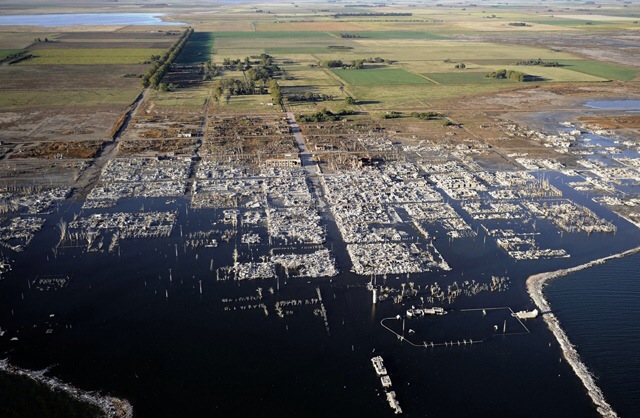
Within days, the town was under two meters of water. By 1993, the surreal, silent landscape of Villa Epecuén lay nearly 10 meters—over 30 feet—below the surface of Lago Epecuén. Gone. A ghost city sleeping in a salty grave.

The Slow Rebirth of a Ruined City
For a quarter of a century, Villa Epecuén was a memory. A local legend. A hidden world known only to the fish and the passage of time. The corrosive salt water went to work, pickling some things and devouring others. It ate away at the concrete, twisted the steel, and bleached everything in a ghostly white film.
Then, just as mysteriously as the rains had come, they stopped. A new, drier weather cycle began in the late 2000s. The waters of Lago Epecuén started to recede. Slowly, inch by inch, the lost city began to re-emerge from its watery tomb.
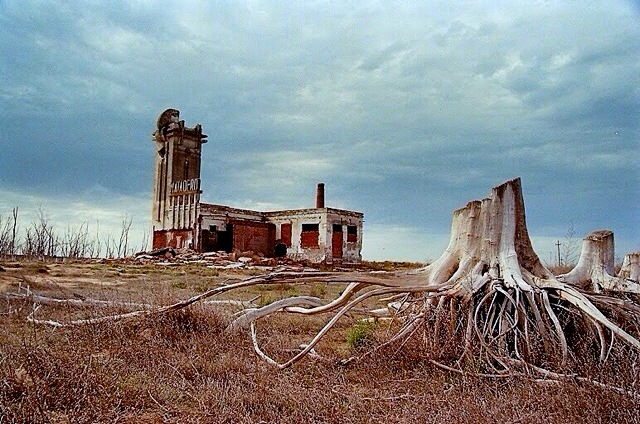
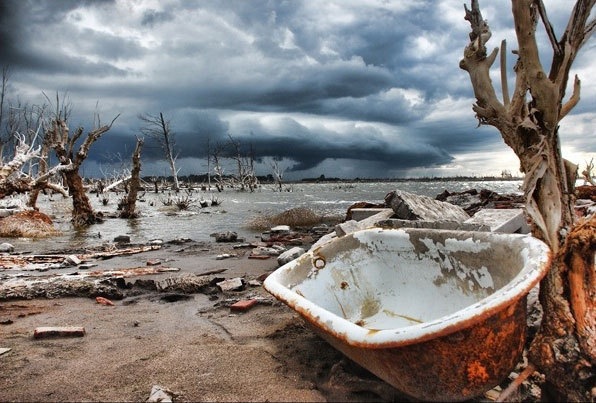
What rose from the depths was horrifying. Apocalyptic. The town was a skeleton. A wasteland. The perfect set for a post-apocalyptic movie, only this was devastatingly real.

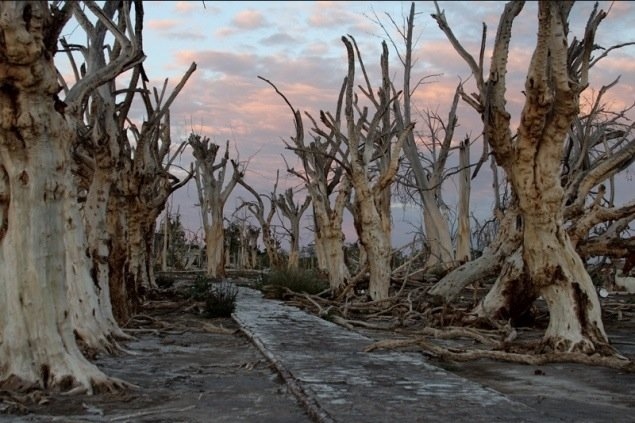
Imagine walking these streets today. The grid of the town is still there, but the buildings are mangled husks. Walls have collapsed. Roofs are gone. Staircases lead to nowhere, climbing into the empty sky. Thousands of trees, long dead, stand petrified and coated in a thick layer of white salt, their bare branches reaching out like gnarled fingers. It’s a forest of ghosts.
Rusted, skeletal remains of cars and trucks lie half-buried in the cracked mud. You can see the old slaughterhouse, its hooks and processing lines still intact, a truly chilling sight. The grand promenade along the waterfront is now a jagged cliff of rubble. The town’s cemetery, eerily, was one of the few places to escape the worst of the flooding, and its ornate tombs now overlook the desolation.

Whispers in the Rubble: The Lone Man Who Never Left
A city of 1,500 people was destroyed. They all left. All except one.
His name is Pablo Novak. In 2009, as the waters pulled back to reveal the bones of his hometown, he returned. He is the sole, official, permanent resident of Villa Epecuén. Now in his 90s, he lives in a small stone hut on the edge of the ruins, without electricity or running water. He is the guardian of the ghost city. Its memory keeper.
Why would anyone choose to live in such a desolate place? For Pablo, the answer is simple. “I am Epecuén,” he has told countless reporters who make the pilgrimage to hear his story. He spends his days riding his rusty bicycle through the silent, ruined streets, pointing out where the bakery used to be, the corner where his friends would gather, the spot where he had his first kiss.
He is a living link to the town’s vibrant past. He remembers the sound of laughter, the smell of the hotels, the bustling energy of the tourist season. For him, these aren’t just ruins; they are the ghosts of his life. His presence transforms the place from a mere disaster zone into a deeply personal tragedy. A reminder that behind every collapsed wall and rusted-out car is a universe of human memories.
What If? The Lingering Questions of Epecuén
The story of Villa Epecuén is a magnet for speculation. It forces us to ask the big “what if” questions.
What if the dike had been built just one meter higher? Would the town have survived that fateful storm? Would it be a thriving resort today, its hotels filled with tourists seeking the healing waters of the lake? Or would it have just delayed the inevitable, another storm finishing the job a few years later?
And what about the conspiracy angles that bubble up in online communities? Was the failure of the dike truly an accident? Some have floated theories that powerful agricultural interests upstream wanted the water levels managed differently, and that the “accident” at Epecuén was a convenient tragedy. There’s no hard evidence, of course. Just the kind of dark speculation that always follows a disaster of this scale. It’s a story of nature’s fury, but was it helped along by human greed?
Today, the ruins of Villa Epecuén have found a strange new life. It’s a tourist attraction once more, but of a very different kind. “Dark tourists,” photographers, and filmmakers are drawn to its eerie, melancholic beauty. It has served as the backdrop for movies and music videos, its stark scenery providing a ready-made apocalyptic landscape.
It stands as a powerful, silent warning. A testament to the awesome power of nature and a chilling reminder of how quickly, how completely, the world we build for ourselves can be taken away. The water gave Villa Epecuén life. And then, the water took it all back.
Originally posted 2014-02-14 21:44:16. Republished by Blog Post Promoter