Saturday, September 5, 2026
HomeUnexplained & ParanormalStrange StoriesStrange Decipher – The Mystery Sword Inscription

Strange Decipher – The Mystery Sword Inscription

The 800-Year-Old Sword and the Impossible Code No One Can Crack

Some mysteries are whispered in dusty archives. Others are buried under tons of desert sand. But this one? This one was forged in fire, quenched in water, and designed to kill.

It’s a riddle of steel and gold. An 800-year-old enigma that has stumped historians, linguists, and keyboard warriors for decades. It lies behind glass, cold and silent, but its blade screams a question that echoes through the centuries.

What in God’s name does +NDXOXCHWDRGHDXORVI+ mean?

Forget everything you think you know about medieval history. Forget the clichéd images of knights in shining armor. We’re about to go down a rabbit hole of secret societies, divine protection, and a weapon that might be more than just a simple piece of steel.

A Weapon Pulled from a Watery Grave

Our story begins not in a grand castle, but in the murky depths of the River Witham in Lincolnshire, England. In July 1825, workers dredging the river felt a sudden jolt. A snag. They pulled and heaved, expecting a log or a rock. What they pulled from the mud was a ghost.

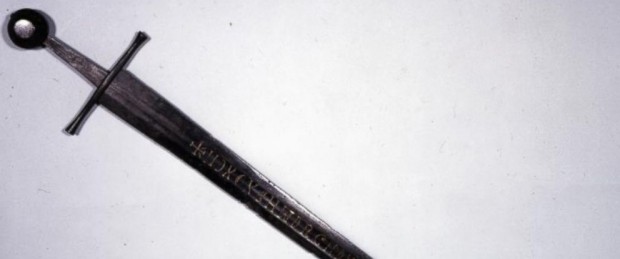
A sword. Not just any sword. A magnificent double-edged blade, 38 inches long and weighing a perfectly balanced two pounds, 10 ounces. The steel, even after centuries underwater, was of astonishing quality. This was not the crude iron club of a common foot soldier. This was an instrument of death for the elite.

Experts at the British Museum, its current home, are blunt about its purpose. This weapon, likely forged in Germany around the 13th century, was terrifyingly effective. In the hands of a trained knight, it could “easily have sliced a man’s head in two.”

But it wasn’t the deadly sharpness that made jaws drop. It was the inscription.

Running down the central groove of the blade, inlaid with shimmering gold wire, was the impossible string of 18 letters: +NDXOXCHWDRGHDXORVI+.

It looked like a cat had walked across a keyboard. It made no sense in any known language. It was a cipher from a lost world. And for nearly 200 years, it has remained one of history’s most stubborn puzzles.

Deep Dive: The Soul of a Sword

To understand the inscription, you first have to understand the sword. In the medieval mind, a sword was so much more than a tool. It was an extension of the warrior’s soul. It had a name. It had a history. It was a sacred object, often passed down through generations.

Think about it. In a world of chaos, plague, and brutal, close-quarters combat, your sword was your last line of defense. It was your protector, your status symbol, your key to glory. Knights and wealthy lords would pay a fortune for a superior blade. German smiths, in particular, were the rock stars of medieval metallurgy, their techniques closely guarded secrets.

The steel used in a blade like the Witham sword was a marvel of its time. It had to be hard enough to hold a razor edge, yet flexible enough not to shatter against armor. This was high-tech stuff. This sword’s owner wasn’t just a soldier; he was a somebody. He had money, power, and a blade that he believed held a power all its own. A power, perhaps, inscribed right into its very being.

The Code That Broke the Internet

For a long time, the sword and its code remained a quiet academic curiosity. But then, the internet happened. When the British Library, which borrowed the sword for a Magna Carta exhibit, posted about the inscription on its blog and asked for the public’s help, the floodgates opened.

The post went viral. Suddenly, everyone was a cryptographer. Reddit threads exploded. History forums buzzed with activity. The 800-year-old mystery had found a new global audience of digital detectives. The theories poured in, ranging from the brilliant to the utterly bizarre.

So let’s put on our tin foil hats and dive into the leading contenders. What is this sword trying to tell us?

Theory 1: The Sacred Acronym

This is the leading academic theory, and it’s a compelling one. The idea, championed by scholars like Marc van Hasselt of Utrecht University, is that the inscription isn’t a word, but a complex religious acronym in Latin.

In the 13th century, Latin was the universal language of the Church and the educated. But more than that, there was a common practice of using abbreviations for holy phrases, known as *nomina sacra* (sacred names). It was a kind of spiritual shorthand.

A knight facing battle wouldn’t just be fighting for his king; he’d be fighting for his soul. He was a Christian warrior. His sword was an instrument of God’s will. Imbuing the blade with a prayer or a declaration of faith makes perfect sense. It was like a permanent, wearable blessing.

So, let’s break it down:

  • The + symbols at the beginning and end are almost certainly crosses, framing the inscription as a holy statement.
  • ND could easily stand for Nomine Domini (“In the Name of the Lord”) or Nostro Domino (“Our Lord”). This is a classic opening for a prayer.
  • XOX is where it gets interesting. The ‘X’ is a common symbol for Christ (from the Greek letter Chi in ΧΡΙΣΤΟΣ). The ‘O’ could represent the Alpha and Omega, the beginning and the end. Some have suggested XOX is a representation of the Holy Trinity – Father, Son, and Holy Spirit. Three figures, bound together.

The rest of the letters are a free-for-all, but experts have made some educated guesses. The entire phrase could be a mash-up of different prayers, creating a powerful spiritual shield for the wielder. One speculative attempt to decipher it looks something like this:

Nomine Domini X(Christus) O(mnipotens) X(Christus) … Christus Hominum … W(?) … Deus Rex Gloriae … Hominum Deus … X(Christus) … Omnipotens Redemptor … Virgo … Iesus

Even with missing pieces (the ‘W’ is particularly tricky as it wasn’t common in formal Latin), you can see the shape of a powerful prayer forming. It invokes the name of the Lord, Christ the Almighty, the King of Glory, the God of Men, and Jesus, the redeemer born of a virgin. For a knight riding into the terrifying chaos of a medieval battlefield, having that prayer literally in his hand would be an immense source of courage.

Theory 2: A Lost Language of Magic

But what if we’re looking in the wrong place? What if the code isn’t a prayer to be read, but an incantation to be spoken? A word of power?

The medieval world was soaked in superstition and a belief in magic. The line between a holy relic and a magical talisman was often blurry. People believed in curses, enchantments, and protective spells. A sword was the perfect object to enchant.

Could the inscription be a magical formula? Perhaps the letters themselves, in this specific order, were thought to hold protective power. They might not form coherent words but act as a kind of magical circuit, warding off evil spirits or, more practically, a fatal blow from an enemy’s axe.

This theory suggests the letters are a phonetic spell, a string of sounds that, when uttered, would activate the sword’s power. It’s an idea straight out of fantasy, but in the 13th century, fantasy and reality were much closer companions. The owner might have believed his sword was literally invincible because of this golden secret etched into its steel.

Theory 3: The Welsh Heresy?

Here’s where the internet sleuths really shine. A fascinating, if fringe, theory popped up on forums that the inscription has nothing to do with Latin at all. Instead, it might be medieval Welsh.

Why Welsh? The sword was found in England, and the Anglo-Welsh conflicts were a defining feature of the era. A Welsh knight or lord fighting against the English would have been a prime candidate to own such a fine weapon.

One proposed translation is a garbled version of the Welsh phrase: “Nid dim ond gobaith sydd yn fy mron, wrth geisio ymladd.” Which roughly translates to: “Nothing but hope is in my breast, while trying to fight.” A poetic, fatalistic sentiment for a warrior.

Another, more aggressive suggestion is a phonetic rendering of something like: “Cleddyf i’m dwrn, nerth i’m braich, ffydd i’m calon.” This means: “A sword in my hand, strength in my arm, faith in my heart.”

Is it a long shot? Absolutely. The spelling and grammar don’t line up perfectly with known medieval Welsh. But it’s a mind-bending possibility. It reframes the sword not as an object of universal Christian faith, but as a symbol of a specific cultural resistance. A hidden message of defiance that an English captor would never understand.

Theory 4: The Ultimate Maker’s Mark

Perhaps the answer is less spiritual and more practical. What if the inscription is simply the signature of the master smith who forged the blade? Not his name, but a secret code known only to his guild.

Medieval guilds were powerful, secretive organizations. The techniques for creating high-quality steel were a source of immense wealth and prestige. A master smith might have used a complex cipher to “sign” his best work, proving its authenticity to those in the know while keeping his identity secret from rivals.

It could be a code that includes his initials, the date of its forging, the location of his workshop, or even the formula for the steel itself. If this is true, then the sword is not just a weapon; it’s a time capsule containing a lost industrial secret. Cracking the code could rewrite what we know about medieval technology.

What If The Truth is Stranger?

The official theories are all plausible. But the mystery invites us to wonder. To speculate. What if the sword belonged to a member of a secret society? The Knights Templar were officially disbanded in the early 14th century, but legends persist. Could this be a Templar sword, bearing a code known only to the inner circle?

What if the owner was a heretic, and the inscription is a blasphemous prayer to a forbidden entity, disguised as a standard Christian blessing? A secret passed in the shadows, now lying in plain sight in one of the world’s most famous museums.

Or maybe, just maybe, the answer is simpler and more human. What if the inscription was a personal message? An inside joke? The initials of a loved one—a wife or a child—whom the knight fought to protect? A personal motto that gave him strength when all seemed lost.

A Riddle Forged for Eternity

In the end, we are left with silence. The knight who carried this sword is long gone. The smith who forged it is dust. The secrets they knew died with them, leaving behind this beautiful, frustrating, and utterly captivating puzzle.

The Witham Sword is more than an artifact. It is a challenge. It taunts us from across the ages, a testament to a world where faith, magic, and violence were woven together. Its gold letters still shine, its edge is still sharp, and its secret remains locked away.

It lies there, waiting. Waiting for the one mind that can finally read the message it has been trying to deliver for 800 years. What do you think it says?

Arindam Mukherjee
Arindam Mukherjee
Arindam loves aliens, mysteries and pursing his interest in the area of hacking as a technical writer at 'Planet wank'. You can catch him at his social profiles anytime.
RELATED ARTICLES
- Advertisment -

Most Popular

Recent Comments

Warren Pan Abbott on The legend of the Devil Monkey !
chris davies on The McPherson Tape Mystery
Reed Reedly on ET has Internet!
Bea Houseoffashion on Proof Of Time Travellers – Gallery
Marcus2012 on ET has Internet!
Reed Reedly on ET has Internet!
LaughsAtConspiracyNuts on The 9/11 Conspiracy – Myths and Facts
Alex Sliverman on Did the ancients fly?
Doctor Wholigan on Time Traveler in 1938 film
chris davies on The McPherson Tape Mystery
Archie1954 on 10 secret UFO hideouts
chris davies on Ghosts of flight 401
Marcus2012 on ET has Internet!
jason Macdonald on Proof of Time Travel? – China
chris davies on Long-Lost Pyramids Found?
Reed Reedly on ET has Internet!
Milkman on Connected Universe
Tenmiles on Baigong Pipes Mystery
Simon Foster on Sirius – The Documentary
From the 1st April on 2013 – Alien Contact date ?
SkyWatcher on Is ET ignoring us?
I Come From The Future on Obama to make UFO Alien disclouser soon ?
Just another person on 2013 – Alien Contact date ?
Malcolm Windowcleaner on The strange case of Rudolph Fentz
Mason Servio on Strange Things on Mars
Marke Wisdom Seeker on What will we find as arctic melts?
Andrea A Elisabeth Levyne on Aliens Captured in Varginha, Brazil
Mitch Grouyeki on Amazing Space Shuttle pictures